TODAY I USED FILL FLASH
THE LEGACY CATALOG
* In The Year 2008
* In The Year 2011
* In The Year 2017
* Henrietta Back In 2010
Umbrellas And Wheelie Bins
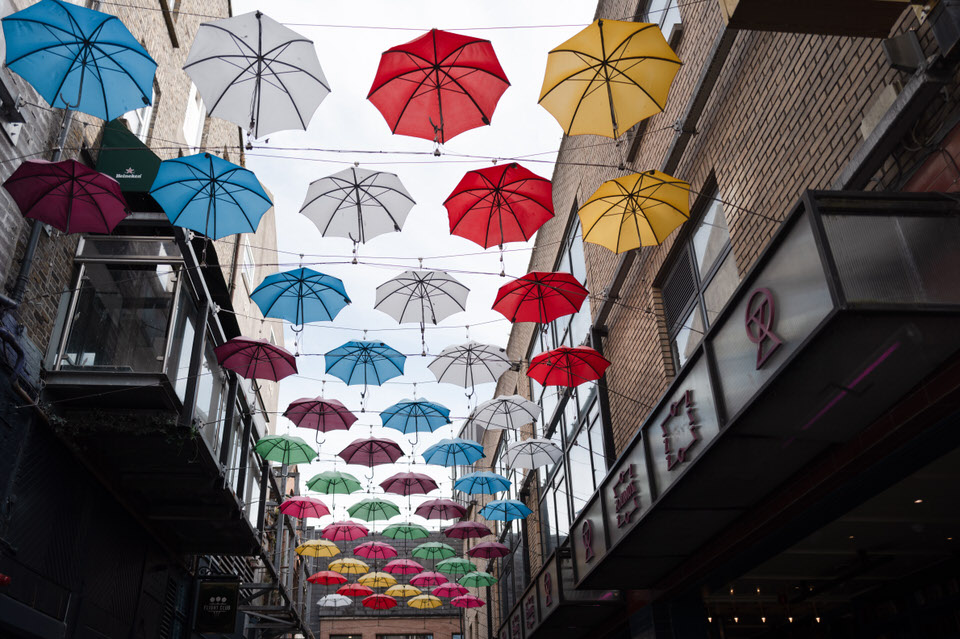
Today I visited St. Anne's Lane off South Anne Street in order to photograph an installation known as "The Umbrellas Dublin".
Many years ago a waitress in a Chinese restaurant asked me how to get to Umbrella Street and I could not assist her and a few days later, by accident, I visited Anne's Lane off South Anne's Street and saw the installation featuring a large number of umbrellas.
Fire Hazards and Photo Ops: The Hidden Safety Risks of Dublin’s Anne’s Lane
-
Off Anne Street South in Dublin lies a network of historic lanes best known for its vibrant, Instagram-famous umbrella canopy installation. It is a brilliant bit of urban design—a colourful overhead display that draws tourists, brightens the streetscape, and boosts local footfall.
-
However, venture just a few metres deeper into the complex, and the aesthetic charm vanishes. In its place is a dense maze of industrial wheelie bins, stacked cardboard, and waste materials. Beyond being an eyesore, the state of these service lanes raises serious safety and fire hazard concerns for nearby businesses, patrons, and emergency services.
Are the Bins a Genuine Safety Concern?
- In short: absolutely. The sheer volume and arrangement of the bins in these narrow corridors present severe risks across several areas.
1. Significant Fire & Fuel Load
- Industrial wheelie bins are primarily made of high-density polyethylene (HDPE), which releases intense radiant heat and thick, toxic smoke when ignited. Combined with piles of bundled cardboard, wooden pallets, and general waste, these lanes hold a substantial "fuel load." In a tight brick courtyard, a fire originating from discarded smoking materials or deliberate arson could rapidly spread up exterior walls, entering nearby kitchens, venues, or residential flats through windows and ventilation ducts.
2. Blocked Emergency Exits
- Perhaps the most alarming issue is the direct obstruction of fire escape routes. In several spots, commercial 1100-litre bins are parked directly in front of or flanking steel emergency doors explicitly marked "Fire escape keep clear." In a crisis, an emergency exit that cannot be opened from the inside—or that leads evacuees directly into a wall of plastic dumpsters—is a critical breach of standard fire safety regulations.
3. Severe Evacuation Bottlenecks
- The alleyways are lined so heavily on both sides that the clear walking path is drastically narrowed. If a restaurant or bar were to catch fire, these lanes would fill with smoke instantly. Reduced visibility combined with a gauntlet of heavy, wheeled bins creates immediate tripping hazards and physical blockades, making a fast evacuation nearly impossible and hindering firefighters trying to gain access.
4. Health and Environmental Hazards
- Overflowing organic waste bins in unventilated rear lanes inevitably attract pests and rodents, posing public health concerns for nearby food service establishments. Leaking liquids also create hazardous slip conditions on already uneven surfaces.
The Umbrella Display: Front of House vs. Back of House
-
The contrast within the Anne’s Lane network highlights a classic city-centre conflict: the tension between aesthetic appeal and behind-the-scenes logistics.
-
The Appeal: The umbrella installation (popularised near venues like Zozimus Bar) successfully transforms a forgotten alley into a destination. It adds character to the city and encourages outdoor dining culture.
-
The Reality: Immediately behind the visual spectacle, the servicing lanes are effectively functioning as an unmanaged, over-capacity waste dump for high-density venues.
-
While overhead installations require their own routine checks—ensuring secure rigging, fire-retardant materials, and clearance for emergency equipment—the primary danger isn't above; it is firmly on the ground.
The Verdict
Urban lanes need to handle logistics, but operational needs cannot come at the expense of human safety. For the Anne’s Lane complex to remain a safe, thriving hub for nightlife and tourism, Dublin City Council and local business operators must address waste management logistics, enforce clear access around fire exits, and eliminate the fire trap hidden just beneath the umbrellas.
I Tried Something Different
Today I tried something a bit different - pairing the Leica Q3 with a compact fill flash.
I bought the Q3 in May 2025, and right from day one, it presented a steady stream of quirks and bugs—most of which were widely documented online.
A few months ago, Leica released a major firmware update that virtually transformed the camera. While it resolved several core flaws, it also introduced a few new idiosyncrasies of its own. Fortunately, a subsequent update seems to have finally tackled the issues that annoyed me most. To a reasonable extent, I can now trust the camera to be consistent and reliable.
Since the start of July 2026, I have dedicated considerable time and effort to mastering the Q3's nuances. As a final stage in this learning curve, I began experimenting with the Godox iT30Pro (Leica version) as a dedicated fill flash—and the initial results are genuine eye-openers.
There is definitely a noticeable lift in image quality, though whether that is purely down to the fill flash lifting shadows or a subtle shift in my own shooting style is open to debate. Either way, I was impressed enough to pick up the Sony version, and I plan to acquire the Fujifilm version next—despite a few user reports suggesting potential compatibility quirks on bodies like the GFX100RF.
Railway Stations
* Clontarf Railway Station
* Docklands Railway Station
* Malahide Railway Station
Recommended Photo Galleries
Our Equipment Choices
I July 2026 I received A Godox iT30Pro L for my Leica Q3 and I also received A Godox iT30Pro S for my Sony A1 II and Sony A7RVI. I will discuss the Leica version here.
The Godox iT30Pro L is Godox's ultra-compact, dedicated TTL mini speedlite designed for Leica camera systems. Weighing a mere 120 g, it provides a portable, modern lighting solution for Leica M, Q, and SL series bodies without disrupting the balanced ergonomics of rangefinders or compact cameras.
Technical Specifications at a Glance
- Guide Number (GN): 15 m (at ISO 100) / ~49.2 ft
- Flash Output Range: 1/1 to 1/128 (in 1/3 EV increments)
- Exposure Modes: Leica TTL, Manual (M), Multi-Stroboscopic
- Sync Modes: High-Speed Sync (HSS up to 1/8000s), 1st Curtain, 2nd Curtain
- Wireless Radio: Built-in 2.4 GHz Godox X System (Transmitter & Receiver; 32 Channels, 4 Groups)
- Display & Controls: 2.8" Full-Colour Touchscreen + Tactile Rear Scroll Dial
- Power Supply: Built-in 7.2V / 900 mAh Li-ion battery (USB-C rechargeable)
- Recycle Time & Battery Life: ~1.5 seconds full power; ~560 full-power flashes per charge
- Dimensions & Weight: 65 × 46 × 47 mm; 120 g
- EU Price Range: ~€100 – €110 (slightly higher than the €85–€89 variants for Canon/Nikon/Sony due to Leica shoe configuration)
Technical Review: Pros, Cons & Forum Insights
The Pros
- True Leica TTL Integration: Unlike previous manual mini flashes (such as the Lux Junior or iM30), the "L" version communicates directly with Leica's TTL metering system, yielding accurate auto-exposures.
- Integrated Godox 2.4 GHz X System: Functions as both a wireless Master/Transmitter (to trigger off-camera AD200s or V1s) and a wireless Receiver (controllable via a Godox X3-L trigger).
- Incredible Form Factor: At 120 g, it sits unobtrusively on top of an M10, M11, or Q3 without making the setup top-heavy.
- Built-in Wide/Normal (WN) Diffuser Switch: A mechanical side switch flips a built-in diffuser panel across the flash lens to soften direct light and widen beam coverage.
- Li-ion Convenience: USB-C direct charging eliminates the need for carrying spare AA/AAA batteries in your kit bag.
The Cons & Things to Be Aware Of
- Touchscreen Sensitivity (Crucial User Warning): A frequent complaint across user forums is that the 2.8" touchscreen is overly sensitive. Carrying the camera on a shoulder strap often leads to accidental power level changes or mode switches unless the screen lock is engaged.
- Fixed Flash Head: The flash head cannot tilt or swivel. You cannot bounce light off ceilings or side walls without removing the flash from the camera or using an off-camera TTL cable/trigger.
- Tight Leica Hot Shoe Tolerances: Leica hot shoes (notably on M film bodies and digital M models) feature tight mechanical tolerances. Ensure the quick-release foot is fully pushed into the shoe until it clicks, otherwise the TTL pins may lose contact.
- Modest Power Output: With a Guide Number of 15 m at ISO 100, this flash is designed for close-range street fill, environmental portraits, or indoor fill-in. It will not overpower harsh direct midday sunlight across long distances.
- Internal Non-Removable Battery: Once depleted, you must plug the flash into a USB-C power bank rather than swapping in fresh batteries.
Ideal Settings & Step-by-Step Setup
Recommended Operational Settings
- Street / Environmental Fill-Flash: Set mode to Leica TTL, with Flash Exposure Compensation (FEC) set between -1.0 EV and -1.6 EV. This brightens shadow areas under eyes or hats while retaining natural ambient light.
- Low-Light / Indoor Portraits: Set mode to Manual (1/16 to 1/64 power), slide the WN switch to "W" (Wide) to deploy the wide-angle diffusion panel, and keep subject distances within 1.5–3 metres.
- Bright Sunlight / Open Aperture Shooting: Enable HSS (High-Speed Sync) on the flash so your Leica can sync up to 1/8000s shutter speed.
Step-by-Step Instructions
-
Mount and Lock to Hot Shoe: Mechanical setup.
Turn off both camera and flash. Press and hold the quick-release lock button on the iT30Pro L base, slide the foot fully into the Leica hot shoe until seated, and release the button to secure the pin mechanism.
-
Power On and Select Exposure Mode: Initial settings.
Power on the flash using the dedicated side power switch. Tap the top-left mode icon on the touchscreen to toggle between TTL (for automatic metering) or M (for manual power control).
-
Adjust Diffuser Position: Light quality setup.
For focal lengths wider than 35 mm or close-up subjects, slide the side WN switch to "W". This drops the internal diffuser in front of the flash tube to broaden coverage and soften shadows.
-
Configure Exposure Compensation / Power: Fine-tuning output.
In TTL mode, use the physical rear scroll wheel to dial in -1.0 EV FEC for natural fill. In Manual mode, spin the dial to set your desired output fraction (e.g. 1/32).
-
Engage Touchscreen Lock: Essential step.
Long-press the lock icon on screen or press the quick-lock function to lock the touchscreen interface. This prevents accidental setting changes while shooting on location.
Why Are Official Leica-Branded Flashes So Expensive?
While the Godox iT30Pro L retails brand new for ~€100 – €110, official Leica-branded speedlites command a substantial price premium.
Pricing Context (EU Market)
- Godox iT30Pro L: ~€105 (New)
- Leica SF 40: ~€380 – €430 (Used / Pre-owned only — Discontinued by Leica; originally retailed at ~€510 new)
- Leica SF 60: ~€600 (New — Currently Leica's primary active entry-level speedlite)
Key Reasons for the Leica Price Premium
- Rebadged OEM Partnering & Licensing Fees: Leica does not manufacture flash electronics in-house. Their SF series speedlites are re-engineered units produced by Japanese manufacturer Nissin (for example, the SF 40 is based on the Nissin i40, and the SF 60 on the Nissin i60A). Leica pays licensing fees for custom camera-to-flash communication protocols and redesigned outer casings, which inflates end-user costs.
- Discontinuation and Availability Premium: Because smaller models like the SF 40 have been discontinued, users seeking an official compact Leica flash must either compete on the second-hand market or buy the significantly larger and costlier SF 60.
- Low Volume Production: Leica operates on vastly smaller production runs than mass-market lighting brands like Godox. Fixed tooling and software engineering costs are spread across far fewer total units sold.
- Brand Equity & Build Consistency: Leica gear carries an overhead markup tied to brand positioning, strict quality control standards, long-term servicing support, and aesthetic matching for anodized metal camera finishes.
- Physical Capabilities: Larger OEM units like the SF 60 offer a tilting/swivelling head, motor-zooming reflectors up to 200 mm, and higher output power (GN 60). However, for compact travel and street shooting, the Godox iT30Pro L matches or exceeds them in pure convenience, radio ecosystem integration, and overall value.