GOING FORWARD PHOTONIQUE WILL BE ADVERTISMENT FREE
GOING FORWARD PHOTONIQUE WILL BE ADVERTISMENT FREE
Originally Photographed November 2026
[[shortcode.sculpture.0013]] THESE LADIES REPLACED HENRIETTA
The Urban Cartographer Presents
Photographed By William Murphy Using A Sony A7RVI
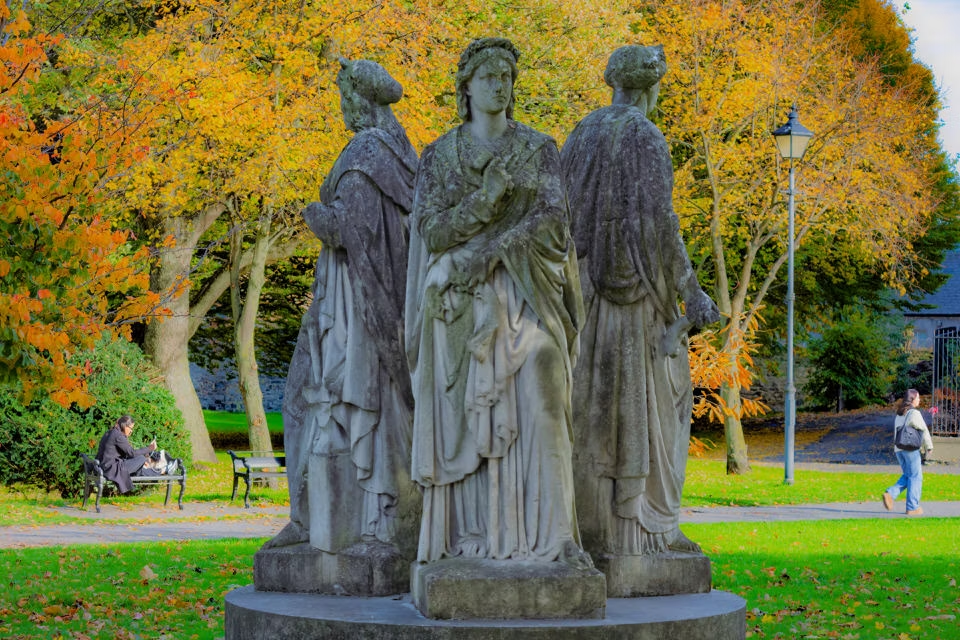
Passing into the Constitution Hill grounds of the Honourable Society of King’s Inns, visitors meet an austere, weather-beaten spectacle: three allegorical stone figures clustered tightly upon an unadorned concrete plinth.
Location: King’s Inns Park, off Constitution Hill and Henrietta Street, Dublin 7 Commissioned: 1872 (The Dublin Exhibition of Arts, Industries and Manufactures, Earlsfort Terrace) Subject: The Industrial Graces (Manufactures in Wood, Metal, and Stone) Medium: Carved Portland stone on modern cast-concrete base
Frequently mythologised by passers-by as discarded props left behind by visiting film units, these figures possess a authentic nineteenth-century pedigree. Carved in 1872 for the Dublin Exhibition Palace on Earlsfort Terrace (now the site of the National Concert Hall), the trio formed an allegorical celebration of Ireland's artisanal and mechanical backbone: Wood, Metal, and Stone.
The statues have charted a nomadic course across the capital over the past century and a half:
1872 (Earlsfort Terrace): Unveiled as part of the decorative scheme for the Great Industrial Exhibition grounds. Late 20th Century (Lord Edward Street / Dame Street): Grouped above an ornamental pool in the sunken Millennium Garden beside Dublin City Hall. Early 2000s (King’s Inns Park): Displaced during the civic repaving of Barnardo Square and re-erected on an utilitarian concrete block near the grounds' famed "Hungry Tree".
Their present setting is visually arresting. Blackened by a century and a half of Dublin coal smoke and vehicle emissions, the rough-hewn Victorian stone stands in stark, heavy contrast to the pristine lawns and restrained neoclassical proportions of James Gandon’s legal campus.
Yet their presence today is shaded by the loss of another monument that once commanded the adjacent path.
Before the park's public landscape became dominated by the industrial trio, an eighteenth-century neoclassical masterpiece stood on a plinth just paces from the Henrietta Street gate. Known affectionately by neighbourhood residents as "Henrietta," the figure was an original late-Georgian allegory of Truth.
Subject: Allegory of Truth Attribution: Circle of James Gandon and Edward Smyth Origin: c. 1780s–1790s; Portland stone; salvaged from the Four Courts roofline Status: Toppled and fractured in April 2012; fragments retained in conservation storage
Truth emerged from Dublin’s Enlightenment building boom. Stationed atop the roofline of the Four Courts on Inns Quay, she surveyed the city’s legal quarter until the catastrophic opening salvos of the Irish Civil War in June 1922. Though artillery bombardment and subsequent infernos gutted the Four Courts and incinerated centuries of public records, this solitary statue miraculously survived the collapse without critical structural damage.
When the Four Courts underwent extensive reconstruction in the 1920s, the figure was retired northward to the manicured grounds of King’s Inns, standing in undisturbed contemplation for almost nine decades.
That endurance came to an abrupt, senseless end in April 2012. Henrietta Street and the King’s Inns campus were serving as a backdrop for the Victorian television drama Ripper Street. Whilst manoeuvring through the park gates, a heavy logistics production truck struck the historic base. The impact tossed the two-hundred-year-old monument onto the paved ground, decapitating the figure and fragmenting the torso.
Following widespread dismay among conservationists and local heritage bodies, the fractured remains were recovered and secured inside the King’s Inns repository for long-term stabilisation. While Truth remains hidden from public view, the nomadic 1872 Industrial Graces now remain as the undisputed guardians of the King’s Inns parkland. Explore related aspects of Dublin's sculptural history:
Just inside the south gate of the King’s Inns park, near the Constitution Hill entrance, stands one of Dublin's most photographed botanical curiosities: The Hungry Tree.
Botanical Origins & Planting
The tree is an ordinary London plane (Platanus × acerifolia), likely planted in the 1930s during landscaping improvements to the King’s Inns public grounds, though local folklore frequently pushes its origins back into the late 19th century.
London planes were the Victorian and Edwardian municipal tree of choice for British and Irish cities: highly resistant to urban coal pollution, tolerant of root compaction, and capable of rapid trunk girth expansion.
The Meal: The 1800s Cast-Iron Bench
Placed adjacent to the sapling was a standard nineteenth-century cast-iron and timber park bench. Over several decades, the tree's trunk expanded radially until its bark made contact with the bench's backrest and armrest.
Rather than diverting around the obstacle or suffering trunk damage, the tree began the biological process of inosculation and callus growth. The tree’s cambium layer gradually flowed around the iron scrollwork and wooden slats, enveloping the metal into its core.
Today, the bench appears frozen mid-consumption:
The central backrest has completely vanished inside the wood grain. The curved cast-iron armrest protrudes directly from the bark as if welded to the trunk. The seat slats tilt downwards where the advancing wood has pressed down into the frame.
Heritage Status and Protection In 2017, the Tree Council of Ireland formally recognized the Hungry Tree on its registry of Tree Heritage, listing it as one of the country's prominent specimen curiosities. That same year, it was nominated for the European Tree of the Year competition. While it did not take the title, the publicity cemented its place on Dublin's urban heritage map, drawing visitors walking the path between Henrietta Street and Grangegorman.
Editorial Update: When this account was first published, the exact film or television production responsible for the destruction of the eighteenth-century "Truth" statue remained unconfirmed. Subsequent documentation and reporting have since identified the production as the BBC period crime drama Ripper Street, which was filming on location around Henrietta Street and the King's Inns in April 2012 when the collision occurred.
Set in London's Whitechapel in 1889 following the Jack the Ripper murders, Ripper Street was a flagship BBC drama that ran for five seasons between 2012 and 2016 (later co-produced with Amazon). While the narrative unfolded across Victorian London, almost the entirety of the series was shot on location in Dublin.
The Irish capital was selected for its remarkable concentration of intact eighteenth- and nineteenth-century streetscapes, which could readily double for Victorian London without heavy digital replacement. Primary standing sets—including the H Division police precinct and surrounding alleys—were built at the former Clancy Barracks on the south bank of the Liffey, while regular location shooting took place across Dublin Castle, Kilmainham Gaol, the North Great George's Street area, and crucially, the Henrietta Street / King's Inns enclave.
Henrietta Street, with its monumental red-brick Georgian palazzi, and the adjoining neoclassical King's Inns campus designed by James Gandon, offered production designers an authentic, atmospheric canvas:
Filming for the drama's inaugural season commenced in Dublin in spring 2012. Large-scale period productions require extensive logistical infrastructure: lighting rigs, grip equipment, generator trucks, catering vehicles, and costume trailers.
During vehicular manoeuvring within the King’s Inns park grounds, a production vehicle reversed into the plinth of the c. 1790s statue of Truth. The shear force of the impact dislodged the stone monument from its mountings, sending it crashing onto the roadway surface below.
The incident sparked swift outrage among conservationists, heritage groups, and Dublin City Council representatives, highlighting the delicate friction between the city's booming film and television production industry and the physical vulnerability of its built heritage. The fragments were catalogued and moved to secure indoor storage by the Honourable Society of King’s Inns, leaving the plinth vacant and ending more than two centuries of public display.