GOING FORWARD PHOTONIQUE WILL BE ADVERTISMENT FREE
GOING FORWARD PHOTONIQUE WILL BE ADVERTISMENT FREE
Originally Photographed 1 November 2026
[[shortcode.sculpture.0013]] THE LENS PERFORMED BETTER THAN EXPECTED
The Urban Cartographer Presents
Photographed By William Murphy Using A Sony A7RVI
It may come as a surprise when I claim that this is difficult to photograph, but after many attempts, I managed to get usable images today.
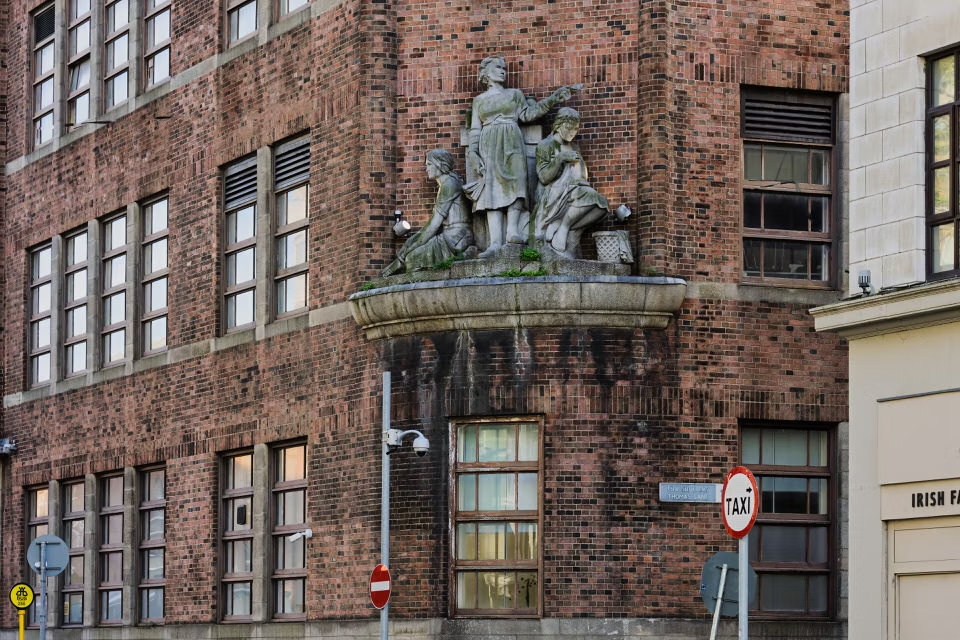
Turn off O’Connell Street toward Cathal Brugha Street, and you encounter an arresting sight anchored high on the curved brick corner of the former St Mary’s College of Domestic Science. Location: Corner façade of the former St Mary’s College, Cathal Brugha Street, Dublin Sculptor: Gabriel Hayes (1909–1978) Date: 1941–1943 Medium: Carved Portland stone sculptural group (in the round)
Commissioned for the new vocational college, Hayes was tasked with creating a sculpture reflecting the institution's instructional work: domestic science, housekeeping, and needlecraft. In doing so, she boldly adapted the classical archetype of the Three Graces—traditionally depicted as bare, idealised daughters of Zeus embodying charm, beauty, and creative joy.
Instead of classical attributes like myrtle sprigs or apples, Hayes sculpted three fully clothed, active young women engaged in practical studies: one kneeling with a scrubbing brush, a central standing figure holding books beside jars of preserved goods, and a seated figure intent on her needlework. Modelled on real working women, the piece delivered a grounded portrayal of female education and labour in mid-century Irish public art.
The work also weathered the moral climate of the time. At the college's opening in 1941, Archbishop John Charles McQuaid declared it "women's work... to build happy homes". When Hayes presented her modern, bodily engaged figures, McQuaid objected, deeming the representation too suggestive for the exterior of a Catholic-affiliated educational hall. In a rare break with clerical dominance, the college authorities and architects stood their ground, defending Hayes's vision and ensuring the stone group stayed put.
With the consolidation of TU Dublin into the centralised campus at Grangegorman, Cathal Brugha Street was vacated as an active educational hub. The subsequent move to sell the premises raised understandable public anxiety that private redevelopment could put Hayes's masterpiece at risk.
However, the Department of Education intervened to acquire the property directly, retaining the site for long-term public and educational use. Crucially, the complex is a designated Protected Structure. By law, statutory protection covers its exterior fabric and architectural sculpture, legally guarding Hayes's three figures against removal or harm as the building enters its next chapter.
This post has been revised from an earlier draft to correct several historical, structural, and descriptive inaccuracies:
Sculptural Form: Corrected from a "relief" to a free-standing sculptural group in the round, mounted on a cantilevered curved balcony/plinth overlooking the street corner. Objects & Attributes: Replaced the mention of a large spindle and sweeping broom with the actual depicted attributes: a hand scrubbing brush, a stack of books and preserving jars, and needlework. The "Three Fates" Distinction: Clarified that the artwork is officially known as The Three Graces (with Dublin's famous Three Fates / Schicksalsbrunnen fountain being an entirely separate 1954 German-gifted monument by Josef Wackerle in St Stephen's Green). Historical Context: Removed the claim that nude female figures would not appear on commercial facades for another fifty years; allegorical and classical figures had preceded and immediately followed this period. Building Status: Added clarification on the post-Grangegorman sale process and the building's statutory heritage protection.