GOING FORWARD PHOTONIQUE WILL BE ADVERTISMENT FREE
GOING FORWARD PHOTONIQUE WILL BE ADVERTISMENT FREE
Originally Photographed 1 November 2026
[[shortcode.sculpture.0013]] THE LENS PERFORMED BETTER THAN EXPECTED
The Urban Cartographer Presents
Photographed By William Murphy Using A Sony A7RVI
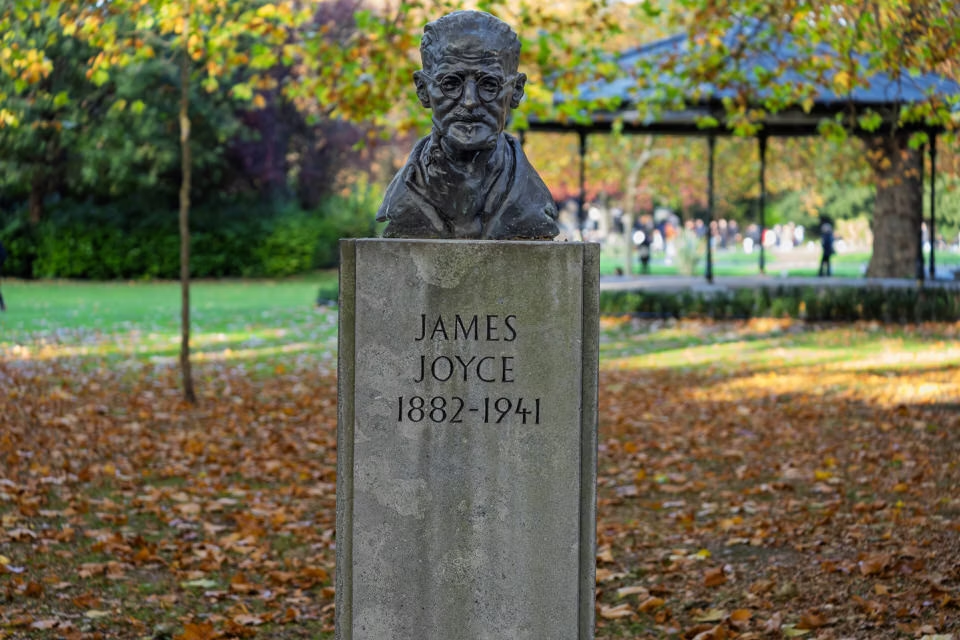
Near the southern tree-lined avenues of Dublin’s St Stephen’s Green stands Marjorie Fitzgibbon’s 1982 bronze portrait bust of James Joyce, quietly gazing across towards Newman House. Cast in Dublin during the centenary year of the author’s birth, the monument serves as a direct spatial and historical tribute: Newman House was the original home of University College Dublin, Joyce’s alma mater and the backdrop to formative scenes in A Portrait of the Artist as a Young Man.
James Joyce was a titan of literary modernism, reshaping twentieth-century prose through groundbreaking stylistic departures and psychological depth. Set upon a tall limestone plinth amongst the park's lush perimeter, the bust captures Joyce’s unmistakable features: the parted hair, high forehead, and heavy circular spectacles resting above a trim moustache and contemplative expression. Cast by the Dublin Art Foundry, the bronze conveys both physical likeness and interiority. It holds a distinguished position within the park's collection of civic memorials, balancing Dublin’s turbulent political monuments with a tribute to its most celebrated avant-garde exile.
Born Marjorie Steele in Reno, Nevada, Fitzgibbon (1930–2018) enjoyed a multifaceted career spanning stage, cinema, and fine art before settling permanently in Ireland in the late 1960s. Encouraged by prominent theatrical and literary figures such as Micheál Mac Liammóir, she turned her creative focus to classical sculpture. Over the following decades, she became an honorary member of the Royal Hibernian Academy (HRHA) and established herself as one of Ireland’s foremost portrait sculptors.
Psychological Insight: Fitzgibbon excelled at capturing not only a sitter’s likeness but their temperament. Her portraits of cultural icons—including Lord Killanin, Eamonn Andrews, and fellow artists commissioned by the Royal Dublin Society—rely on keen observation and emotional presence.
Textured Realism: Rejecting purely idealised forms, her surfaces preserve the tactile marks of the original clay and plaster maquettes, lending organic energy and expressive light play to the finished bronze.
Mastery of Traditional Casting: Working closely with foundries, Fitzgibbon understood how patination and metallurgic texture translate human character into permanent civic art.Her depiction of Joyce stands out as a restrained, perceptive study of an intellect who, despite living decades abroad, carried Dublin's exact topography in his mind's eye.
Beyond the bust of James Joyce, St Stephen’s Green functions as an open-air pantheon of Irish literary culture and political history. The park’s monuments span 18th-century rebellion, Victorian civic philanthropy, the 1916 Rising, and modern avant-garde sculpture.
W. B. Yeats Memorial Garden (Standing Figure: Knife Edge)Unveiled in 1967, this dedicated garden honours the Nobel laureate poet W. B. Yeats. Rather than a figurative portrait, the centrepiece is an abstract bronze sculpture, Standing Figure: Knife Edge, created by the renowned British sculptor Henry Moore.
James Clarence Mangan Memorial: Erected in 1909 near the park’s centre, this memorial celebrates the 19th-century Romantic poet James Clarence Mangan. Sculpted by Oliver Sheppard, it features a marble bust of Mangan set atop an art nouveau plinth flanked by a personification of Róisín Dubh (Dark Rosaleen), one of Mangan's most famous translations.
Thomas Kettle Memorial: Honouring the poet, barrister, Nationalist MP, and University College Dublin professor who died at the Battle of the Somme in 1916. Sculpted by Albert Power, the portrait bust was commissioned to remember both his literary contribution and sacrifice.
Rabindranath Tagore Bust: A bronze bust presented in 2011 to celebrate the 150th anniversary of the birth of the Bengali polymath and Nobel laureate, symbolising cultural ties between India and Ireland (particularly Tagore's friendship with W. B. Yeats).
Theobald Wolfe Tone & The Great Famine Memorial: Positioned at the north-east entrance (facing Merrion Row), this striking ensemble by sculptor Edward Delaney was erected in 1967. It features an imposing bronze statue of Wolfe Tone—leader of the 1798 Rebellion and considered the father of Irish Republicanism—set against a semi-circle of rough-hewn granite megaliths. On the reverse side facing into the park stands Delaney's sombre Great Famine memorial depicting emaciated figures.
Countess Constance Markievicz Bust: Sculpted by Gabriel Hayes and unveiled in 1956, this bronze bust commemorates the revolutionary, suffragist, and Irish Citizen Army commander. The Green was Markievicz’s active garrison during the 1916 Easter Rising, where she and Michael Mallin dug trenches and held the park before retreating to the Royal College of Surgeons.
Jeremiah O’Donovan Rossa Memorial: Created by Seamus Murphy in 1954, this carved limestone relief near the north-west entrance honours the 19th-century Fenian leader whose Dublin graveside oration by Patrick Pearse in 1915 helped ignite the 1916 Rising.
Robert Emmet Statue: A bronze statue by Jerome Connor commemorating the leader of the 1803 Rebellion, sited opposite the house on the west side of the Green where Emmet was born.
Fusiliers’ Arch: Dominating the north-west entrance at the top of Grafton Street, this triumphal arch was erected in 1907 to commemorate soldiers of the Royal Dublin Fusiliers who died during the Second Boer War (1899–1902). Still bearing bullet scars from the 1916 fighting, it is historically nicknamed "Traitor's Gate" by republicans.
Lord Ardilaun Statue: Positioned on the western side facing the Royal College of Surgeons, this large bronze statue by Thomas Farrell depicts Arthur Guinness (Lord Ardilaun). Ardilaun financed the transformation of the Green from an exclusive private square into a public Victorian park, officially handing it to the city of Dublin in 1880.