GOING FORWARD PHOTONIQUE WILL BE ADVERTISMENT FREE
GOING FORWARD PHOTONIQUE WILL BE ADVERTISMENT FREE
Originally Photographed 1 November 2026
[[shortcode.limerick.0011]] THE RESULTS WERE NOT WHAT I EXPECTED
The Urban Cartographer Presents
Photographed By William Murphy Using A Sony A7RVI
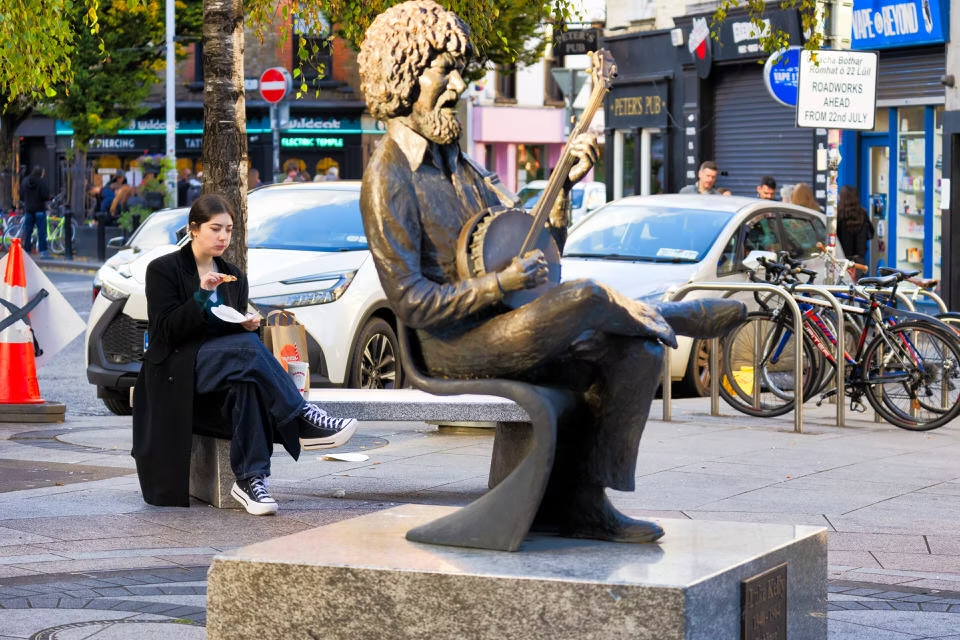
The Luke Kelly Statue on South King Street portrays the legendary Dublin balladeer mid-performance, seated with his five-string banjo, head tilted back, and mouth opened wide in full, resonant song. Unveiled on 30 January 2019 to mark the 35th anniversary of his death, the life-size bronze monument captures the raw vitality and intensity that defined Kelly's stage presence. Rather than an idealised civic monument, the bronze surface renders the craggy contours of his features, his signature mane of wild curly hair, and the physical force of a working-class artist pouring everything into a ballad.
The Sculptor: The work was created by renowned Irish figurative sculptor John Coll. Coll, who originally studied biology before establishing himself as one of Ireland's foremost public sculptors, is celebrated for his expressive, tactile bronze portraits of major Irish cultural figures, including Patrick Kavanagh by the Grand Canal and Brendan Behan near the Royal Canal. His Luke Kelly commission was funded through a private initiative championed by music enthusiast Gerry Hunt, businessman Liam O'Connor, and local supporters, alongside Dublin City Council.
The Subject: Luke Kelly (1940–1984) was a founding member of The Dubliners and remains an enduring icon of Irish folk music and working-class heritage. Born on Sheriff Street in Dublin's North Inner City, his booming, unadorned vocal delivery and five-string banjo playing brought international acclaim to Dublin street ballads, labour songs, and rebel tunes. His definitive renditions of Patrick Kavanagh’s On Raglan Road, Phil Coulter's The Town I Loved So Well, and Ewan MacColl's Dirty Old Town permanently transformed the landscape of traditional Irish music before his premature death at the age of 43.
Selection of South King Street: When Dublin City Council resolved to honour Kelly on his 35th anniversary, two sculptures were commissioned simultaneously to balance the historic Northside–Southside divide of the city. While Vera Klute's large-scale marble portrait bust was sited on the Northside along the Royal Canal near Guild Street (close to Kelly's birthplace on Sheriff Street), Coll's seated figure was placed on the Southside. South King Street—pedestrianised and situated mere yards from Grafton Street and St Stephen's Green—was chosen for its direct connection to Dublin's theatrical and musical heartland. The Gaiety Theatre sits adjacent on the same street, an institution where The Dubliners staged historic residencies, while nearby venues such as O'Donoghue's Pub on Merrion Row provided the setting where Kelly and his bandmates first coalesced. Placing the sculpture directly on the paving stones embeds Kelly right amongst ordinary Dublin pedestrians and street performers, reflecting his accessible, populist spirit.
Luke Kelly Sculpture by Vera Klute, situated at the Royal Canal Greenway along Guild Street and Sheriff Street Upper, presents a monumental, stylised portrait bust. Standing approximately two metres tall on an elevated base, the piece gazes across the north inner city where Kelly was born and raised.
Form & Materiality: Carved from Libyan marble with intricate, individually bent treated wire framing his beard and unmistakable spherical curls. The mixed-media approach blends contemporary sculptural geometry with classical monumental stonecraft.
Emotional Register: Meditative and mythic. Based on a 1974 television performance of Phil Coulter’s Scorn Not His Simplicity, the closed eyes and tilted head convey internal sorrow, vulnerability, and contemplative gravitas rather than kinetic performance.
Cultural Context: Firmly rooted in working-class local identity. It acts as a civic beacon for the North Wall community, highlighting Kelly's social consciousness and working-class heritage.
Together, the two works function as complementary dialogues in public art: Coll delivers the physical vitality of the performer on the Southside pavements, while Klute offers an enduring, meditative icon overseeing the Northside canal of his youth.
Working at 100–400mm on South King Street makes background control notoriously tricky. Because the sculpture sits flush on the paving stones right in the throat of a primary pedestrian artery connecting Grafton Street to the Gaiety and Stephen's Green, extreme telephoto focal lengths introduce severe optical compression. While a narrow field of view isolates individual features, it also stacks dozens of metres of background into a tight slice behind the bronze:
Visual Compression and "Pavement Stacking": At 300mm to 400mm, you must stand a considerable distance back along South King Street (towards Mercer Street or Chatham Street) to frame the figure. That long working distance opens a wide shooting corridor through which constant foot traffic crosses. Furthermore, any pedestrians walking 20 or 30 metres behind the statue—past the Gaiety or towards Stephen's Green Shopping Centre—are optically pulled right up against Luke's shoulders and banjo.
The Low-Level Pigeon and Gull Congestion: The outdoor tables, takeaway spots, and high footfall around South King Street keep Dublin's gulls and feral pigeons actively foraging along the paving. At ground level, telephoto compression turns a bird pottering about ten metres behind the bronze into an unavoidable dark blob or distracting wing-blur right against the body of the instrument.
John Coll’s work is distinguished by its expressive, textured figurative bronzes—frequently depicting writers, cultural icons, and the natural world (drawing on his background in marine biology and zoology).
Coll frequently returns to the marine environment for his gallery and small-run bronze casts. Prominent recurring motifs include: