GOING FORWARD PHOTONIQUE WILL BE ADVERTISMENT FREE
GOING FORWARD PHOTONIQUE WILL BE ADVERTISMENT FREE
Originally Photographed 17 June 2026
Street Photography Journal (17 June 2026)
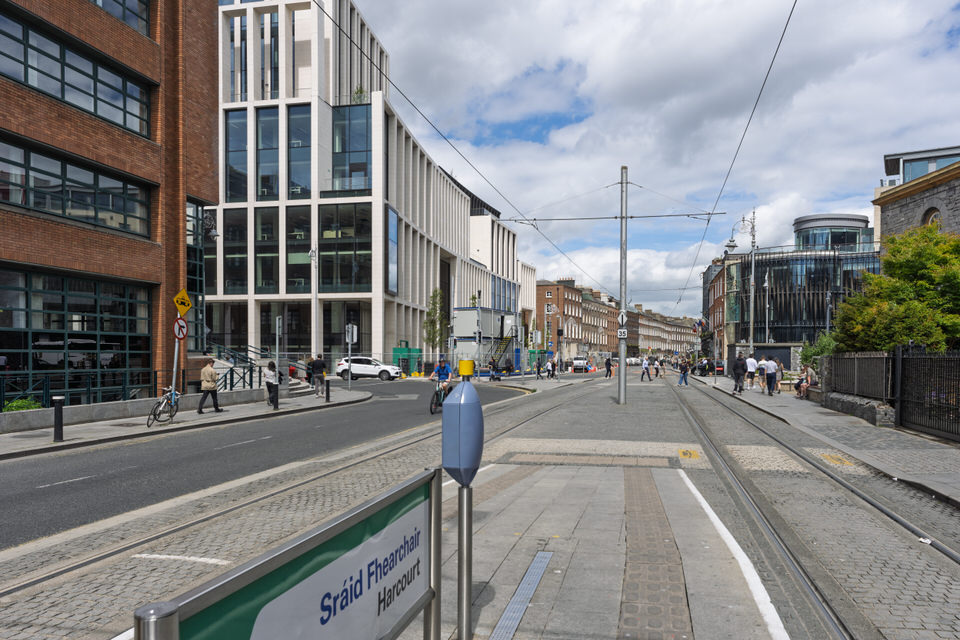
Harcourt Street is one of Dublin’s most architecturally and socially significant thoroughfares. Developed in the late eighteenth century as a grand Georgian street, it has evolved from an aristocratic residential enclave into a bustling transport hub, a corporate financial center, and the historical beating heart of Dublin's nightlife.
* DublinBikes Docking Stations * Train Stations * Pelletstown Railway station
The Harcourt Street Luas Stop and Railway History
Today, the Harcourt Street Luas stop serves as a vital artery on the light rail’s Green Line, moving thousands of commuters daily. However, its position is no accident of modern city planning; it directly mirrors the nineteenth-century transport infrastructure that preceded it.
The tram stop sits directly outside the grand facade of the former Harcourt Street Railway Terminus. Designed by the renowned architect George Wilkinson, the station opened in 1859. Constructed on an elevated embankment twenty-five feet above street level, the building features a striking central arch and a classical colonnade of Doric columns. The massive brick vaults beneath the tracks—known as the undercroft—were originally leased to Gilbey’s for storing bonded spirits.
The station served as the terminus for the Dublin, Wicklow, and Wexford Railway, carrying passengers out to the coastal suburbs and down to Bray.
The Spectacular Train Crash of 1900
The station is permanently etched into Dublin folklore due to an extraordinary incident on St Valentine's Day, 14 February 1900. A heavy cattle train arriving from Enniscorthy failed to brake in time. It ploughed through the platform, crashed straight through the outer terminal stone wall, and left the massive steam locomotive suspended precariously in mid-air over Hatch Street. Remarkably, no one was killed, though the driver, William Hyland, suffered injuries that resulted in the amputation of his right arm.
The station was ultimately closed on New Year's Eve in 1958 under a national rail rationalisation policy spearheaded by Córas Iompair Éireann (CIÉ). It lay dormant for decades, but its legacy was revived when the old alignment was reused to lay the tracks for the Luas Green Line, which opened in 2004.
Nightclubs and the TV Club Era
Harcourt Street’s association with after-dark entertainment spans over half a century, but its status as the "Mecca of Irish Nightlife" began in earnest in the 1960s with the opening of The Television Club (affectionately known as the TV Club).
Located opposite the old railway station, the site originally housed the Four Provinces Ballroom. It was acquired by the broadcaster Eamonn Andrews (famed as the host of This Is Your Life) and converted into a multi-use media space. By day, the building operated as Ireland’s first multi-track recording studio, capturing the era's biggest showbands and early rock acts. By night, it transformed into a sprawling dancehall where those same bands performed to packed crowds of young Dubliners.
Though the TV Club studio was tragically destroyed by a fire in the late 1970s, it set a lasting precedent for the street. Over subsequent decades, the basements of Harcourt Street’s Georgian houses were converted into trendy disco bars and boutique venues, including legendary spots like Maxwell Plums.
When the old train station building itself was repurposed in 1993, it became home to The Pod, an iconic, award-winning venue that defined the 1990s Irish rave and electronic music scene. Today, clubs like Krystle ensure that Harcourt Street remains the primary destination for late-night clubbing in the capital.
Corporate Regeneration and the Garda HQ Replacement
In recent years, Harcourt Street has undergone a profound structural shift, transitioning away from ageing institutional buildings toward ultra-modern, sustainable corporate architecture.
For decades, one of the street's most dominant fixtures was the sprawling Harcourt Street Garda Station, which served as a major regional headquarters for An Garda Síochána. The complex, consisting of four distinct office blocks rented from private landlords via the Office of Public Works (OPW), housed high-profile specialised units, including the National Bureau of Criminal Investigation (NBCI) and the Drugs and Organised Crime Bureau.
Recognising that the fragmented, leased complex was no longer fit for modern policing, the state commissioned a custom-built, state-of-the-art facility. Operations were systematically relocated to Walter Scott House on Military Road in Kilmainham, a purpose-built, highly secure six-storey complex completed ahead of its official operational rollout.
With the Gardaí vacated, the prime 1.9-acre site on Harcourt Street cleared the way for one of the most significant commercial developments in Dublin’s modern history:
The Demolition: The old Garda complex has been cleared to break down the dense, mid-century blocks that disrupted the historic streetscape.
The New Development: In its place, a massive 343,000 square feet Grade A office development has risen.
Sustainability Focus: Designed to meet the highest modern environmental standards, the project features two interconnecting buildings built with strict carbon targets, aiming for world-class LEED and WELL Platinum Certifications.
This grand architectural intervention blends the street's historical eighteenth-century shell with twentieth-first-century commercial enterprise, solidifying Harcourt Street's dual identity as a professional powerhouse by day and an entertainment hub by night.
* February 2026: High Resolution Images * April 2026: High Resolution Images * May 2026: High Resolution Images