GOING FORWARD PHOTONIQUE WILL BE ADVERTISMENT FREE
GOING FORWARD PHOTONIQUE WILL BE ADVERTISMENT FREE
Originally Photographed 17 June 2026
Street Photography Journal (17 June 2026)
The Flying Giant of D6 - The Extraordinary History of Ranelagh and Ireland’s First Aeronaut
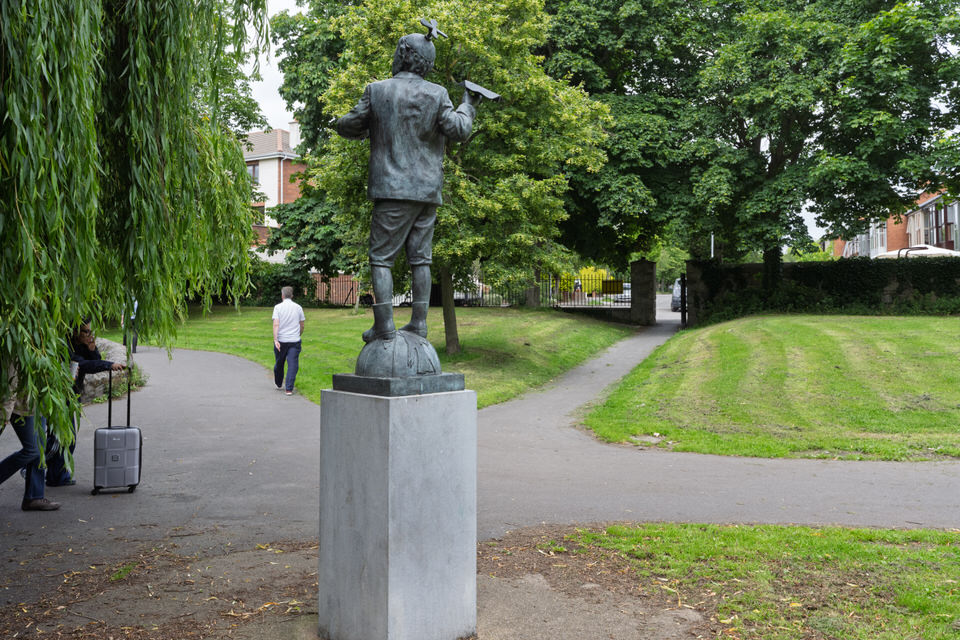
If you spend any time near the bustling Luas stop in Ranelagh, you have likely passed a striking bronze monument sitting tucked near the public park. Hundreds of commuters rush past it daily without a glance. Yet, if you stop to frame a photograph of it, something fascinating happens: passing pedestrians suddenly stop, look up, and appear to notice it for the very first time.
In a village with a highly transient population of commuters and newer arrivals, the deep civic heritage of this corner of Dublin 6 is easily hidden in plain sight. This monument marks the exact spot where Irish aviation history was born—the launchpad of an extraordinary, flamboyant pioneer named Richard Crosbie.
To understand how his story fits into this vibrant neighbourhood, we have to unwrap the changing layers of Ranelagh itself—from its unique local pronunciation to its wild cycle through Georgian grandeur, mid-century "flatland," and modern premium real estate.
"Wren" vs. "Ran": The Linguistic Geography of the Capital
Before diving into the history, it is worth addressing a classic local linguistic quirk. If you, like myself, were educated in a traditional Dublin city-centre school or come from an older urban family, you likely pronounce the name as "Wren-e-la" rather than the phonetic "Ran-e-la."
This distinction is a beautiful marker of older Dublin socio-linguistic geography. The name originates from the Anglo-Irish peer Lord Ranelagh (the Jones family), whose title derived from their historic lands in County Wicklow—originally from the Irish Raghnallach. When the title was established in the seventeenth century, a common vowel shift in British English raised and flattened the short "a" sound when preceding nasal consonants, sliding it closer to an "e".
This phonological habit crossed the Irish Sea to London, where the famous Chelsea pleasure grounds established by the family were universally pronounced "Wren-e-la" by the Georgian upper classes. For generations, Dublin's inner-suburb merchants, old city families, and historic schools maintained this prestigious Georgian vernacular. The modern shift to a hard "Ran-e-la" is a contemporary development, driven by the phonetic reading of modern street signage and the influx of residents from outside the capital who arrive without the city's traditional oral history.
From Battlefield to "Flatland" and Back Again
The physical and social topography of Ranelagh has undergone a complete cyclical transformation over the last two and a half centuries.
Before the mid-1700s, the area was a patchwork of fields known as Willans Green or Wrena. It was a site of bloody conflict, most notably the Battle of Rathmines in 1649, where Royalist forces were decisively routed by a Parliamentarian garrison, with much of the slaughter occurring across these very fields. By the nineteenth century, the arrival of the Dublin, Wicklow and Wexford Railway in 1859 transformed it into a highly fashionable, red-brick Victorian suburb for the city’s professional classes.
However, as the wealthy classes migrated further out to coastal enclaves in the mid-twentieth century, the massive Victorian houses on roads like Marlborough, Chelmsford, and Dartmouth became economically unviable as single-family homes. From the 1950s through the 1980s, Ranelagh devolved into Dublin’s premier "Flatland."
Landlords aggressively subdivided these historic properties into multi-occupancy bedsits. It became the default, affordable rite-of-passage district for rural students attending UCD or Trinity, young civil servants, and bohemian artists. The historic architecture suffered under decades of minimal maintenance and institutional linoleum, but it gave the village an energetic, counter-culture atmosphere.
The death knell of Flatland came with strict new rental regulations, the abolition of the traditional bedsit, and the opening of the Luas Green Line in 2004, which re-utilized the old 1859 railway alignment. Extremely quickly, affluent professionals bought up the housing stock, pouring millions into reversing decades of subdivision to restore original plasterwork, sash windows, and fanlights. Today, Ranelagh stands as one of the most affluent urban villages in the country.
The Northern Red-Brick Gateway: Northbrook, Dartmouth, and the Canal
To truly understand the architectural transition of the area, one must walk the elegant, leafy corridors at Ranelagh's northernmost tip, where the suburb meets the historic waters of the Grand Canal. Exploring down along Northbrook Road and Dartmouth Road reveals the true zenith of Victorian suburban planning in Dublin 6.
Running parallel to the old railway cutting (now the Luas line), Northbrook Road is widely regarded as one of Ranelagh’s most prestigious residential streets. Its imposing, two-storey-over-basement red-brick houses showcase the classic polychrome brickwork, intricate wrought-iron railings, and heavy granite steps that defined the mid-to-late 19th-century boom. These homes were designed for the upper-middle-class professionals—the doctors, lawyers, and merchants who commuted into the city centre.
Intersecting this axis is Dartmouth Road, which leads seamlessly into the iconic Dartmouth Square. This area represents one of the finest late-Victorian formal layouts in the capital. The uniform rows of high-ceilinged red bricks frame a central, mature parkland that acts as a quiet green sanctuary just metres from the bustling main road.
Following these avenues down to the edge of the Grand Canal brings you to a distinct urban threshold. Here, the residential peace of Ranelagh encounters the heavy stone masonry of the canal locks and bridges, constructed in the late 18th century to link the River Liffey with the Shannon. This waterway once formed a strict physical boundary between the crowded urban core of the city and the fresh air of the southern townships. Today, the walk from Dartmouth Road to the canal locks perfectly captures the visual transition from grand Victorian domesticity to early industrial water engineering.
The Secret History of Ranelagh Gardens
The public park tucked neatly behind the Luas embankment is a small, quiet fragment of what was once a sprawling, 18th-century commercial spectacle. In 1775, an enterprising organist and builder named William Hollard established a commercial venture on the site. Inspired directly by the fashionable Ranelagh Gardens in Chelsea, he created an elegant layout of tree-lined gravel walkways, alcoves, elaborate evening illuminations, and a central ornamental lake.
For a fee, Dublin's high society could escape the filth of the medieval city walls to promenade, listen to live orchestral music, hold masked balls, and view spectacular firework displays. Hollard’s venture eventually ran into financial ruin, and in the 19th century, a large portion of the grounds was absorbed by the Convent of the Sisters of St. Joseph of Cluny. This fortunately preserved the open ground from being entirely built over by Victorian housing developers, leaving us with the beautiful urban oasis we enjoy today.
Richard Crosbie: The First Irish Aeronaut
It was within these very pleasure gardens, on 19 January 1785, that Richard Crosbie secured his place in global aviation folklore. Crosbie was a towering man of striking physical appearance—six feet three inches tall, stout, and immensely mechanically gifted. Fascinated by the hydrogen balloon experiments of the Montgolfier brothers in France, Crosbie spent 1784 exhibiting experimental prototype balloons in Ranelagh Gardens, using animals (including a cat) as test passengers.
At 2:40 PM on that freezing January afternoon, before a breathless crowd of over 20,000 spectators, Crosbie climbed into an extraordinarily theatrical, hand-painted wicker gondola he called his "flying barge," which was emblazoned with the arms of Ireland. Dressed in a spectacular robe of leopard skin lined with white satin and topped with a feathered hat, he released the ropes.
The hydrogen-filled craft rose majestically over the city. The flight lasted roughly ten minutes, crossing the bay and landing safely in Clontarf. He was carried in absolute triumph through the streets of Dublin to the home of Lord Charlemont. It was the first successful manned flight in Irish history.
A Tragic and Unfortunate Family Legacy
While Richard’s eyes were fixed on the heavens, his family’s feet were planted on deeply tragic and unstable ground. The Crosbies of County Wicklow and Carlow were plagued by political disaster and financial ruin.
Richard’s older brother was Sir Edward Crosbie, a man of liberal, United Irishmen-sympathizing views. Following the United Irish attack on Carlow town during the 1798 Rebellion, Edward was arrested by government forces, subjected to a notoriously corrupt and hasty military court-martial, and executed. His head was severed and placed on a pike outside Carlow Jail—a brutal end that devastated the family's social standing.
Richard himself never managed to monetise his brilliant engineering feats. His lifelong dream was to be the first man to fly across the Irish Sea. On a subsequent attempt in July 1785 from Leinster Lawn, his balloon lost altitude and crashed into the freezing waters of the channel, where he had to be rescued by a passing vessel.
Short of money and eventually banned from launching further disruptive spectacles in the city centre by the Lord Mayor, Crosbie emigrated. He spent years working as a nomadic comic actor in New York and staging minor balloon exhibitions in Baltimore, Maryland. He eventually returned to Dublin, dying in relative obscurity and poverty in 1824 at his residence on North Cumberland Street.
The next time you walk past the Ranelagh Luas stop, stroll down Dartmouth Road, or wander to the edge of the canal, take a moment to look at the statue. You are standing at a direct threshold to an era when Dublin was at the absolute vanguard of global technological daring, led by a flamboyant giant whose family was destined to be crushed by the machinery of Irish history.
* February 2026: High Resolution Images * April 2026: High Resolution Images * May 2026: High Resolution Images