GOING FORWARD PHOTONIQUE WILL BE ADVERTISMENT FREE
GOING FORWARD PHOTONIQUE WILL BE ADVERTISMENT FREE
Originally Photographed 6 December 2009
MANY YEARS LATER I DISCOVERED THAT AUTOFOCUS WAS FAULTY - LONG STORY
The architecture of Glasnevin naturally invites vertical lines, yet forcing the frame can compromise the environmental context.. Source: Ibrahim Alkan / Getty Images
* In The Year 2008 * In The Year 2011 * In The Year 2017
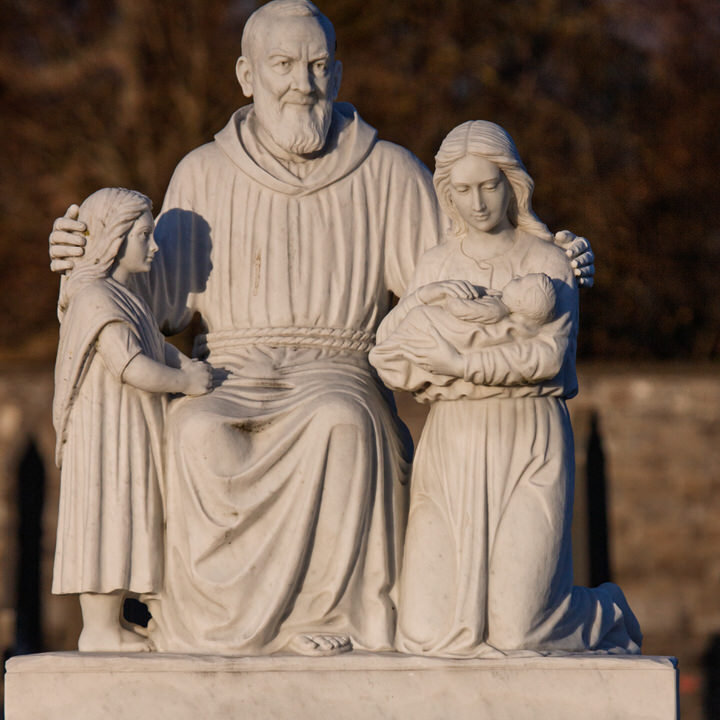
The photographs used date from a December 2009 visit to Glasnevin Cemetery when I used a Canon 1Ds III.
Across the Horizon - Why I Choose Landscape Over Portrait
Back in December 2009, I was using a Canon 1DsIII which I later discovered was faulty in Auto Mode and my backup camera was a Sigma Dp1 which had many issues. During a conversation around that time, someone mentioned to me that he couldn’t understand why all my photographs were captured in landscape format especially as I was using a professional camera. He confidently declared that "expert photographers" shoot in portrait mode. It was quite clear he wasn’t overly impressed by my skills or my approach.
Intrigued, and perhaps a little challenged, I decided to conduct a deliberate experiment. I headed to Glasnevin Cemetery with the sole intention of forcing myself to shoot in both styles to see what I could learn. The verdict? I absolutely did not enjoy the experience of shooting in portrait orientation, and I genuinely disliked the resulting images. From that moment on, I committed almost exclusively to the horizontal frame.
Fast forward fifteen years to this week, June 2026. I decided to dig out those old Glasnevin RAW files to reprocess them. There was no doubting that I could fundamentally improve the exposure, dynamic range, and detail using the latest version of Lightroom Classic, which was updated just yesterday. Yet, despite the modern software bells and whistles, the vertical compositions still failed to appeal to me. Out of curiosity, I decided to crop those portrait images into a strict 1:1
Much to my surprise, I found myself vastly preferring the square crops over the original vertical frames
Coincidentally, a few weeks ago, an acquaintance who was looking to buy a camera asked if he could test-drive a few bodies from my kit. We organised two weekend field sessions. As I watched him work, I noticed a striking pattern: he instinctively kept rotating the camera to shoot almost entirely in portrait format.
By the end of our sessions, it got me thinking. We are living in an era completely dominated by modern mobile devices. Handheld technology and vertically scrolling social feeds are subtly re-engineering how a new generation views the world, creating an ingrained, modern preference for vertical imagery. But for those of us documenting public spaces and the built environment, the horizontal frame offers profound structural, optical, and narrative advantages that a vertical frame simply cannot replicate.
Our preference for landscape orientation is fundamentally rooted in human anatomy. Our eyes are positioned horizontally on our heads, granting us a natural field of view that mirrors a panoramic landscape. We naturally perceive our surroundings in an aspect ratio close to 4:3 or 16:9, relying on a wide horizontal sweep to track movement and peripheral context, while our vertical range is comparatively restricted.
When a viewer looks at a landscape photograph, it feels experientially natural. The eye scans the frame from left to right, effortlessly mimicking the way we naturally explore a real-world environment. Forcing the eye to move up and down a narrow vertical box introduces a subtle visual friction, restricting the natural flow of exploration.
Street and architectural photography are rarely just about an isolated subject; they are about the relationship between the human element and the wider environment. It is the dialogue between a passerby and the geometry of the city—the shopfronts, the public art, and the historic facades.
Landscape Orientation (Horizontal)
Portrait Orientation (Vertical)
The Mode of Isolation: It cuts away the surrounding environment to emphasise height, vertical lines, or a singular figure.
The Editorial Feel: It naturally mirrors the layout of a magazine cover, fashion poster, or smartphone screen, prioritising subject isolation over environmental context.
In a busy, dynamic urban space, compelling moments occur simultaneously across the pavement. A horizontal format provides the necessary frame real estate to utilise layering—strategically placing distinct visual elements in the foreground, midground, and background.
This width makes it possible to stitch together unrelated interactions happening along the street at the exact same fraction of a second. Vertical frames lack the lateral space to accommodate this layout, forcing you to stack elements vertically. This often results in dead, cluttered empty space at the bottom of the frame and irrelevant sky or ceilings at the top.
Beyond the artistic and biological arguments, there is a massive practical and technical reason to favour horizontal and square images over vertical ones: the mechanics of presentation. If you display your work on modern screens, high-resolution monitors, or self-hosted digital galleries, landscape format reigns supreme. Designing and presenting fluid digital slide shows becomes infinitely easier when your images maintain a consistent horizontal orientation.
Vertical images completely break the visual rhythm of a digital presentation. They force software to generate massive black bars on either side of the screen (letterboxing) or require aggressive zooming that crops out vital details. Even a 1:1 square format preserves a balanced center of gravity on a landscape screen. By sticking to a horizontal workflow, your photographs fill the display natively, offering a clean, cohesive, and immersive viewing experience for your audience.
For those who prefer a completely handheld photography workflow, camera ergonomics heavily favour keeping the body level. Holding a camera natively in landscape orientation allows your elbows to stay tucked firmly against your chest, turning your upper body into a stable, balanced platform that minimises micro-shake.
The moment you rotate a camera vertically into portrait mode, your right elbow is forced up into the air, destabilising your stance. More importantly, that sudden physical shift acts as a loud visual cue to the public, instantly signaling that you are actively framing a shot and breaking the candid nature of the moment.
Final Thoughts
My brief experiment at Glasnevin all those years ago confirmed my instinct, and looking back at those reprocessed files today only solidifies it. For my eyes, my workflow, and the way I display my work, the horizon will always remain horizontal.
lasnevin Cemetery: Ireland’s National Necropolis
Glasnevin Cemetery, officially established as Prospect Cemetery, is the largest non-denominational burial ground in Ireland. Spanning 124 acres in north Dublin, the historic Victorian garden cemetery opened its gates in 1832 and is now the final resting place of approximately 1.5 million people.
Before its foundation, Irish Catholics faced severe hardships when burying their dead. The repressive 18th-century Penal Laws placed heavy restrictions on public Catholic worship, forcing families to conduct limited versions of their funeral services inside Protestant churchyards. Tension boiled over in 1825 at St Kevin's Cemetery on Camden Street, when a Protestant sexton publicly reprimanded a Catholic priest for attempting to say graveside prayers. The resulting public outcry prompted Daniel O’Connell—the "Liberator" and champion of Catholic rights—to launch an aggressive legal campaign. He proved that no law explicitly forbade a Catholic from praying in a graveyard and campaigned heavily for a spacious, dignified burial ground open to people of all faiths and none.
The sprawling cemetery is split into two distinct areas. The primary historical section, noted for its high perimeter walls and fortified watchtowers, sits on the Finglas Road. Directly across the road lies the "St Paul’s" extension, framed securely between two active railway lines. A restored pedestrian gateway also links the main cemetery directly to the tranquil National Botanic Gardens.
Glasnevin operates as a virtual "who’s who" of Irish historical and cultural life. It contains the prominent graves and monuments of national icons such as Daniel O’Connell (interred in a crypt beneath his signature round tower), Charles Stewart Parnell, Michael Collins, Éamon de Valera, Arthur Griffith, Maud Gonne, Kevin Barry, Sir Roger Casement, Countess Constance Markievicz, and Jeremiah O’Donovan Rossa. Ireland’s artistic legacy is equally well-represented by the graves of writer Brendan Behan, activist Seán MacBride, author Christy Brown, Legion of Mary founder Frank Duff, and folk icon Luke Kelly of The Dubliners. Additionally, Stephen Gately, lead singer of the pop group Boyzone, was cremated at the onsite Glasnevin Crematorium—the first facility of its kind in the Republic of Ireland—on 17 October 2009.
Visitors can track two centuries of evolving Irish funerary art along the cemetery's pathways. The landscape shifts gracefully from the austere, towering stone pillars of the early 19th century to the richly carved Celtic crosses born of the late-Victorian Gaelic Revival, and finally to the polished, minimalist Italian marble popular in the late 20th century.
The imposing boundary walls and strategic watchtowers surrounding the older grounds were originally engineered to deter body snatchers ("resurrection men"), who routinely raided Dublin graves to supply medical schools in the 18th and early 19th centuries. Armed watchmen patrolled the grounds alongside a pack of fierce bloodhounds. When later questioned in the British Parliament regarding these macabre Dublin graveyard raids, Prime Minister Robert Peel famously remarked with dark wit that it was, indeed, a "grave matter".
Reflecting its founding principle of human equality, Glasnevin was historically one of the rare cemeteries of its era to permit the burial of stillborn infants in consecrated ground, creating a dedicated, deeply poignant sanctuary known as the Angels Plot.
* February 2026: High Resolution Images * April 2026: High Resolution Images * May 2026: High Resolution Images