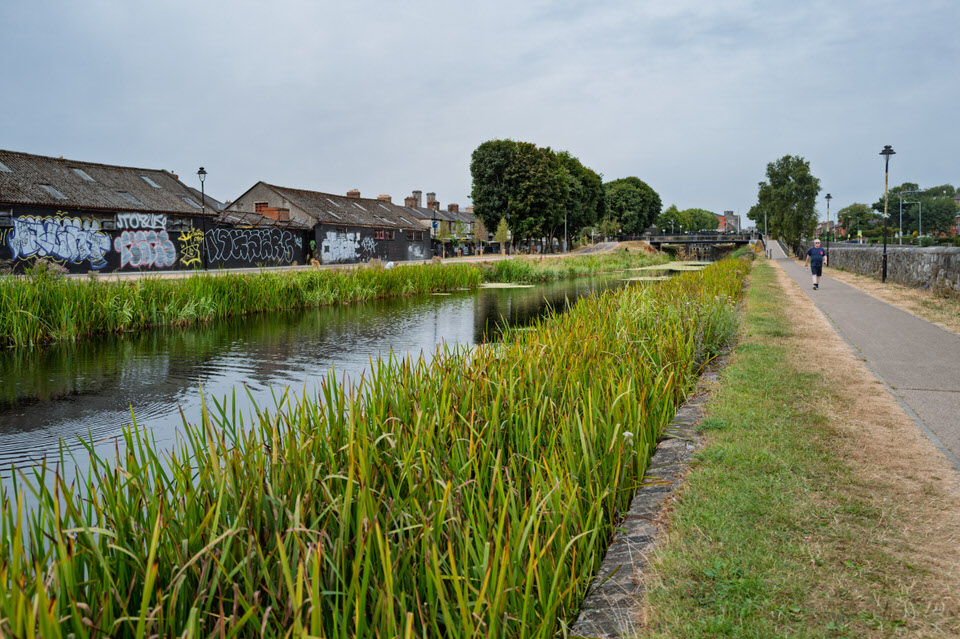
TODAY I EXPLORED A SECTION OF THE ROYAL CANAL
THE LEGACY CATALOG
* In The Year 2008
* In The Year 2011
* In The Year 2017
* Henrietta Back In 2010
From Binns Bridge To Cross Guns Bridge
The stretch of the Royal Canal between Dorset Street (Binns Bridge) and Cross Guns Bridge (Phibsborough Road) in Dublin has undergone a remarkable transformation in recent years, evolving from a narrow, uneven towpath into a world-class urban greenway corridor.
1. Upgrades to the Footpath and Cycle Path
-
Historically, this section of the canal towpath was composed of gravel, compact dirt, and narrow paved sections, bounded by stone canal walls and railway lines. It catered mainly to local pedestrians and anglers, with limited accessibility, restricted lighting, and difficult pinch-points under narrow bridges.
-
As part of the Royal Canal Greenway initiative—specifically Phase 3 delivered by Dublin City Council in partnership with Waterways Ireland and the National Transport Authority—the section between Spencer Dock and Phibsborough underwent a complete overhaul:
-
Segregated Mobility: The upgrade introduced wide, high-grade tarmacadam surface paths with dedicated space for pedestrians and cyclists to safely coexist.
-
Safety & Accessibility: Installation of bat-sensitive LED lighting, ramps, public seating, decorative railings, and improved ramp alignments under historic bridges.
Urban Integration: The path forms a vital arterial link in the national active travel network, connecting the Dublin Docklands directly to North Dublin communities and beyond to the 146 km Royal Canal Greenway route to the Shannon.
2. The Canal Locks: Locks 3, 4, and 5
- The Royal Canal rises steeply out of sea level at the River Liffey as it heads westwards toward Phibsborough. To manage this sharp elevation gain across a short distance, a series of closely spaced locks was engineered:
[Binns Bridge / Dorset St] ---> Lock 3 & 4 (Double Lock) ---> Lock 5 [Cross Guns Bridge]
-
Lock 3 and Lock 4 (The Double Lock): Located along the stretch between Russell Street / Binns Bridge and Dakota Court, Lock 3 and Lock 4 form a classic double lock (often referred to as a staircase lock). In a double lock layout, the top gate of the lower lock chamber (Lock 3) serves as the bottom gate of the upper lock chamber (Lock 4). This design saved both space and masonry during 18th-century construction by eliminating an intermediate canal basin between the two chambers.
-
Lock 5 (Westmoreland Lock): Positioned immediately adjacent to Cross Guns Bridge on Phibsborough Road. Its foundation stone was laid in 1790 by John Fane, 10th Earl of Westmoreland (then Lord Lieutenant of Ireland). The lock and bridge remain key industrial heritage landmarks of Phibsborough.
3. Why the Path is Closed (3 to 8 August 2026)
- The temporary public closure between Dorset Street/Lock 4 and Cross Guns Bridge from 3 to 8 August 2026 is managed under statutory notices issued by Waterways Ireland and Dublin City Council. The primary reasons for this targeted temporary closure include:
- BusConnects Infrastructure & Ground Investigation Works: Site investigation, soil testing, and preparatory structural works for the upcoming pedestrian/cyclist overbridge associated with the BusConnects Ballymun/Finglas to City Centre Core Bus Corridor project.
- Masonry & Bridge Maintenance: routine inspection and conservation maintenance on the historic stone canal walls, lock gates, and bridge abutments along Lock 4 and Cross Guns Bridge.
Public Safety: Due to restricted width along the canal cut, heavy machinery and engineering teams require a full path closure to carry out work safely without exposing pedestrians or cyclists to hazards.
- A signposted pedestrian and cycle diversion is operational via Phibsborough Road and Dorset Street for the duration of the works.
My Visits To Waterford
Railway Stations
* Clontarf Railway Station
* Docklands Railway Station
* Malahide Railway Station
Recommended Photo Galleries
Our Equipment Choices
In July 2026 I received A Godox iT30Pro L for my Leica Q3 and I also received A Godox iT30Pro S for my Sony A1 II and Sony A7RVI. I will discuss the Leica version here.
The Godox iT30Pro L is Godox's ultra-compact, dedicated TTL mini speedlite designed for Leica camera systems. Weighing a mere 120 g, it provides a portable, modern lighting solution for Leica M, Q, and SL series bodies without disrupting the balanced ergonomics of rangefinders or compact cameras.
Technical Specifications at a Glance
- Guide Number (GN): 15 m (at ISO 100) / ~49.2 ft
- Flash Output Range: 1/1 to 1/128 (in 1/3 EV increments)
- Exposure Modes: Leica TTL, Manual (M), Multi-Stroboscopic
- Sync Modes: High-Speed Sync (HSS up to 1/8000s), 1st Curtain, 2nd Curtain
- Wireless Radio: Built-in 2.4 GHz Godox X System (Transmitter & Receiver; 32 Channels, 4 Groups)
- Display & Controls: 2.8" Full-Colour Touchscreen + Tactile Rear Scroll Dial
- Power Supply: Built-in 7.2V / 900 mAh Li-ion battery (USB-C rechargeable)
- Recycle Time & Battery Life: ~1.5 seconds full power; ~560 full-power flashes per charge
- Dimensions & Weight: 65 × 46 × 47 mm; 120 g
- EU Price Range: ~€100 – €110 (slightly higher than the €85–€89 variants for Canon/Nikon/Sony due to Leica shoe configuration)
Technical Review: Pros, Cons & Forum Insights
The Pros
- True Leica TTL Integration: Unlike previous manual mini flashes (such as the Lux Junior or iM30), the "L" version communicates directly with Leica's TTL metering system, yielding accurate auto-exposures.
- Integrated Godox 2.4 GHz X System: Functions as both a wireless Master/Transmitter (to trigger off-camera AD200s or V1s) and a wireless Receiver (controllable via a Godox X3-L trigger).
- Incredible Form Factor: At 120 g, it sits unobtrusively on top of an M10, M11, or Q3 without making the setup top-heavy.
- Built-in Wide/Normal (WN) Diffuser Switch: A mechanical side switch flips a built-in diffuser panel across the flash lens to soften direct light and widen beam coverage.
- Li-ion Convenience: USB-C direct charging eliminates the need for carrying spare AA/AAA batteries in your kit bag.
The Cons & Things to Be Aware Of
- Touchscreen Sensitivity (Crucial User Warning): A frequent complaint across user forums is that the 2.8" touchscreen is overly sensitive. Carrying the camera on a shoulder strap often leads to accidental power level changes or mode switches unless the screen lock is engaged.
- Fixed Flash Head: The flash head cannot tilt or swivel. You cannot bounce light off ceilings or side walls without removing the flash from the camera or using an off-camera TTL cable/trigger.
- Tight Leica Hot Shoe Tolerances: Leica hot shoes (notably on M film bodies and digital M models) feature tight mechanical tolerances. Ensure the quick-release foot is fully pushed into the shoe until it clicks, otherwise the TTL pins may lose contact.
- Modest Power Output: With a Guide Number of 15 m at ISO 100, this flash is designed for close-range street fill, environmental portraits, or indoor fill-in. It will not overpower harsh direct midday sunlight across long distances.
- Internal Non-Removable Battery: Once depleted, you must plug the flash into a USB-C power bank rather than swapping in fresh batteries.
Ideal Settings & Step-by-Step Setup
Recommended Operational Settings
- Street / Environmental Fill-Flash: Set mode to Leica TTL, with Flash Exposure Compensation (FEC) set between -1.0 EV and -1.6 EV. This brightens shadow areas under eyes or hats while retaining natural ambient light.
- Low-Light / Indoor Portraits: Set mode to Manual (1/16 to 1/64 power), slide the WN switch to "W" (Wide) to deploy the wide-angle diffusion panel, and keep subject distances within 1.5–3 metres.
- Bright Sunlight / Open Aperture Shooting: Enable HSS (High-Speed Sync) on the flash so your Leica can sync up to 1/8000s shutter speed.
Step-by-Step Instructions
-
Mount and Lock to Hot Shoe: Mechanical setup.
Turn off both camera and flash. Press and hold the quick-release lock button on the iT30Pro L base, slide the foot fully into the Leica hot shoe until seated, and release the button to secure the pin mechanism.
-
Power On and Select Exposure Mode: Initial settings.
Power on the flash using the dedicated side power switch. Tap the top-left mode icon on the touchscreen to toggle between TTL (for automatic metering) or M (for manual power control).
-
Adjust Diffuser Position: Light quality setup.
For focal lengths wider than 35 mm or close-up subjects, slide the side WN switch to "W". This drops the internal diffuser in front of the flash tube to broaden coverage and soften shadows.
-
Configure Exposure Compensation / Power: Fine-tuning output.
In TTL mode, use the physical rear scroll wheel to dial in -1.0 EV FEC for natural fill. In Manual mode, spin the dial to set your desired output fraction (e.g. 1/32).
-
Engage Touchscreen Lock: Essential step.
Long-press the lock icon on screen or press the quick-lock function to lock the touchscreen interface. This prevents accidental setting changes while shooting on location.
Why Are Official Leica-Branded Flashes So Expensive?
While the Godox iT30Pro L retails brand new for ~€100 – €110, official Leica-branded speedlites command a substantial price premium.
Pricing Context (EU Market)
- Godox iT30Pro L: ~€105 (New)
- Leica SF 40: ~€380 – €430 (Used / Pre-owned only — Discontinued by Leica; originally retailed at ~€510 new)
- Leica SF 60: ~€600 (New — Currently Leica's primary active entry-level speedlite)
Key Reasons for the Leica Price Premium
- Rebadged OEM Partnering & Licensing Fees: Leica does not manufacture flash electronics in-house. Their SF series speedlites are re-engineered units produced by Japanese manufacturer Nissin (for example, the SF 40 is based on the Nissin i40, and the SF 60 on the Nissin i60A). Leica pays licensing fees for custom camera-to-flash communication protocols and redesigned outer casings, which inflates end-user costs.
- Discontinuation and Availability Premium: Because smaller models like the SF 40 have been discontinued, users seeking an official compact Leica flash must either compete on the second-hand market or buy the significantly larger and costlier SF 60.
- Low Volume Production: Leica operates on vastly smaller production runs than mass-market lighting brands like Godox. Fixed tooling and software engineering costs are spread across far fewer total units sold.
- Brand Equity & Build Consistency: Leica gear carries an overhead markup tied to brand positioning, strict quality control standards, long-term servicing support, and aesthetic matching for anodized metal camera finishes.
- Physical Capabilities: Larger OEM units like the SF 60 offer a tilting/swivelling head, motor-zooming reflectors up to 200 mm, and higher output power (GN 60). However, for compact travel and street shooting, the Godox iT30Pro L matches or exceeds them in pure convenience, radio ecosystem integration, and overall value.