GOING FORWARD PHOTONIQUE WILL BE ADVERTISMENT FREE
GOING FORWARD PHOTONIQUE WILL BE ADVERTISMENT FREE
Originally Photographed 8 July 2026
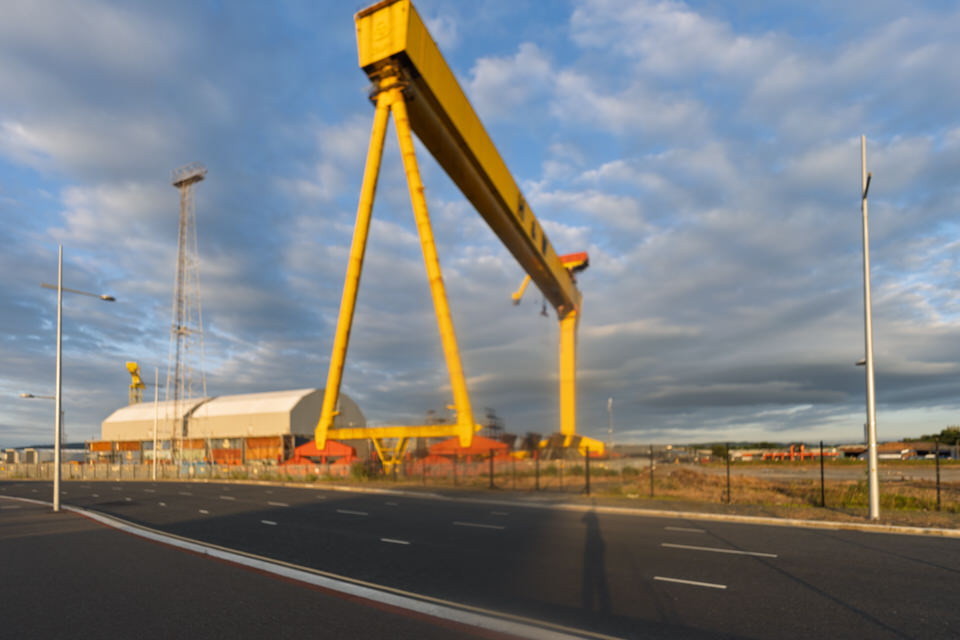
REALLY BIG GANTRY CRANES
* In The Year 2008 * In The Year 2011 * In The Year 2017 * Henrietta Back In 2010
The Belfast shipyards present a fascinating paradox. To stand beneath the gaze of the Harland & Wolff gantry cranes, Samson and Goliath, is to feel both incredibly close to and entirely detached from these industrial monuments.
The Scale Illusion and Bell's Theorem Crescent
My initial attempt to close the distance led me down a loop named Bell's Theorem Crescent.
What's in a Name?
Skirting the Belfast Metropolitan College, this road is named after the Belfast-born physicist John Stewart Bell. His groundbreaking 1964 "Bell's Theorem" mathematically proved quantum entanglement—the idea that subatomic particles remain connected across vast distances. Because Belfast City Council has a policy against naming streets after specific people, they compromised on naming it after his famous mathematical concept. It is arguably the only street in the world named after a quantum physics theorem.
As fitting as "action at a distance" was for my photography attempt, the crescent proved to be a closed loop that deposited me back onto Queen's Road, leaving me no closer to my giant subjects. Under an ultra-wide 15mm lens, the distant cranes shrank into insignificance, swallowed up by a vast foreground of empty sky and asphalt.
The Enigma of Hamilton Road
Hamilton Road cuts through the raw, unpolished core of the historic shipyards. Today, its status is deeply confusing:
The Signage: The road was heavily guarded by imposing "Road Closed" signs and civil works, giving it the distinct, unwelcoming appearance of a private industrial thoroughfare.
The Reality: Local vehicles continued to carefully navigate the barriers toward Queens Road.
Hesitant to proceed but lured by the composition, I used this half-abandoned environment to frame the cranes.
Wide-Angle vs. Compression
While Hamilton Road sits directly in the shadow of the structural works—providing an incredibly raw, dramatic perspective—the ultra-wide 15mm Voigtlander was the wrong tool for the job. Ultra-wide lenses expand perspective, making distant objects look even smaller.
To properly capture the overwhelming weight of the cranes without the tourist-centric sanitisation of the Titanic Belfast museum lawns, a longer focal length is required. I left the docklands that evening knowing I would need to return later in the week with a 28-70mm zoom lens to compress the distance and give Samson and Goliath the visual dominance they deserve.
The Voigtländer 15mm f/4.5 Super Wide-Heliar Aspherical III is a legendary, ultra-compact manual prime lens that holds a unique position in the world of wide-angle photography. Originally designed for rangefinders, Voigtländer’s native Sony E-mount version is optically optimised for modern mirrorless digital sensors.
Technical Features of the Voigtländer 15mm E-Mount
Unlike using adapted rangefinder lenses, the native E-mount version of the Super Wide-Heliar III is built to communicate flawlessly with modern Sony bodies:
Electronic Communication: The lens features built-in electronic contacts. This allows it to transmit full EXIF data to your camera, automatically trigger the camera's focus magnification (MF Assist) when you turn the focus ring, and enable in-camera lens corrections.
In-Body Image Stabilization (IBIS): Because the lens communicates its exact 15mm focal length to the camera, the A7R VI can precisely calibrate its 5-axis sensor stabilization, allowing you to easily shoot sharp images handheld in low-light conditions.
Mechanical Perfection: True to Voigtländer’s heritage, the lens has a robust, all-metal barrel with a beautifully dampened focus ring. It also features the Selective Aperture Control System, letting you switch between a clicked aperture (in 1/3 stops) for photography and a de-clicked, silent aperture for video.
Why Pair This Lens with the Sony A7R VI?
Practical Considerations and Limitations
The f/4.5 Aperture: This is a relatively slow lens. It is not designed for shallow-depth-of-field portraits or isolating subjects from the background.
Manual Only: There is no autofocus motor. If you are capturing fast-moving subjects close up, you will need to rely on zone focusing or focus peaking.
Perspective Distortion: Like all rectilinear ultra-wide lenses, anything placed near the very edges of the frame will stretch dramatically. Keeping the camera level is critical to preventing vertical lines from converging or "leaning" backward.
* Clontarf Railway Station * Docklands Railway Station * Malahide Railway Station