GOING FORWARD PHOTONIQUE WILL BE ADVERTISMENT FREE
GOING FORWARD PHOTONIQUE WILL BE ADVERTISMENT FREE
Originally Photographed 10 October 2026
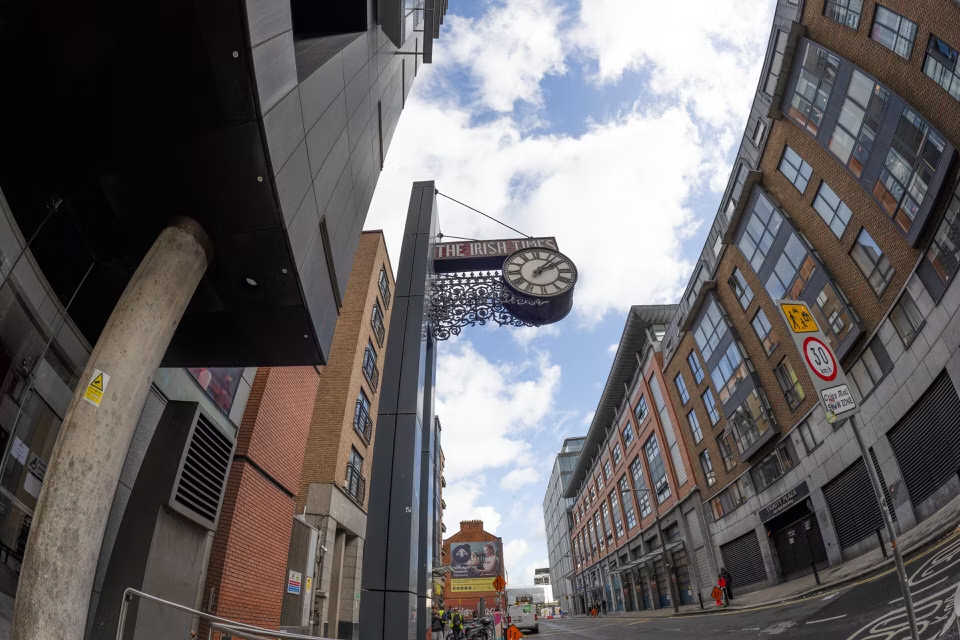
YOU MAY HAVE NOTICED THAT I USED A FISHEYE LENS
The Urban Cartographer Presents:
Photographed By William Murphy Using A Sony A7RVI And A Fisheye Lens
The Original Home: D’Olier Street
Founded in 1859, the newspaper operated from premises on Fleet Street before establishing its long-term headquarters along D’Olier Street in 1895. This late-Victorian terrace became so synonymous with the publication that the paper earned the enduring Dublin moniker "The Old Lady of D’Olier Street".
The Landmark Clock
Projecting outward on ornate cast-iron brackets, the drum-shaped street clock—flanked by illuminated glass dials with Roman numerals and an integrated stained-glass sign reading THE IRISH TIMES—became one of Dublin's most familiar meeting points and visual anchors. Originally salvaged from a demolished city building, the double-sided mechanical timepiece required regular manual winding and twice-yearly manual adjustments for daylight saving time.
Relocation to Tara Street
In 2006, after more than a century on D’Olier Street, the newspaper relocated its editorial offices and headquarters around the corner to modern, purpose-built premises on Tara Street (at the junction with Townsend Street). The iconic clock was carefully dismantled, restored, and re-erected on the new Tara Street façade. During its reinstallation, the clock mechanism was fully automated, preserving an antique piece of Dublin streetscape while updating it for contemporary service. The former D’Olier Street premises have since been converted to mixed commercial and retail use.
History of the Publication
Origins (1859): Founded on 29 March 1859 by Major Lawrence Knox, The Irish Times began as an unabashedly Protestant and unionist three-day-a-week paper, transitioning to a daily within a few months.
Post-Independence Shift: Following the creation of the Irish Free State in 1922, the publication gradually broadened its horizons, shifting from a voice for the southern unionist minority to an independent national broadsheet.
The Smyllie Era: Under the legendary editorship of R.M. Smyllie (1934–1954), the paper gained intellectual vitality and literary stature, famously outmanoeuvring strict wartime censorship during the Emergency (World War II) with subtle wit and irony.
The Irish Times Trust (1974): To protect its editorial independence from commercial takeover or narrow partisan control, ownership of the newspaper was transferred to The Irish Times Trust. This non-profit corporate structure mandates that profits are reinvested in journalism and that the publication remains free from political or religious affiliation.
Modern Expansion: In 2018, the organisation completed the acquisition of Landmark Media Investments (including the Irish Examiner and regional titles), expanding its national footprint.
Current Status and Reputation
The Irish Times remains Ireland's paper of record, occupying a centre-left to liberal editorial stance on social and civic issues while maintaining orthodox, analytical business reporting.
Journalistic Prestige: It is widely cited internationally for Irish political, legal, and economic reporting. Its investigative journalism, cultural analysis, and foreign correspondence (with dedicated international bureaux) are regarded as among the most rigorous in the country.
Digital Transformation: Operating through irishtimes.com, the title was one of the earliest newspapers globally to establish an online edition (launching in 1994). It maintains a successful digital subscription model alongside its print circulation.
Perception: While widely praised for authority and depth, critics occasionally accuse the paper of reflecting an affluent Dublin or metropolitan consensus—sometimes colloquially styled the "Dublin 4" perspective—on social and European affairs. Nevertheless, it remains the standard reference point for domestic policy debate, public record, and intellectual commentary across Ireland.