GOING FORWARD PHOTONIQUE WILL BE ADVERTISMENT FREE
GOING FORWARD PHOTONIQUE WILL BE ADVERTISMENT FREE
Originally Photographed 5 AUGUST 2026
NOT MANY PEOPLE NOTICE THIS
* In The Year 2008 * In The Year 2011 * In The Year 2017 * Henrietta Back In 2010
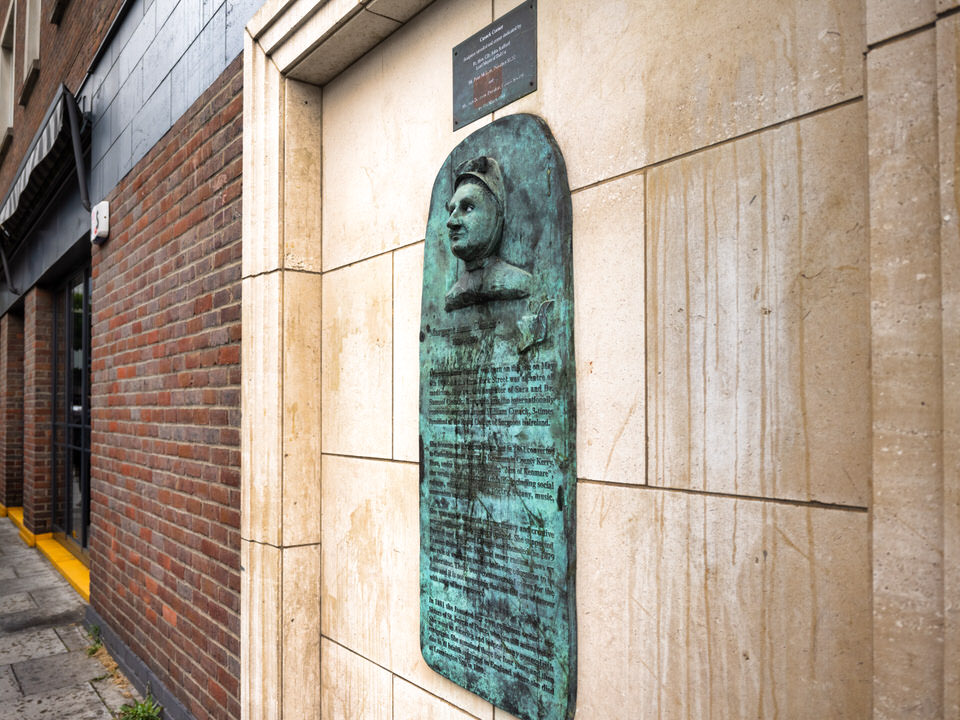
Sister Cusack was born in May 1829. Aged 13 she emigrated to England and when her fiancé died she joined an Anglican order and then converted to Catholicism. In 1861 she became the co-founder of the Convent of the Poor are Sisters of the Holy Cross in Kenmare and she remained there until 1881.
She founded the Famine Relief Fund which made her world famous. In 1884, she began the Order of St Joseph of Peace in a stable in Knock.
The Creator: The plaque was created and installed through the efforts of the Cusack Society.
The Sponsors: The proposal and installation were led by Mr Sean Donovan of the Cusack Society, acting in partnership with the Royal College of Surgeons in Ireland (RCSI), whose campus buildings sit immediately adjacent to Mercer Street and York Street.
Text Included on the Plaque
The plaque commemorates the life and turbulent legacy of Margaret Anna Cusack. While physical plaques in Dublin often summarise key biographical milestones, the official public documentation and civic record accompanying the memorial commemorate:
"Known as the Nun of Kenmare, Margaret Anna Cusack was born in a house at the corner of Mercer Street and York Street in 1829. Recently the corner was renamed Cusack Corner. Although she was honoured by Pope Leo XIII, the Vatican—because of her work for women's liberation—ordered that her name be 'effaced' as founder of the Order of St Joseph of Peace. In 1888 she returned to the Anglican Communion after a dispute with her bishop and issued 'The Nun of Kenmare: An Autobiography' the following year. She died on 5 June 1899, aged 70, and was buried in a Church of England-reserved burial site at Leamington Spa, Warwickshire, in England."
Is It True That The Corner Was Named In Her Honour?
Yes. The junction of Mercer Street Upper and York Street in Dublin 2 was officially designated and locally renamed as Cusack Corner. While Mercer Street and York Street retain their historical street names on postal addresses, the physical intersection itself bears the formal ceremonial designation and plaque marking it as Cusack Corner to honour her birthplace.
Dominance of Dedicated Online Trade-In Platforms
Apparently it is not my imagination—the decline of second-hand inventory in physical camera shops is a distinct, well-documented trend across Dublin and broader retail photography over the last few years.
While physical dealers historically relied on trade-in stock to drive foot traffic, several structural shifts have severely pinched the local supply pipeline.
Dominance of Dedicated Online Trade-In Platforms
Direct Peer-to-Peer Selling
Extended Upgrade Cycles and Technological Plateau
Margin Pressures and Warranty Liabilities on Physical Shops
Rapid Inventory Turnover for Popular Categories
When quality second-hand stock does enter local shops—especially compact digital cameras, prime lenses, or clean film bodies—it rarely stays in the display case for long. The global resurgence in analog gear and vintage digital compacts means desirable pre-owned items are bought almost immediately upon being listed.
* Clontarf Railway Station * Docklands Railway Station * Malahide Railway Station