GOING FORWARD PHOTONIQUE WILL BE ADVERTISMENT FREE
GOING FORWARD PHOTONIQUE WILL BE ADVERTISMENT FREE
Originally Photographed Not Specified
[[shortcode.sculpture.0013]] STILL A WORK IN PROGRESS
The Urban Cartographer Presents
Photographed By William Murphy Using A Sony A7RVI
Before and After - Documenting the Bedford Row Mural
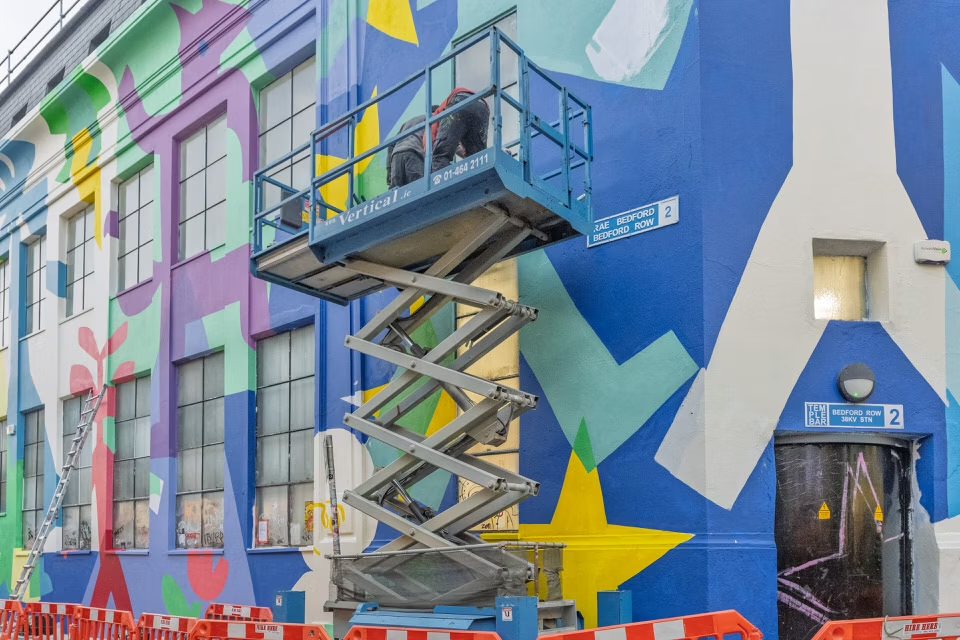
Documenting the built environment means paying close attention to surfaces that constantly evolve, and the exterior walls along Bedford Row in Temple Bar have become one of the city centre’s most dynamic canvases. Today, Friday 6 November 2026, I caught the crew in active production, layering fresh pigment, line work, and scaffolding against a masonry shell that carries well over a century of heavy municipal utility.
Photographing street art in progress is always about capturing that fleeting transition between the old layer and the new. In urban documentation, public art is never static—it breathes, weathers, gets tagged, and eventually yields to a fresh commission. But what makes this specific wall compelling through the lens is the tension between the temporary nature of urban paint and the sheer permanence of the infrastructure behind it.
The building is an active ESB Networks facility, the Bedford Row 38kV Substation, designed between 1926 and 1928 by architect Vincent Kelly. Rendered in a restrained, early International Modern industrial style, it was commissioned during the foundational years of the Electricity Supply Board to manage distribution across central Dublin.
Because of the dense cluster of telecommunications heritage in this quarter—most notably Thomas Manley Deane’s 1899 Crown Alley Telephone Exchange just around the corner, as well as the later exchange complexes along Dame Court, Dame Lane, and the former International Telephone Exchange on Exchequer Street—the building’s origins are easily misremembered as telecom-related. In reality, its roots run straight to the origins of the city's power grid. Before Kelly’s substation was erected, Dublin Corporation opened its pioneering municipal electric generating station on this very site in 1892, burning coal to supply arc lighting to city streets before bulk generation migrated downriver to the Pigeon House in Ringsend.
Watching a new mural take shape against these austere industrial walls brings that utility full circle. A century ago, this site was the literal pulse of Dublin’s electric light; today, the substation remains fully operational inside, while its exterior serves as a high-visibility public gallery. Catching the crew mid-stroke captures that brief moment where civic infrastructure, urban documentation, and street art meet before the paint dries and the street moves on.
The exterior walls of the Bedford Row 38kV Substation (at the junction of Bedford Row and Fleet Street) and its immediate perimeter have hosted several prominent street art installations and mural projects over the past fifteen years:
The Artist: Painted by Dublin artist James Earley (working under his moniker/studio Inputout).
Style & Significance: Rooted in Earley's signature aesthetic—drawing upon his family’s multi-generational heritage in ecclesiastical stained-glass craftsmanship fused with contemporary graffiti line-work and geometric stylization. This piece was among the first to prove that the austere, modernist industrial facade of Vincent Kelly's 1920s substation could act as a large-scale civic gallery in Temple Bar.
The Works: While parts of the main substation masonry on Bedford Row were reserved for standalone large-format murals, the adjacent corners and return walls along Bedford Lane were integrated into this community heritage trail.
Contributing Artists: Featured recurring work and multi-panel cultural portraits by artists such as Kevin Bohan, Vagabundler/collective contributors, and local printmakers, depicting Irish writers, musicians, and cultural figures.
ESB & DCC Partnerships: Because the wall faces high pedestrian footfall between the Quays and Temple Bar Square, Dublin City Council (South East Area / Arts Office) and ESB Networks established formal coordination initiatives to regularly refresh the substation walls with commissioned murals to deter unsanctioned graffiti. These cycles brought in rotating Dublin crews and commercial street-art collectives executing large-scale, high-contrast graphic murals across the frontage.
The crew documented at work in November 2026 represents the latest planned refresh of the ESB site—stripping back the weathered artwork from the 2020–2024 cycle and laying down a fresh commission across Vincent Kelly’s 1928 substation facade.
[[shortcode.bedfordrow.0001]]