[[shortcode.sculpture.0013]]
A VERY COLD CHRISTMAS MORNING
The Urban Cartographer Presents:
Christmas Morning in Trim
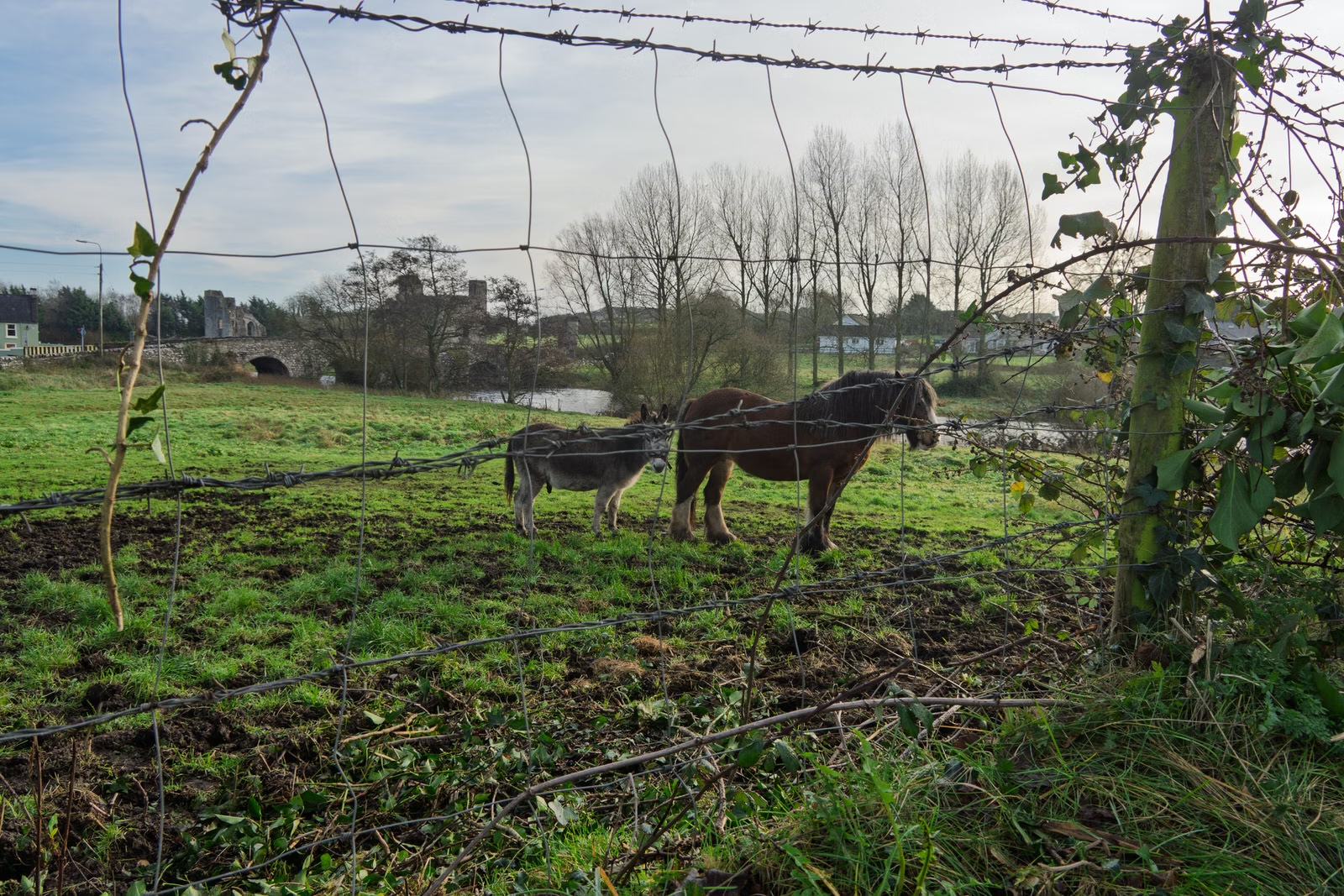
Donkey And Hob In A Field
Photographed By William Murphy Using A Sony NEX-7
An Unlikely Bond
Early on a crisp, frosty Christmas morning in 2014, I came across this striking pair sharing a winter pasture near the banks of the River Boyne in Trim, County Meath. Standing side-by-side behind the hedgerow was a small grey donkey and his pasture mate—a sturdy, heavy-feathered Irish Cob.
Donkeys are deeply social herd animals that suffer intensely from loneliness and should never be kept on their own. While pairing them with another donkey is ideal, they readily form lifelong friendships with cobs, horses, and ponies. Despite their gentle, contemplative demeanour, donkeys are remarkably self-reliant guardians. Unlike horses, whose defence is primarily flight or a double-barrelled backward kick, donkeys stand their ground. With their exceptionally flexible hip joints, they can kick forward, sideways, and backward with surgical accuracy, making short work of foxes or nuisance dogs attempting to enter their territory.
Overlooking the medieval pastures and the historic ruins of Trim, the two companions stood together against the winter chill—a quiet, timeless scene in the heart of Ireland’s ancient Boyne Valley.
About Trim, County Meath
Nestled on the River Boyne, Trim (from the Irish Baile Átha Troim, meaning "Town of the Ford of the Elder Trees") is widely regarded as one of Ireland’s finest and best-preserved medieval settlements.
- Trim Castle: Dominating the town’s skyline is Trim Castle, the largest Anglo-Norman fortification in Ireland. Founded by Hugh de Lacy in 1172, its monumental twenty-sided cruciform keep famously featured as the backdrop for King Edward I's York in Mel Gibson’s film Braveheart.
- Medieval Heritage: Beyond the castle walls lie the atmospheric ruins of the Yellow Steeple (the remnants of the 14th-century Augustinian St Mary’s Abbey), the Sheep Gate, and the Dominican Black Friary.
- The Old Bridge: Crossing the River Boyne at Trim is the Old Bridge, dating to the late 14th century (circa 1393), recognised as one of the oldest operating stone bridges in Ireland.
- The Porchfield: The extensive open parklands and water meadows alongside the river—visible in the wider landscape surrounding the town—have remained largely intact since medieval times, providing historic grazing pastures and walking trails.
Questions & Answers: Caring for Horses, Ponies, Cobs, and Donkeys
Q: What is the anatomical and behavioural difference between a horse, a cob, and a donkey?
- Horses and Ponies: Both belong to Equus caballus. Technically, ponies measure under 14.2 hands (148 cm) at the withers, while horses measure above.
- Cobs: A cob is a specific type rather than an independent species—a short-legged, deep-chested, heavy-boned animal (often with heavy feathering) capable of carrying significant weight.
- Donkeys: Donkeys belong to Equus asinus. They have longer ears with rich vascularisation for cooling, a upright mane without a true forelock, a tail with a switch tuft, and a flatter croup. Mentally, while horses flee when startled, donkeys freeze to assess danger, a trait often wrongly mislabelled as stubbornness.
Q: Can donkeys, cobs, and horses eat the same diet?
- No. Donkeys evolved in arid desert regions and process fibrous nutrients with extreme metabolic efficiency. Rich, lush dairy pasture, grain, or high-sugar feeds can trigger severe, fatal conditions in donkeys and hardy native cobs, most notably laminitis (a painful inflammation of the hoof laminae) and hyperlipaemia. Donkeys require high-fibre, low-sugar forage (such as clean barley straw supplemented with restricted grazing), whereas horses and active cobs generally require higher-energy hay or haylage and specialised feed balancers.
Q: Do donkeys and horses require different winter shelter and coat care?
- A horse’s coat secretes natural oils that make it water-resistant, shedding rain and snow. Donkeys lack this level of waterproofing; their coats soak through, making them prone to chills, rain scald, and hypothermia in damp climates like Ireland. Donkeys must have permanent, dry, draught-free field shelters throughout the autumn and winter months, whereas cobs and native ponies with thick double coats generally tolerate cold, wet weather much better, provided they have adequate forage and windbreaks.
Q: Why must you never keep a donkey on its own?
- Donkeys are exceptionally bonded herd animals. An isolated donkey experiences chronic stress, anxiety, and depression, which can manifest in behavioural pacing or metabolic breakdown (hyperlipaemia). While another donkey is their preferred choice, pairing them with a quiet pony, cob, or mule satisfies their social drive.
Q: How do their hoof care requirements compare?
- Donkeys have hooves that are more upright, elastic, and porous than horse hooves, designed to grip rock rather than mud. In the wet, sodden soils of the UK and Ireland, donkeys are particularly susceptible to thrush, seedy toe, and abscesses. Both horses and donkeys require routine trimming by a registered farrier every 6 to 10 weeks, but donkeys require scrupulous daily picking and dry standing areas to avoid hoof rot.
Recent Discussions And Catalogs
Limerick Explorations & Public Art
Waterford Walls & Urban Murals
THE LEGACY CATALOG