[[shortcode.sculpture.0013]]
I USED AN UNUSUAL CAMERA
The Urban Cartographer Presents:
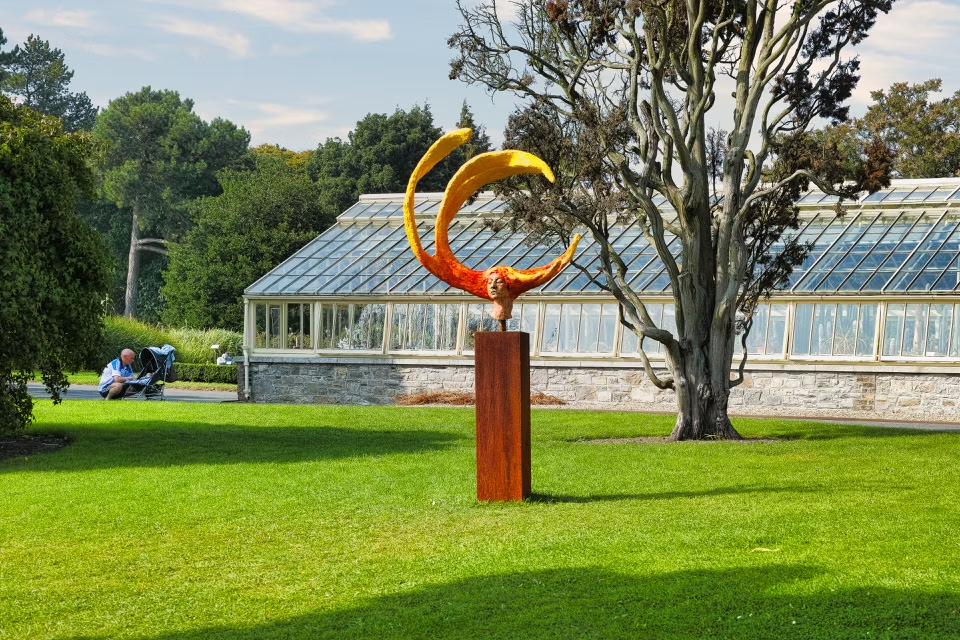
Sunburst By Ayelet Lalor
Legacy Catalog - 12 September 2014
Photographed By William Murphy Using A Sigma DP3 Merrill
Artwork & Artist Identification
- Title: Sunburst
- Artist: Ayelet Lalor
- Event & Location: Sculpture in Context 2014, National Botanic Gardens, Glasnevin, Dublin
- Medium & Construction: Mixed media, incorporating acrylic resin, modeled polymer/ferrocement layers, and wire-mesh armature finished with vibrant pigments, mounted atop a weathered timber post. The piece belongs to Lalor’s figurative series exploring expressive female forms, mythology, and dynamic upward-sweeping gestures of energy and light.
The Sigma DP3 Merrill: Love and Frustration
Released in 2013, the Sigma DP3 Merrill occupied a unique, highly specialised niche in digital photography. Equipped with a fixed 50mm f/2.8 lens (a 75mm full-frame equivalent) and an APS-C Foveon X3 direct image sensor, it was engineered with an uncompromising focus on raw optical resolving power.
Why Enthusiasts Loved It
- Foveon X3 Sensor Micro-Detail: Rather than using a conventional Bayer colour filter array that interpolates colour via demosaicing algorithms, the Foveon sensor records full red, green, and blue colour information at every pixel location by stacking three silicon photodiode layers vertically. At base ISO (ISO 100), this eliminates colour moiré and anti-aliasing softening, producing per-pixel micro-contrast, organic textures, and three-dimensional edge definition comparable to medium-format captures.
- Matched 50mm f/2.8 Optics: Tailored specifically for the flat silicon sensor plane with tele-centric light delivery, the fixed optic provides biting sharpness across the entire frame wide open. Its short-telephoto perspective and close-focusing capabilities made it particularly well-suited for isolating sculptures, architectural elements, and textural studies.
- Monochrome Tonal Gradation: Because each silicon layer captures distinct physical depths of luminance data, converting Merrill raw files to black-and-white yields exceptional tonal transitions and grain structure that closely mimics traditional silver halide emulsions.
Why Others Found It Unusable
- Glacial Operational Speed: Operating the camera demanded deliberate discipline. Autofocus was contrast-detect only, sluggish, and prone to hunting in mixed or low contrast. Writing massive raw files (X3F) caused noticeable operational lag.
- Severe Battery Depletion: The Foveon sensor and accompanying True II processing engines consumed considerable energy, frequently exhausting a battery in fewer than 80 to 100 shots. Photographers routinely carried three to five spare BP-41 packs for an afternoon outing.
- Restrictive ISO Usability: While virtually unmatched at ISO 100 and clean at ISO 200, image quality fell off steeply above ISO 400. Higher sensitivity introduced blotchy chroma noise, desaturation, and green/magenta shadow cast, limiting handheld work strictly to good daylight or requiring a tripod.
- Proprietary Software Pipeline: Unlocking the camera's detail required Sigma Photo Pro (SPP). The slow rendering times and processor-heavy demands of SPP made high-volume batch processing exceptionally time-consuming.
Frequently Asked Questions
What is Sunburst, and who created it?
Sunburst is a contemporary figurative outdoor sculpture created by Irish artist Ayelet Lalor. Formed as part of her expressive series exploring the female form, natural elements, and upward-reaching gestures of light and vitality, the work was installed atop a weathered timber post in front of the historic Curvilinear Range glasshouse during Sculpture in Context 2014 at the National Botanic Gardens in Glasnevin, Dublin.
What materials and techniques were used to construct Sunburst?
The sculpture utilizes a durable mixed-media construction designed for outdoor display. Lalor built the piece over a structural wire-mesh armature, applying modeled polymer and ferrocement structural layers followed by cast acrylic resin. The exterior was finished with intense, gradated pigments to withstand outdoor exposure while capturing dynamic reflections under direct sunlight.
What camera was used to document Sunburst, and why was it chosen?
The piece was photographed on 12 September 2014 using the Sigma DP3 Merrill. The camera was selected specifically for its fixed, telecentric 50mm f/2.8 optic (a 75mm full-frame field of view equivalent) and its APS-C Foveon X3 direct image sensor, which excels at resolving micro-textures, pigment gradations, and intricate surface details without the softness of an anti-aliasing filter.
How does the Foveon X3 sensor differ from a conventional digital camera sensor?
Standard digital sensors use a Bayer colour filter array in a single horizontal plane, capturing only one color channel (red, green, or blue) at each pixel and mathematically interpolating the rest through demosaicing algorithms. In contrast, the Foveon X3 sensor stacks three separate photodiode layers vertically in silicon. Because silicon absorbs different wavelengths of light at different depths, the sensor records full red, green, and blue data at every single pixel location, eliminating color moiré and delivering medium-format-style micro-contrast and per-pixel color fidelity at base ISO.
What made the Sigma DP3 Merrill challenging to use for documentary work?
While capable of extraordinary image quality under controlled conditions, the DP3 Merrill suffered from severe operational limitations:
- Glacial Speed: Sluggish contrast-detection autofocus prone to hunting, alongside long write times for its dense, uncompressed X3F raw files.
- Low-Light Dropoff: Image quality deteriorated sharply past ISO 200, developing blotchy chroma noise and color casts above ISO 400 that restricted handheld field photography to bright daylight.
- Heavy Power Consumption: High sensor and processing draw typically limited battery life to just 80 to 100 shots per pack.
- Complex Raw Processing: Extracting the sensor's full dynamic range and edge acuity required Sigma Photo Pro (SPP), a processor-heavy standalone software that significantly slowed down catalog workflows.
Recent Discussions An d Catalogs
Limerick Explorations & Public Art
Waterford Walls & Urban Murals
THE LEGACY CATALOG