MORE COMPLEX THAN EXPECTED
THE LEGACY CATALOG
* January 2025
* February 2025
* March 2025
* April 2025
* May 2025
* June 2025
Bethesda Place and the Rebirth of Parnell Square North
Beyond the Wall:
-
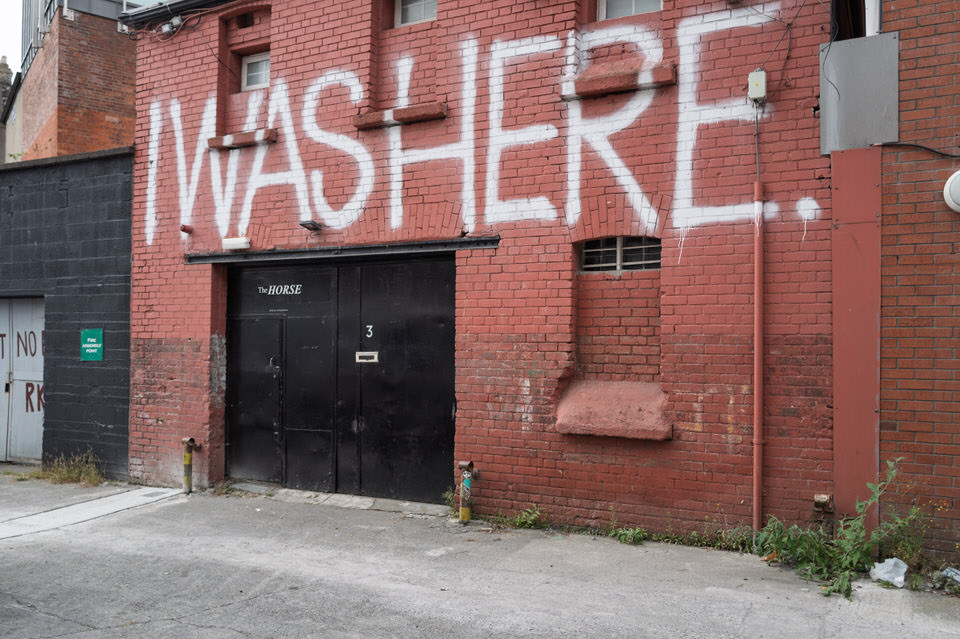
When I first turned off Dorset Street into Bethesda Place, I thought I was documenting a quiet, isolated cul-de-sac. The lane terminated abruptly at a brick wall featuring a large street art mural, framed by the gritty, layered textures of Dublin’s inner city. It felt like a self-contained pocket of urban decay and quiet resistance.
-
What I did not realise at the time was that I was standing on the fringe of a much larger, intricate complex of historical laneways—and that directly behind that painted brick wall sat a enigmatic, multi-faceted structure waiting to be re-discovered.
The Laneway Network and the Bethesda Origin
The origins of Bethesda Place back to 1784, when William Smyth—a wealthy Dublin merchant and philanthropist—founded the Bethesda Chapel on the east side of Dorset Street. The name itself derives from the biblical Pool of Bethesda in Jerusalem, long associated with healing and sanctuary. Smyth established the chapel alongside an asylum for female orphans and later the Lock Penitentiary.
-
Though the original chapel on Dorset Street was destroyed by fire in 1839 (and subsequently rebuilt on Granby Row), Bethesda Place was originally laid out to provide rear access to these charitable institutions.
-
What appears from Dorset Street to be a dead end is actually one arm of a twin-section laneway layout. Moving round to Frederick Street North, another lane — Frederick Lane North —threads directly behind Findlater’s Church (Abbey Presbyterian Church) and Charlemont House (the Hugh Lane Gallery). Off this northern artery lies a second, separate branch of Bethesda Place, forming a labyrinthine rear service network for the historic Georgian terraces of Parnell Square North.
The Mystery of the Five-Sided Structure
-
From the end of Bethesda Place, the boundary wall conceals a peculiar, pentagonal brick projection. This structure is the Amharclann.
-
Built in 1963 by architects Boyle & Delaney, the Amharclann was constructed as a dedicated Irish-language theatre and assembly hall for Coláiste Mhuire, the Christian Brothers secondary school that occupied Nos. 23–28 Parnell Square North until its relocation.
-
Designed as a distinctive octagonal, brick-and-concrete multi-faceted pavilion, it sits linked by a high-level enclosed bridge to No. 27 Parnell Square North. Because of its angled layout relative to the narrow plot lines, its rear elevation presents as a bold, five-sided structure jutting into the rear lanes.
What is "The Horse" on Bethesda Place?
-
Tucked into this secluded lane at No. 3 Bethesda Place isThe Horse.
-
Far from a equine relic or historical stable marker, The Horse is an independent, artist-run contemporary art gallery founded in 2021. Operating out of a repurposed industrial workshop in Dublin 1, it provides an experimental platform for underrepresented and emerging art practitioners. Its presence brings a quiet, grass-roots creative energy to a lane that is about to undergo a massive institutional transformation.
Setting the Baseline for Transformation
This entire block is on the precipice of one of the largest cultural redevelopments in Dublin’s modern history: the Parnell Square Cultural Quarter (PSCQ).
The redevelopment plan will dramatically reshape these laneways:
- Demolition of the Amharclann: The 1963 theatre hall will be demolished to clear the site behind Nos. 23–28 Parnell Square North.
- The New Dublin City Library: Replacing the current Central Library in the Ilac Centre, a state-of-the-art, five-storey-over-basement library facility designed by Grafton Architects and Shaffrey Architects will rise in its place.
- Hugh Lane Gallery Integration: Charlemont House (No. 22) closes to the public on 28 September 2025 for an extensive three-year overhaul of its 1930s wing. When it reopens around 2028, an internal connection will link the gallery directly to the new library, creating a unified art and literature campus.
- Laneway Reconfiguration: Frederick Lane North and Bethesda Place will be reconfigured for service, access, and pedestrian integration across the expanded cultural campus.
Photographing this isolated lane was only the beginning. As the heavy machinery moves in and the urban fabric shifts, this photographic series will track the complex of lanes from hidden backwaters to the public heart of Dublin's new cultural quarter
My Visits To Waterford
Railway Stations
* Clontarf Railway Station
* Docklands Railway Station
* Malahide Railway Station
Recommended Photo Galleries
Our Equipment Choices
In July 2026 I received A Godox iT30Pro L for my Leica Q3 and I also received A Godox iT30Pro S for my Sony A1 II and Sony A7RVI. I will discuss the Leica version here.
The Godox iT30Pro L is Godox's ultra-compact, dedicated TTL mini speedlite designed for Leica camera systems. Weighing a mere 120 g, it provides a portable, modern lighting solution for Leica M, Q, and SL series bodies without disrupting the balanced ergonomics of rangefinders or compact cameras.
Technical Specifications at a Glance
- Guide Number (GN): 15 m (at ISO 100) / ~49.2 ft
- Flash Output Range: 1/1 to 1/128 (in 1/3 EV increments)
- Exposure Modes: Leica TTL, Manual (M), Multi-Stroboscopic
- Sync Modes: High-Speed Sync (HSS up to 1/8000s), 1st Curtain, 2nd Curtain
- Wireless Radio: Built-in 2.4 GHz Godox X System (Transmitter & Receiver; 32 Channels, 4 Groups)
- Display & Controls: 2.8" Full-Colour Touchscreen + Tactile Rear Scroll Dial
- Power Supply: Built-in 7.2V / 900 mAh Li-ion battery (USB-C rechargeable)
- Recycle Time & Battery Life: ~1.5 seconds full power; ~560 full-power flashes per charge
- Dimensions & Weight: 65 × 46 × 47 mm; 120 g
- EU Price Range: ~€100 – €110 (slightly higher than the €85–€89 variants for Canon/Nikon/Sony due to Leica shoe configuration)
Technical Review: Pros, Cons & Forum Insights
The Pros
- True Leica TTL Integration: Unlike previous manual mini flashes (such as the Lux Junior or iM30), the "L" version communicates directly with Leica's TTL metering system, yielding accurate auto-exposures.
- Integrated Godox 2.4 GHz X System: Functions as both a wireless Master/Transmitter (to trigger off-camera AD200s or V1s) and a wireless Receiver (controllable via a Godox X3-L trigger).
- Incredible Form Factor: At 120 g, it sits unobtrusively on top of an M10, M11, or Q3 without making the setup top-heavy.
- Built-in Wide/Normal (WN) Diffuser Switch: A mechanical side switch flips a built-in diffuser panel across the flash lens to soften direct light and widen beam coverage.
- Li-ion Convenience: USB-C direct charging eliminates the need for carrying spare AA/AAA batteries in your kit bag.
The Cons & Things to Be Aware Of
- Touchscreen Sensitivity (Crucial User Warning): A frequent complaint across user forums is that the 2.8" touchscreen is overly sensitive. Carrying the camera on a shoulder strap often leads to accidental power level changes or mode switches unless the screen lock is engaged.
- Fixed Flash Head: The flash head cannot tilt or swivel. You cannot bounce light off ceilings or side walls without removing the flash from the camera or using an off-camera TTL cable/trigger.
- Tight Leica Hot Shoe Tolerances: Leica hot shoes (notably on M film bodies and digital M models) feature tight mechanical tolerances. Ensure the quick-release foot is fully pushed into the shoe until it clicks, otherwise the TTL pins may lose contact.
- Modest Power Output: With a Guide Number of 15 m at ISO 100, this flash is designed for close-range street fill, environmental portraits, or indoor fill-in. It will not overpower harsh direct midday sunlight across long distances.
- Internal Non-Removable Battery: Once depleted, you must plug the flash into a USB-C power bank rather than swapping in fresh batteries.
Ideal Settings & Step-by-Step Setup
Recommended Operational Settings
- Street / Environmental Fill-Flash: Set mode to Leica TTL, with Flash Exposure Compensation (FEC) set between -1.0 EV and -1.6 EV. This brightens shadow areas under eyes or hats while retaining natural ambient light.
- Low-Light / Indoor Portraits: Set mode to Manual (1/16 to 1/64 power), slide the WN switch to "W" (Wide) to deploy the wide-angle diffusion panel, and keep subject distances within 1.5–3 metres.
- Bright Sunlight / Open Aperture Shooting: Enable HSS (High-Speed Sync) on the flash so your Leica can sync up to 1/8000s shutter speed.
Step-by-Step Instructions
-
Mount and Lock to Hot Shoe: Mechanical setup.
Turn off both camera and flash. Press and hold the quick-release lock button on the iT30Pro L base, slide the foot fully into the Leica hot shoe until seated, and release the button to secure the pin mechanism.
-
Power On and Select Exposure Mode: Initial settings.
Power on the flash using the dedicated side power switch. Tap the top-left mode icon on the touchscreen to toggle between TTL (for automatic metering) or M (for manual power control).
-
Adjust Diffuser Position: Light quality setup.
For focal lengths wider than 35 mm or close-up subjects, slide the side WN switch to "W". This drops the internal diffuser in front of the flash tube to broaden coverage and soften shadows.
-
Configure Exposure Compensation / Power: Fine-tuning output.
In TTL mode, use the physical rear scroll wheel to dial in -1.0 EV FEC for natural fill. In Manual mode, spin the dial to set your desired output fraction (e.g. 1/32).
-
Engage Touchscreen Lock: Essential step.
Long-press the lock icon on screen or press the quick-lock function to lock the touchscreen interface. This prevents accidental setting changes while shooting on location.
Why Are Official Leica-Branded Flashes So Expensive?
While the Godox iT30Pro L retails brand new for ~€100 – €110, official Leica-branded speedlites command a substantial price premium.
Pricing Context (EU Market)
- Godox iT30Pro L: ~€105 (New)
- Leica SF 40: ~€380 – €430 (Used / Pre-owned only — Discontinued by Leica; originally retailed at ~€510 new)
- Leica SF 60: ~€600 (New — Currently Leica's primary active entry-level speedlite)
Key Reasons for the Leica Price Premium
- Rebadged OEM Partnering & Licensing Fees: Leica does not manufacture flash electronics in-house. Their SF series speedlites are re-engineered units produced by Japanese manufacturer Nissin (for example, the SF 40 is based on the Nissin i40, and the SF 60 on the Nissin i60A). Leica pays licensing fees for custom camera-to-flash communication protocols and redesigned outer casings, which inflates end-user costs.
- Discontinuation and Availability Premium: Because smaller models like the SF 40 have been discontinued, users seeking an official compact Leica flash must either compete on the second-hand market or buy the significantly larger and costlier SF 60.
- Low Volume Production: Leica operates on vastly smaller production runs than mass-market lighting brands like Godox. Fixed tooling and software engineering costs are spread across far fewer total units sold.
- Brand Equity & Build Consistency: Leica gear carries an overhead markup tied to brand positioning, strict quality control standards, long-term servicing support, and aesthetic matching for anodized metal camera finishes.
- Physical Capabilities: Larger OEM units like the SF 60 offer a tilting/swivelling head, motor-zooming reflectors up to 200 mm, and higher output power (GN 60). However, for compact travel and street shooting, the Godox iT30Pro L matches or exceeds them in pure convenience, radio ecosystem integration, and overall value.