GOING FORWARD PHOTONIQUE WILL BE ADVERTISMENT FREE
GOING FORWARD PHOTONIQUE WILL BE ADVERTISMENT FREE
Originally Photographed August 2026
THIS WAS VERY DIFFICULT TO PHOTOGRAPH
* In The Year 2008 * In The Year 2011 * In The Year 2017 * Henrietta Back In 2010
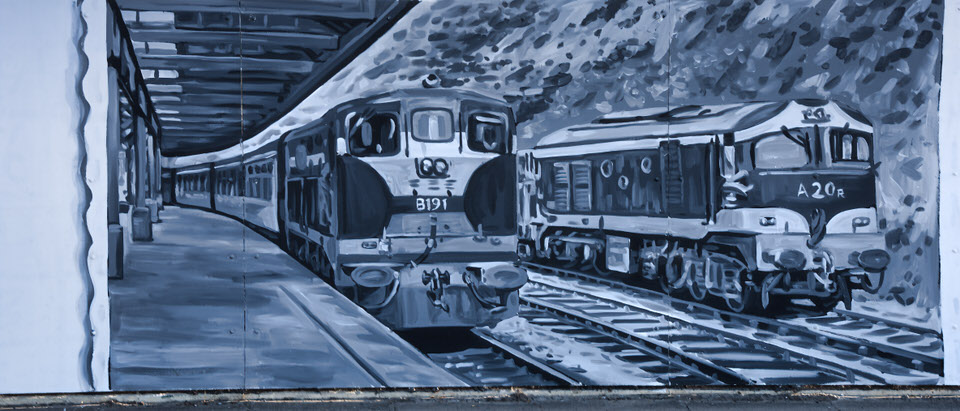
Mariana Duarte Santos: 150 Metres of Memory on Dock Road, Ferrybank
I have never liked walking along this stretch of roadway and I had to make a number of attempts to photograph this mural.
Waterford City and County Council, in partnership with Waterford Walls, commissioned a major public artwork along Dock Road in Ferrybank, translating the layered industrial and social history of the area into a sprawling visual archive.
Stretching 150 metres outward from the vicinity of Plunkett Station, the mural was executed by Portuguese artist Mariana Duarte Santos. Drawing directly from municipal archives, historic maps, census records, contemporary newspaper accounts, and period photography, the installation comprises 29 distinct scenes. Together, they chart the development of the city's north bank as a busy rail terminus, working port, and close-knit residential community embracing both Ferrybank and Sallypark.
Documenting all 29 panels along this arterial corridor presents a distinct practical challenge. Heavy, unrelenting commercial traffic along Dock Road makes working at the base of the wall hazardous. Capturing the full sequence required working from across the dual carriageway, relying on a 70–200mm f/4 telephoto lens to isolate individual panels and compress perspective, while carefully managing shutter speeds and stabilisation to eliminate camera shake.
Originally from Lisbon, Mariana Duarte Santos transitioned to large-scale outdoor murals in 2019, creating over 50 public installations across Portugal, Spain, Luxembourg, and Ireland. Her figurative, memory-driven approach—frequently drawing upon vintage monochromatic and sepia aesthetics—lends itself naturally to local archival storytelling.
"With the ongoing regeneration of the North Quays, preserving and celebrating the history and essence of Ferrybank is vitally important. This mural is significant not only in scale but is a stunning visual narrative that bridges past and present. Most importantly, it pays tribute to the people who shaped Ferrybank, from railway workers and stevedores to families and generations of residents whose lives and livelihoods defined the character of the area." — As extensive redevelopment reshapes the North Quays, this 150-metre installation provides an enduring link to the stevedores, rail crews, and neighbourhood families whose labour built Ferrybank.
Artist Instagram: @mariana95santos
Technical Note: Camera Suitability (Sony A7RVI / High-Resolution Full Frame)
Working across a busy multi-lane roadway with a 70–200mm f/4 lens brings specific optical and sensor demands:
Pixel Density & Motion Blur: On a very high-resolution sensor (such as the 61MP+ Sony A7R series / A7RVI), micro-vibrations from camera shake or passing heavy goods vehicles are amplified at 100% crop. When shooting handheld across the road at 135–200mm, relying solely on standard Optical SteadyShot (OSS) can be risky. Maintaining a minimum shutter speed of 1/500s or faster (via Auto ISO minimum shutter speed presets) is vital to keep fine archival brushwork tack-sharp.
Cropping & Perspective: The high resolving power of the A7R line is an enormous advantage here. Standing across the street often forces a compromise between framing out traffic and capturing the vertical plane square-on; high-resolution captures allow precise perspective correction and tighter compositional crops without degrading detail for web display or prints.
Depth of Field: At 70–200mm from across the road, stopping down to f/5.6 or f/8 ensures edge-to-edge sharpness across the entire mural surface, especially when standing slightly off-axis to avoid roadside obstructions.
Local awareness and engagement have been quite active, driven largely by local media coverage and direct community outreach:
Direct Community Involvement: When work began earlier in the year, Mariana Duarte Santos and project organisers actively appealed to residents of Ferrybank and Sallypark for family photographs, personal anecdotes, and historical documents. Several panels incorporate faces and scenes provided directly by local families connected to the old railway terminus and shipping wharves.
Regional Media Coverage: The project received dedicated coverage across local radio and print, including WLR FM in Waterford and KCLR 96FM across South Kilkenny/Carlow. Because Ferrybank straddles the Waterford/Kilkenny boundary, KCLR in particular highlighted the border-community angle and interviewed the artist on site.
Reactions to the North Quays Context: Community feedback has generally viewed the mural as an important cultural anchor during a period of heavy disruption. With the large-scale North Quays commercial and transport regeneration underway right alongside Dock Road, residents and civic groups have welcomed having the working-class social identity of Ferrybank and Sallypark preserved in high visibility before the new developments open.
Roadside Visibility vs. Pedestrian Access: The main point of local discussion mirrors my photographic experience: because Dock Road is a busy commercial artery, the primary public engagement is visual through car and bus windows rather than casual pedestrian foot traffic, making it a prominent daily landmark for commuters heading into and out of Plunkett Station.
As many of the murals were incomplete when I left Waterford at 11am Friday morning I will not be able to photograph the completed works until August 2027 however I photographed the artists in action and actually got to speak with some of the artists. Another issue that I had was that I visited an number of sites where old artwork remained until Thursday.
My stay In Waterford was dictated by hotel room availability which meant that I had choices to make. The event started 7th August with the 16th being the final day but I could get accommodation for four nights Monday to Friday morning. As a back up I had a booking for the last week in August but there were issues as Booking.Com had been hacked and I was receiving constant emails claiming that my booking was about to be cancelled. Now that I am in a position to review my visit to Waterford a later visit could well have been a better option - when I visited earlier festivals there was a buzz to being there during the creation phase but that buzz was lacking this year.
In the past this was not a problem but this year there was a major problem is that in general many of the murals were very much incomplete when I left Waterford on Friday morning - so what I photographed were works in progress. As already mentioned some Artists did not begin their projects until Wednesday or Thursday however some completed their project within 24 hours.
By late Wednesday I was getting worried as almost every large mural looked somewhat similar and the situation had not really improved by late Thursday.
Before any actual artwork takes shape, artists coat their primed wall in random spray-painted squiggles, numbers, loops, and doodles.
When walking the city as a photographer during these early phases, every single location looks like the same chaotic tag-job because they are all using the exact same workflow:
The Scribble Phase: The artist sprays random, dense shapes over the blank wall.
The Overlay: They step back, photograph the scribbled wall on a phone or iPad, and overlay their pre-designed digital sketch (usually in Procreate or Photoshop) at 50% opacity over the photo.
The Map: Each random loop or symbol becomes a precise reference point. Where a line in their sketch crosses a specific squiggle on screen, they map that exact intersection on the physical wall.
Why It Has Replaced Older Methods
Until a few years ago, artists relied on measured geometric chalk grids, paper pounce wheels, or nighttime projectors:
Projectors don't work in daytime light or tight alleys, and require heavy gear.
Chalk grids require tape measures, spirit levels, and hours of tedious geometric scaling.
The Scribble Grid takes 10 minutes to spray, works on any irregular surface (even brick recesses or corrugated metal), and allows high-precision scaling regardless of wall scale.
The Photographic Dilemma
However, as soon as artists begin blocking in their base colours and laying down outlines over the next 24 to 48 hours, those scribbles will disappear under solid paint layers, and the individual visual identity of each piece will finally emerge. The problem being that I was not there to see the final artwork
Zabou (France)
VILE (Portugal)
TELMO MIEL (Netherlands)
MR CENZ (UK)
MR.DHEO (Portugal)
Fintan Magee (Australia)
Dan Kitchener / DANK (UK)
L7MATRIX (France/Brazil)
Fio Silva (Argentina)
DAN FERRER (Spain)
CONSE (Spain)
SPEKER (Italy) & SILYME (Italy)
NOL (Netherlands)
ADOR (France)
KMG (Scotland)
WRN (Brazil) & MARIE (Brazil)
DAN LEO (Ireland)
ROB HILKEN (Northern Ireland)
SHANE HA (Ireland)
RASK (Ireland)
SOAK (Ireland)
STAYLO (Ireland)
MUL (UK/Ireland)
OMIM (Ireland), NOVICE (Ireland), RO (Ireland), NIALLOL (Ireland), LAIDBACK (Ireland)
EMBER (Ireland), KONE (Ireland), KAROL (Ireland), HMC (Ireland), ANDYMC (Ireland)
Ailbhe Larsen (Ireland)
* Clontarf Railway Station * Docklands Railway Station * Malahide Railway Station
I was a bit surprised when I realised that I used a Sony NEX-7 in May 2015 but when I checked my catalogs I discovered that the A7RII arrived late in 2015 and the 90mm F2.8 Macro lens at Christmas. I continued to use the NEX-7 for about a year as and easy to carry backup camera.
When the Sony NEX-7 debuted in late 2011, it didn't just iterate on compact mirrorless cameras—it completely redefined what serious photographers expected from a small body. Coming out of an era defined by bulky DSLRs, the NEX-7 proved that shrinking the physical footprint did not mean sacrificing control, resolution, or handling.
The Rangefinder Ergonomics & Built-In OLED EVF
Earlier compact mirrorless options (including the NEX-5) felt like upgraded point-and-shoots with touchscreen menus and optional clip-on viewfinders. The NEX-7 changed that completely by embedding a brilliant 2.36-million-dot OLED Electronic Viewfinder (EVF) directly into the top-left corner of a solid, magnesium-alloy rangefinder-style body. This gave photographers eye-level framing without forcing an awkward top attachment, making manual focusing with focus peaking seamless and intuitive.
The Legendary Tri-Navi Control System
The defining operational triumph of the NEX-7 was its Tri-Navi interface. Featuring two twin twin-dial thumb rollers on the top plate alongside a rear control wheel, it offered three simultaneous parameter adjustments without ever taking your eye away from the EVF:
Direct Tactile Access: Instantly adjust Aperture, Shutter Speed, and ISO (or exposure compensation) on the fly.
No Menu Diving: Solved the primary complaint of early mirrorless platforms by putting manual shooting mechanics directly under your thumbs.
Ultra-Fast Shutter Lag: Delivered a rapid 0.02-second shutter release lag—at the time, the world's fastest.
Class-Leading 24.3 MP APS-C Sensor
The E-Mount Bridge & VG10E Ecosystem
By combining DSLR-grade image quality, rangefinder handling, manual tactile control, and high adaptability for adapted glass, the NEX-7 laid the foundational architecture that eventually evolved into the high-resolution A7R series and flagship A1 bodies.