GOING FORWARD PHOTONIQUE WILL BE ADVERTISMENT FREE
GOING FORWARD PHOTONIQUE WILL BE ADVERTISMENT FREE
Originally Photographed 11 MAY 2008
PHOTOGRAPHED USING A SONY A7RII WITH A BATIS 25MM LENS
The Urban Cartographer Presents
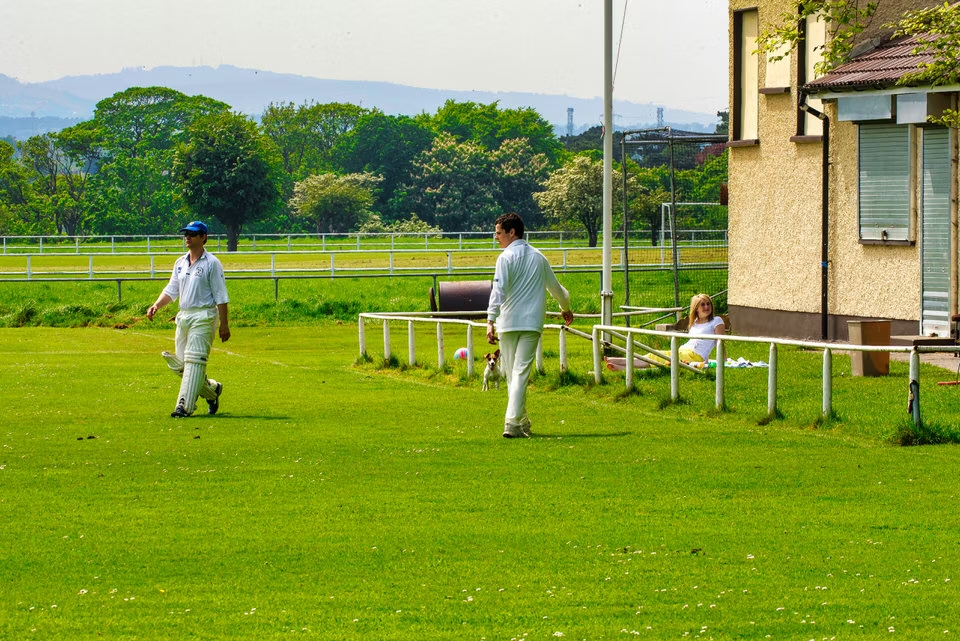
The two cricket clubs featured in my photographs are both located close to the Wellington Monument in Dublin's Phoenix Park. I have not visited this immediate area again since taking these photos on 11 May 2008.
Cricket was introduced to Ireland by the English in the early 19th century, taking early root in towns such as Kilkenny and Ballinasloe. By the 1830s, the game began to spread rapidly, and many of the clubs founded over the following three decades are still active today.
The first Irish national team played in 1855 against the Gentlemen of England in Dublin. Throughout the 1850s, the Englishman Charles Lawrence played a pivotal role in developing the Irish game through his coaching. During the 1850s and 1860s, Ireland also welcomed touring professional sides for the first time, playing its inaugural match against the Marylebone Cricket Club (M.C.C.) in 1858.
Cricket enjoyed steady popularity until the early 1880s, when two major developments curtailed its growth: the social upheaval of the Land War (which led to the establishment of the Irish Land Commission in 1881) and the rise of the Gaelic Athletic Association (GAA). The GAA's ban on "foreign" (in practice, British) games meant that anyone playing cricket was barred from participating in Gaelic football and hurling—a rule that remained in place until 1971.
Despite these domestic headwinds, Irish cricket achieved notable international milestones at the turn of the century. Irish teams toured Canada and the United States in 1879, 1888, 1892, and 1909. Ireland played its first match with first-class status on 19 May 1902 against a London County side featuring W.G. Grace; captained by Sir Tim O’Brien, the Irish won convincingly by 238 runs. Two years later, in 1904, Ireland defeated a touring South African side.
In January 2012, Cricket Ireland Chief Executive Warren Deutrom publicly declared Ireland’s ambition to play Test cricket by 2020—a move intended in part to stem the tide of talented Irish players using residency rules to qualify for England. Unveiling a strategic plan running through 2015, Deutrom outlined ambitious goals: growing participation to 50,000 players, reaching 8th in the world rankings, establishing a domestic first-class structure, and cementing cricket as the fifth most popular team sport in Ireland.
Deutrom had previously written to the International Cricket Council (ICC) in 2009 to state the board's intention to apply for Full Membership. Momentum built steadily over the following years. Former Australian fast bowler Jason Gillespie noted that granting Ireland Test status "would be huge news in world cricket, and it would be a massive positive story for the world game." Following Ireland’s famous victory over the West Indies at the 2015 Cricket World Cup, West Indian legend Michael Holding urged the ICC to act immediately, stating, "they need to be recognised now."
Initially, in 2015, the ICC outlined a pathway requiring Ireland to win the 2015–17 ICC Intercontinental Cup and defeat the 10th-ranked Test nation in a four-match series in 2018. However, on 22 June 2017, after more than a decade of top-flight associate cricket, the ICC voted at its London meeting to grant Full Membership to both Ireland and Afghanistan, making Ireland the eleventh Test-playing nation.
Ireland played its inaugural home Test match against Pakistan in Malahide in May 2018, followed by its first overseas Test against Afghanistan in India in March 2019 (losing by seven wickets), and a memorable four-day Test against England at Lord’s in July 2019. Under the ICC Future Tours Programme for 2019–2023, Ireland was scheduled for sixteen Tests, though alongside Afghanistan and Zimbabwe, it was not included in the first two editions of the ICC World Test Championship.
Founded in 1830, Phoenix Cricket Club is the oldest cricket club in Ireland and one of the oldest in the world. Prior to 1834, members met and practised in Phoenix Park before relocating in 1835 to open fields south of the Grand Canal, behind Upper Baggot Street.
In 1838, the Commissioner of Woods and Forests granted the club permission to use a 150-square-yard plot near the Wellington Monument. Initially, temporary railings had to be erected after several players were injured on turf churned up by wandering livestock; these were later replaced by permanent rails of an agreed thickness, painted white so they would be clearly visible to horsemen riding through the park.
When Chesterfield Avenue—the main thoroughfare running through Phoenix Park—was widened in 1846, the club had to relocate once more. An adjacent site was recommended, and in recognition of the expenses the club had already incurred, the Board of Works financed the move at a cost of £73. Phoenix has remained on that ground ever since.
On the pitch, the two decades between 1950 and 1970 were lean years due to an ageing squad; despite winning two cups in the 1950s, the club went through the entire 1960s without a major trophy. A younger generation began to emerge in the late 1960s, sparking a golden era. Ending a 22-year drought, Phoenix won the Leinster Senior Cup in 1973 and became the inaugural winners of the Wiggins Teape League in 1974. In 1975, Phoenix completed a domestic "Grand Slam"—winning all three major senior trophies in a single season, becoming the first club to achieve the feat. Throughout the 1970s, a core group of 15 players propelled the 1st XI to six cups, three league titles, and two Wiggins Teape trophies.
Today, Phoenix Cricket Club continues to promote the sport, offering competitive cricket for members and visiting sides while providing free entertainment for locals and tourists strolling through Phoenix Park.
Just across the way sits the second club captured in my photos. In the early 1860s, the Lord Lieutenant of Ireland decided that public service employees needed dedicated facilities for rest and recreation. He successfully pushed a bill through Parliament granting civil servants their own cricket ground in Phoenix Park, right beside the old Dog Pond, where the Civil Service Cricket Club continues to play to this day.
Phoenix Park cricket, Phoenix Cricket Club, Civil Service Cricket Club, Wellington Monument Dublin, history of cricket in Ireland, Irish cricket history, Cricket Ireland Test status, Dublin cricket clubs, Phoenix Park Dublin photography, Irish sporting history, Leinster cricket clubs,Canon 1Ds III, William Murphy, Infomatique, Photonique, The Urban Cartographer,
Explore the history of Irish cricket and two historic Dublin clubs—Phoenix Cricket Club and Civil Service Cricket Club—near the Wellington Monument.
Immediatly Below The Urban Cartographer Presents
Select An Image
[[shortcode.clocks.0001]]