GOING FORWARD PHOTONIQUE WILL BE ADVERTISMENT FREE
GOING FORWARD PHOTONIQUE WILL BE ADVERTISMENT FREE
Originally Photographed 4 July 2026
THIS PARK WILL BE REPLACED BY A METRO STATION
* In The Year 2008 * In The Year 2011 * In The Year 2017 * Henrietta Back In 2010
The Mater Plot (Four Masters Park): Defensive Architecture and the Layering of Dublin's Heritage
On a walk through the Phibsboro–Cabra area to photograph one of Dublin's lesser-known green spaces, I spotted a small Sheela na Gig mounted near St Joseph’s Church. Once you know what to look for, these raw, enigmatic figures—traditionally carved in stone to depict a naked female form displaying an exaggerated vulva—become visible in the most unexpected urban corners. While historically linked to medieval churches, the ones cropping up around North Dublin appear to be made of modern cast concrete.
Far from a historical accident, these are part of a contemporary guerrilla art campaign by a feminist activist collective known as Project Sheela. By mounting these modern replicas in public spaces, the campaign uses an ancient, frequently misunderstood symbol—whose pagan roots may well predate the great High Crosses of Ireland—as a form of street-level protest to reclaim female autonomy and historical visibility.
There is an exquisite irony to finding these unmapped, tactile icons freely exposed on neighbourhood walls just a short walk away from an official, municipal heritage site that has spent years locked behind iron bars.
A Layer of Abstraction
The story behind this particular green space—historically known as Four Masters Park, or the Mater Plot—perfectly mirrors this ongoing tension between public access and physical containment.
The Context of the Park
For decades, a frustrating stalemate hung over this pocket of land at the corner of Berkeley Road and Eccles Street. While the site is owned by the Sisters of Mercy, its ongoing maintenance and landscaping were funded by public money via Dublin City Council. Because a resolution regarding public liability and management proved elusive, the heavy outer gates remained padlocked shut for years. It left a vital pocket of urban green space tantalisingly visible, yet completely out of reach for the local community.
Though the main park gates have finally been opened to the public, the introduction of a new wrought-iron perimeter fence around the central Celtic cross highlights the bittersweet compromise of modern urban management.
The Rise of Defensive Landscaping
This approach creates a stark conflict in how public art is experienced:
The Practicality: It secures the physical survival of delicate stone carvings, safeguarding them against contemporary urban pressures. The Loss of Immediacy: It establishes a literal boundary. When a monument like the Four Masters Celtic Cross is ringed by iron railings, it is effectively placed inside an outdoor museum vitrine, stripped of its democratic status as a shared piece of the streetscape.
By locking heritage behind miniature perimeters within an open park, the city achieves a strange duality: the public is finally allowed into the space, but the art is pushed further away. It keeps the monuments pristine, but it completely dismantles the casual, spontaneous interaction that makes street-level art so vital to the living fabric of Dublin.
1. The Four Masters Memorial Cross: Preservation by Partition
The Artifact: Sculpted by James Cahill and erected in 1876, this ornate, neo-Celtic High Cross was commissioned to honour the four Franciscan friars (led by Mícheál Ó Cléirigh) who compiled the Annals of the Four Masters in the 1630s—a monumental effort to rescue ancient Irish history from erasure during the turbulent Cromwellian era.
The Spatial Narrative: Cahill’s cross is intricate, heavy with traditional stone-carving motifs, and explicitly didactic. It represents Victorian-era nationalism looking backward to secure an identity. The Layer of Abstraction: In your piece, this cross serves as the ultimate symbol of the city's modern "defensive landscaping." Because it is an explicit heritage piece with delicate relief carvings, it has been ringed by localised wrought-iron railings within the park. It is safe, but it is entirely institutionalised—placed behind bars to protect a history that was ironically written to be shared with the common people.
2. The Healing Hands (The Eternal Flame): The Unreachable Touch
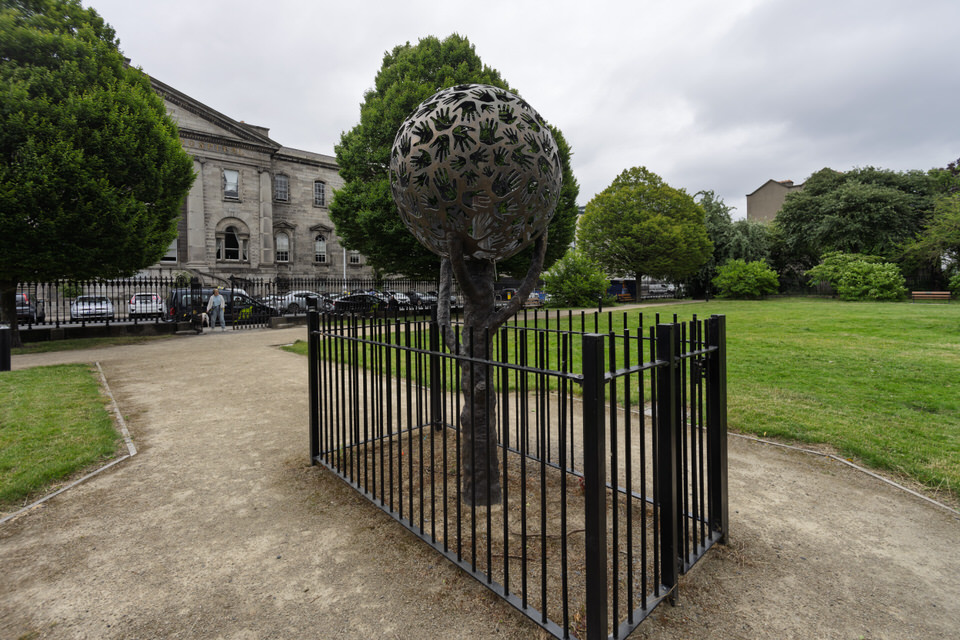
The Artifact: Installed in the year 2000 to mark the third millennium, this striking bronze and stone work by Irish artist Tony O’Malley depicts a highly organic tree trunk topped by a sphere of interwoven, sculpted hands. Cradled at the very centre of these grasping, supportive hands is a flickering eternal flame.
The Spatial Narrative: O'Malley's sculpture is fundamentally about human connection, community healing, and modern resilience—a poignant focal point considering its immediate proximity to the Mater Hospital and St Joseph's Church. It relies on the concept of physical vulnerability, holding a delicate flame within a protective, collective grasp of open hands.
The Layer of Abstraction: There is a crushing irony to The Healing Hands sitting inside a park that spent decades chained shut due to public liability stalemates. A monument explicitly named "Healing Hands," designed to project warmth, warmth, and collective sanctuary, was for years left tantalisingly viewable only through a padlocked perimeter. Even with the park gates open, the institutional nature of the surrounding defensive architecture contrasts starkly with the sculpture's raw, tactile message of open human contact.
The Extinguished Flame
There is a final, crushing irony waiting at the centre of the Mater Plot. If you stand before Tom O’Mally’s The Healing Hands today, you will notice something missing from the core of the interwoven bronze fingers: the eternal flame does not burn. Sponsored at the turn of the millennium by An Bord Gáis to symbolise everlasting care and community warmth, the gas lines have long since gone cold, leaving the sculpture as dark as the padlocked gates that once surrounded it.
This pocket park is a landscape on the precipice of erasure. Under current Dublin Metro plans, this entire green footprint is slated to become the new underground Mater Station. The iron-ringed Celtic cross and the cold bronze flame are scheduled for extraction—uprooted from their disputed ground to be stored in a municipal warehouse until they can be engineered into a sterile, modern transit plaza. What I photographed yesterday is not just a study in defensive architecture; it is the final, stagnant chapter of a Dublin streetscape before the excavators arrive.
The Station Under The Mater Hospital
During the construction of the Mater Hospital’s Whitty Building (completed around 2013 under the original, ultimately scrapped Metro North plans), a massive underground concrete "station box" was structurally integrated directly beneath the hospital. The state spent approximately €12 million to €20 million on these enabling works so that future tunneling teams could break through right into the hospital basement without disrupting the medical facilities above.
However, when the project was resurrected and redesigned as MetroLink, transport planners completely abandoned that purpose-built hospital box.
Why the Station Shifted to the Park
Transport Infrastructure Ireland (TII) and the National Transport Authority (NTA) defended the move to the Mater Plot (Four Masters Park) based on a few engineering and operational shifts: Tunnel Depth and Alignment: The redesigned MetroLink routing requires a much larger, deeper tunnel alignment that couldn't easily curve into the pre-built hospital box without drastically slowing down train speeds or affecting surrounding building foundations.
Construction Disruption: Building the station directly out of the hospital footprint would require massive, years-long disruption right at the doorstep of the emergency department and high-dependency wards.
The Cut-and-Cover Strategy: Four Masters Park offers an open, self-contained footprint. It allows contractors to use a "cut-and-cover" method—literally digging a massive open trench (109m long and 29m deep) straight down through the park, dropping the station infrastructure in, and roofing over it.
The Ultimate Irony
* Clontarf Railway Station * Docklands Railway Station * Malahide Railway Station