Photonique

A Mobile Friendly Site

This Is Our Fastest Server

GOING FORWARD PHOTONIQUE WILL BE ADVERTISMENT FREE
Originally Photographed 12 August 2026


THIS SOLAR ECLIPSE CAUGHT ME BY SURPRISE


THE LEGACY CATALOG

* In The Year 2008 * In The Year 2011 * In The Year 2017 * Henrietta Back In 2010


The Highlight Of My Visit To Waterford Was The Solar Eclipse


The highlight of my visit to Waterford coincided with the August 12 solar eclipse. While totality crossed Spain and Iceland, Ireland saw the moon obscure over 90% of the sun. Using a Leica Q3, I documented the event from ground level: capturing the sudden shift in ambient street lighting and the candid reactions of onlookers gathered across the city. I focused on the uncanny, desaturated twilight falling over the historic streetscapes and the shared curiosity of people pausing on footpaths to watch the skies dim.

One thing I noticed was that the LED streetlight switched on for the duration of the event.

Here is why that happens:

  • Photocell Sensors (Dusk-to-Dawn Control): Most modern street lighting systems are not run on fixed clock timers. Instead, individual lanterns (or centralized nodes) use photoelectric control units (photocells) that continuously measure ambient illuminance (lux levels) in the sky.

  • The Lux Switching Threshold: Standard council-spec photocells are typically calibrated to trigger the light on when ambient daylight drops below roughly 20 to 35 lux (simulating civil twilight).

  • The Eclipse "False Night": When the Moon blocks out the vast majority of the Sun—especially when combined with existing cloud cover or late-day sun angles—ambient daylight plummets below that calibrated threshold. The sensors interpret the sudden darkness as nightfall and close the circuit, powering up the LEDs.

  • Turning Back Off: As the Moon moves past maximum obscuration and ambient light levels rise back above the cut-off threshold (often around 18–20 lux), the sensors trigger the lights to turn back off until actual sunset.


Waterford Walls August 2026


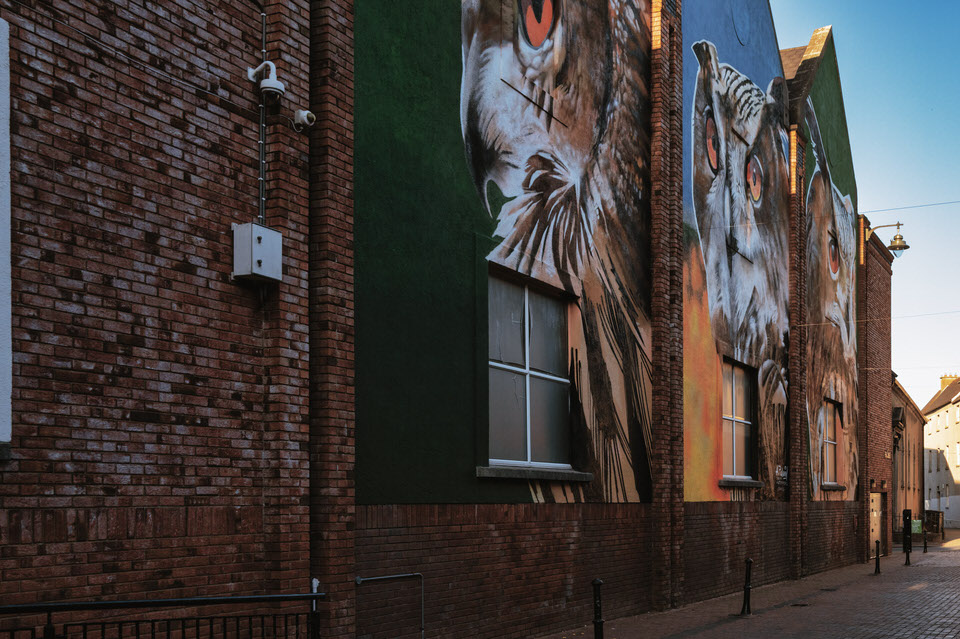
I really enjoyed my visit to Waterford but in my opinion this year there was something different about the Waterford Walls festival in that it lacked the "buzz" that it once had to the extent that I began to wonder if management had changed. For example the staff at my hotel were unaware that the festival was ongoing event even though they were aware that it is an annual event

While the festival hasn't vanished—the 2026 edition runs from August 7 to 16—the structure, atmosphere, and local visibility of Waterford Walls have shifted noticeably over recent years.

  1. Shift from Grassroots to Corporate Agency
  • In its early years, Waterford Walls operated as a tight-knit, community-driven local initiative led by founder Edel Byrne (Partington).

  • Over time, it formalised into The Walls Project CLG, a registered non-profit placemaking agency. Today, executive direction is handled by John O'Connell alongside a formal management team. Because The Walls Project now manages large-scale year-round projects nationwide (such as Dublin Walls and national public commissions), the organisation’s bandwidth and focus are split across a much broader scope than just the August festival in Waterford.

  1. Dispersed Footprint vs. Centralised "Hub"
  • In earlier editions, much of the action was concentrated in tight urban clusters in the city centre, creating a visible, tangible buzz where artists, spectators, and locals constantly crossed paths.

  • In recent years, the festival expanded its physical footprint across a wider regional perimeter (including outer suburban walls and surrounding areas). While this spreads art into more neighbourhoods, it dilutes the central "festival hub" feel in the core city streets.

  1. Digital-First Marketing & Local Disconnect
  • The promotion strategy has increasingly moved toward digital maps, artist social media channels, and national tourism campaigns (such as Discover Ireland).

  • A unintended side-effect of this shift is a reduced physical presence in local commerce. Without heavy printed signage, central information kiosks, or traditional local PR bursts, key front-line hospitality workers—like hotel front desks or shopkeepers—are frequently out of the loop regarding daily schedules or artist locations.


International Artists

Zabou (France)

  • Style & Career: Based in London, Zabou is internationally renowned for her striking, high-contrast figurative realism. She uses spray paint to blend portraits of real, expressive humans with bold color fields and graphic components.
  • Key Visuals: Highly detailed portraits featuring dramatic side-lighting and emotional intensity.

VILE (Portugal)

  • Style & Career: Rodrigo Miguel (VILE) is famous for his mind-bending 3D transparent/cut-out graffiti technique. Using precise shading, stencil work, and perspective tricks, he renders his name as if it were carved directly through solid concrete walls, revealing the empty background space behind them.

TELMO MIEL (Netherlands)

  • Style & Career: The artistic duo Telmo Pieper and Miel Krutzmann are globally celebrated for their large-scale surrealist photo-realism. They fuse layered imagery, overlapping human forms, and dreamlike elements into a single cohesive piece.

MR CENZ (UK)

  • Style & Career: A staple of the London street scene since 1988, Mr Cenz creates distinctive futuristic female portraits. His signature aesthetic blends classic graffiti lettering, photorealistic faces, neon hues, and abstract translucent flow-lines.

MR.DHEO (Portugal)

  • Style & Career: Self-taught artist known for hyper-realistic narrative portraiture. His work often tackles political commentary, pop culture, and social critique with crisp lines and dramatic contrasts.

Fintan Magee (Australia)

  • Style & Career: Frequently referred to as "the Australian Banksy," Magee is a world-class muralist whose work explores social issues, climate change, migration, and the working class.
  • Key Visuals: Large, painterly figures rendered with soft light, atmospheric texture, and water reflections.

Dan Kitchener / DANK (UK)

  • Style & Career: DANK is legendary for his atmospheric cinematic street scenes, particularly rainy, neon-soaked nightscapes of Tokyo, Hong Kong, and London.
  • Key Visuals: Wet pavement reflections, glowing light blurs, and dramatic rain effects rendered with incredible speed using spray paint.

L7MATRIX (France/Brazil)

  • Style & Career: Known for combining raw graffiti lettering with fine-art realism. His most famous subjects are hyper-vibrant, exploding birds and animals that seem to dissolve into dynamic splatters, lines, and movement.

Fio Silva (Argentina)

  • Style & Career: Dynamic, organic murals featuring wild birds, flora, and fauna. Her style relies on heavy black line work, bold color blocking, and sweeping lines that flow along the architecture of the wall.

DAN FERRER (Spain)

  • Style & Career: Ferrer’s work blends figurative realism with allegory and childhood symbolism. He often depicts larger-than-life children breaking through limitations or exploring dream worlds.

CONSE (Spain)

  • Style & Career: Master of hyper-realism and portraiture. He focuses heavily on capturing subtle skin textures, deep expressions, and intimate human moments on massive scales.

SPEKER (Italy) & SILYME (Italy)

  • Style & Career: Traditional graffiti writers turned muralists who specialize in technical wildstyle lettering, sharp geometric angles, dynamic color gradients, and complex letter construction.

NOL (Netherlands)

  • Style & Career: Distinctive for his whimsical, retro-cartoon character designs. NOL uses bold black outlines, playful narrative themes, and bright primary colors.

ADOR (France)

  • Style & Career: Illustrative, satirical, and story-driven. ADOR creates imaginary worlds populated by quirky, long-nosed humanoid characters engaged in chaotic or humorous scenarios.

KMG (Scotland)

  • Style & Career: Illustrative street artist known for her cheeky, humorous, and bold character-based work that frequently pokes fun at modern society and pop culture.

WRN (Brazil) & MARIE (Brazil)

  • Style & Career: Bringing South American tropical street aesthetics, rich patterns, and vibrant color palettes rooted in Brazilian urban culture.

Irish & Northern Irish Artists

DAN LEO (Ireland)

  • Style & Career: One of Ireland's most recognizable street artists. Dan Leo's work is characterized by heavy black outlines, sharp geometric partitioning, and vibrant graphic depictions of animals and wildlife.

ROB HILKEN (Northern Ireland)

  • Style & Career: Belfast-based artist and curator whose work focuses on geometric abstraction, color field theory, and structural symmetry that interacts with urban architecture.

SHANE HA (Ireland)

  • Style & Career: Galway-born visual artist (often signing as Torc_art) whose style blends illustrative geometry, Celtic knotwork elements, and modern pop-surrealist characters.

RASK (Ireland)

  • Style & Career: A veteran of the Irish graffiti scene, Rask is renowned for his technical prowess in classic lettering, complex wildstyle, and large-scale collaborative pieces.

SOAK (Ireland)

  • Style & Career: Longstanding Irish writer and muralist known for versatile lettering, character design, and heavy involvement in the grassroots national graffiti scene.

STAYLO (Ireland)

  • Style & Career: Focuses on contemporary lettering, bold color choices, and clean vector-like spray execution across urban landscapes.

MUL (UK/Ireland)

  • Style & Career: Known for the ubiquitous "Heart" and continuous-line characters, MUL focuses on rapid, high-impact graphic iconography that interacts playfully with urban infrastructure.

OMIM (Ireland), NOVICE (Ireland), RO (Ireland), NIALLOL (Ireland), LAIDBACK (Ireland)

  • Style & Career: Core contributors to the evolving Irish street art circuit. Their styles range from raw freehand graffiti and calligraffiti to contemporary character-driven compositions.

EMBER (Ireland), KONE (Ireland), KAROL (Ireland), HMC (Ireland), ANDYMC (Ireland)

  • Style & Career: Represents a mix of established writers and emerging Irish crews. Expect high-energy lettering, sharp fill-ins, and complex color schemes designed to pop against weather-worn stone and concrete.

Ailbhe Larsen (Ireland)

  • Style & Career: Illustrative artist whose work leans toward fine-art storytelling, fine linework, and soft, organic motifs that contrast sharply with raw urban brickwork.

Photographic Field Strategy

  • Hyper-Realism & Portraits (Zabou, Conse, Mr.Dheo, Fintan Magee): Photograph these with a mid-to-telephoto focal length (50mm–85mm) to avoid field distortion and preserve exact facial proportions.
  • 3D Illusion & Perspective Works (VILE, Telmo Miel): Stand directly at the artist's intended "vanishing point" (usually offset slightly from center) to capture the intended optical depth effect.
  • Wide Architectural Gables (Dan Kitchener, Fio Silva): High-resolution wide-angle lenses (15mm–24mm) are essential in Waterford's tighter medieval laneways to capture the full scope of multi-story gable end pieces without perspective clipping.

Railway Stations

* Clontarf Railway Station * Docklands Railway Station * Malahide Railway Station


Examples Of Waterford Walls Murals


Why Was I Using A NEX-7 In May 2016


I was a bit surprised when I realised that I used a Sony NEX-7 in May 2015 but when I checked my catalogs I discovered that the A7RII arrived late in 2015 and the 90mm F2.8 Macro lens at Christmas. I continued to use the NEX-7 for about a year as and easy to carry backup camera.

When the Sony NEX-7 debuted in late 2011, it didn't just iterate on compact mirrorless cameras—it completely redefined what serious photographers expected from a small body. Coming out of an era defined by bulky DSLRs, the NEX-7 proved that shrinking the physical footprint did not mean sacrificing control, resolution, or handling.

The Rangefinder Ergonomics & Built-In OLED EVF

Earlier compact mirrorless options (including the NEX-5) felt like upgraded point-and-shoots with touchscreen menus and optional clip-on viewfinders. The NEX-7 changed that completely by embedding a brilliant 2.36-million-dot OLED Electronic Viewfinder (EVF) directly into the top-left corner of a solid, magnesium-alloy rangefinder-style body. This gave photographers eye-level framing without forcing an awkward top attachment, making manual focusing with focus peaking seamless and intuitive.

The Legendary Tri-Navi Control System

  • The defining operational triumph of the NEX-7 was its Tri-Navi interface. Featuring two twin twin-dial thumb rollers on the top plate alongside a rear control wheel, it offered three simultaneous parameter adjustments without ever taking your eye away from the EVF:

  • Direct Tactile Access: Instantly adjust Aperture, Shutter Speed, and ISO (or exposure compensation) on the fly.

  • No Menu Diving: Solved the primary complaint of early mirrorless platforms by putting manual shooting mechanics directly under your thumbs.

  • Ultra-Fast Shutter Lag: Delivered a rapid 0.02-second shutter release lag—at the time, the world's fastest.

Class-Leading 24.3 MP APS-C Sensor

  • At its launch, its 24.3-megapixel Exmor APS-C sensor delivered resolution and dynamic range that directly rivaled—and often surpassed—mid-to-high-end full-frame and APS-C DSLRs of the time. It captured rich fine detail, provided immense cropping flexibility, and proved that a tiny body could handle demanding archive work.

The E-Mount Bridge & VG10E Ecosystem

  • The NEX-7 served as the key bridge to professional mirrorless adoption. Paired alongside video-focused hardware like the NEX-VG10E—which introduced the large APS-C sensor and interchangeable E-mount optics into a dedicated video camcorder form factor—Sony established a unified lens ecosystem.

By combining DSLR-grade image quality, rangefinder handling, manual tactile control, and high adaptability for adapted glass, the NEX-7 laid the foundational architecture that eventually evolved into the high-resolution A7R series and flagship A1 bodies.

GLOBAL INDEX OF PHOTO GALLERIES
THE URBAN CARTOGRAPHER
HENRY MOORE SCULPTURE AT TRINITY
LET MISTER SCREEN DIRECT YOU
HIGH RESOLUTION PHOTOGRAPHS PLUS MAP
PARKS AND GARDENS
CORK CITY AND COUNTY