GOING FORWARD PHOTONIQUE WILL BE ADVERTISMENT FREE
GOING FORWARD PHOTONIQUE WILL BE ADVERTISMENT FREE
Originally Photographed July 2025
I USED A SONY A7RV WHICH I HAD ON LOAN MY MY DEALER
The Urban Cartographer Presents:
Photographed By William Murphy Using A Fujifilm GFX100RF
In July 2025, I was still awaiting delivery of my Sony Alpha 1 II. Having placed the order prior to Christmas 2024, the prolonged delay prompted my dealer to arrange the loan of a Sony α7R V for an upcoming documentary trip to Limerick. In the field, the α7R V's resolution and handling thoroughly impressed me—to the extent that I felt it outperformed my Fujifilm GFX100RF. Satisfied with the arrangement, the dealer agreed to let me retain the body permanently on the condition that I committed to an accompanying set of G Master lenses.
In an ironic twist of logistics, I received a text message confirming the arrival of the Alpha 1 II on the very eve of my return journey to Dublin. My camera kit has since evolved further: in June of this year, I acquired the Sony α7R VI, and in several key respects, its operational capabilities and imaging performance have outpaced even the flagship Alpha 1 II.
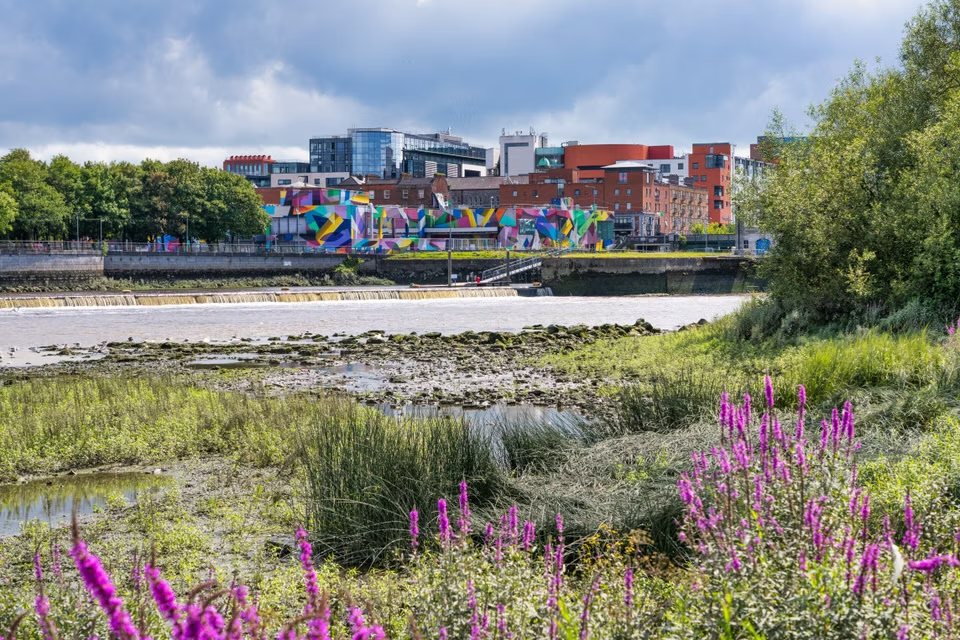
The massive mural covering the former Dunnes Stores building on Honan’s Quay and Sarsfield Street represents one of the most visible modern urban interventions in Limerick. Once an austere, vacant retail complex overlooking the River Shannon, the site was acquired by the University of Limerick (UL) to establish a flagship City Centre Campus. Before any physical architectural redevelopment began, UL and local stakeholders commissioned a sweeping piece of street art to cloak its Brutalist brick façade.
The landmark mural was produced in autumn 2022 by internationally celebrated Spanish urban artist Digo Diego, working in direct collaboration with Draw Out – Urban Exhibitionists, Limerick’s premier urban art initiative led by creative director Catherine O’Halloran.
Diego’s aesthetic is rooted in environmental geometry and abstract storytelling. The mural uses sweeping curvilinear forms, sharp geometric intersections, and a palette spanning deep river blues, magenta, yellow, and pastel tones. Conceptually, the work was designed to dialogue directly with its immediate natural setting:
The River Shannon: Fluid ribbons of blue and turquoise evoke the tidal rhythms of the adjacent river. Biodiversity and Growth: Abstract leaf and petal contours symbolise ecological renewal and sustainable urban development. Urban Expansion: In late 2023, the project expanded downward into Limerick’s first major ground mural, flowing off the wall onto the tarmac of Honan’s Quay to pedestrianise and animate the public realm.
For the University of Limerick, the mural served as a visual stake in the ground. Historically insulated within its suburban campus in Plassey (Castletroy), UL faced frequent civic calls to integrate itself into the urban core of Limerick.
Purchasing the 1970s former Dunnes Stores site for over €8 million in 2019 was hailed as a transformational step to bring thousands of students and staff directly into the city centre. Commissioning Digo Diego and Draw Out was intended to signal an immediate, creative institutional presence while long-term master planning and capital fundraising were underway. Former UL leadership framed it as an act of civic dialogue—an outward-facing gesture showing that the university was committed to revitalising neglected public spaces.
Public reception in Limerick was sharply divided along artistic and political lines:
Praise for Urban Animation: Culturally, the mural was widely lauded. The sheer scale and saturated colours lifted a drab, grey waterfront corner. Together with the riverside boardwalk and temporary summer activations, it turned Honan’s Quay into a popular photographic stop and boosted Limerick’s burgeoning reputation for world-class street art.
Scepticism Over Dereliction: Conversely, many residents and local commentators voiced fatigue. The site had lain empty since Dunnes Stores departed in 2008. To some, painting a disused shopping centre felt like superficial cosmetic dressing—"sticking a plaster on urban decay"—while the city waited years for tangible educational or commercial footfall.
Governance Scrutiny: Public sentiment was further complicated by high-profile governance controversies surrounding UL’s real-estate acquisitions, including debates over the site's valuation and the sluggish timeline for structural redevelopment.
The honest assessment is that the Honan's Quay mural is both.
As a statement, it established art as a tool of place-making rather than simple decoration. It declared that civic institutions should treat the Shannon riverfront with vitality, breaking away from decades of turned-back architectural neglect. It also validated street art as an integral part of Limerick’s cultural identity.
As a distraction, it inherently functioned as visual camouflage. Massive, colourful murals on derelict buildings often risk softening the urgency of structural urban renewal. While it brightened the quay, paint could not substitute for lecture halls, community hubs, or retail life. Ultimately, the mural serves as a vibrant holding pattern—a striking cultural asset that reflects civic ambition, but one that continuously reminds passersby of the unfinished transformation behind the wall.
The building commonly known as the Shannon Boat Club is the historic clubhouse of the Shannon Rowing Club, one of the most distinctive and photogenic architectural features along the River Shannon in Limerick. Perched directly on a limestone pier—often referred to as Shannon Island or Wesley Pier—adjacent to Sarsfield Bridge, it commands an extraordinary position in the river's central sweep, framed against King John's Castle upstream and the tidal estuary below.
Arts and Crafts Heritage: Completed around 1905, the clubhouse was designed by English architect William Clifford Smith, who won an architectural competition for the commission in 1902. Smith subsequently settled in Limerick, where his work helped popularise the Edwardian Arts and Crafts and "freestyle" domestic architecture throughout the city’s residential avenues.
Textural Contrast: The building is a two-storey over basement structure featuring a combination of rock-faced limestone masonry, smooth render/pebbledash, and red-brick detailing. The hipped slate roof with intersecting gables, prominent chimneys, and varied timber-mullioned fenestration give it a domestic, picturesque silhouette set starkly against the broad water. Civic Protection: It is widely noted as one of the few protected, listed sports clubhouses in Ireland, retaining its bridged limestone platform connecting directly to Sarsfield Bridge and its lower river-level timber slipway.
Founding: The club itself dates back to the 1860s, founded under the patronage of Sir Peter Tait—the entrepreneurial mayor of Limerick who modernised military uniform manufacture in the city. Riverside Focus: For much of the 19th and early 20th centuries, Limerick’s urban core turned its back on the river, using it primarily for commerce and industry rather than amenity. The Shannon Rowing Club was an early exception, deliberately orienting its elevations and balconies toward the water and establishing the riverfront as a social and recreational setting.
Because the clubhouse sits out in the water rather than along the street wall, it acts as an anchor in wide river panoramas. Whether shot from Honan’s Quay, Arthur’s Quay, or Clancy’s Strand on the northern bank, its warm brick, masonry texture, and nautical profile create depth against the flat expanse of the Shannon and the heavier, grey limestone of Sarsfield Bridge and the Curragower Falls.
The Limerick Boat Club is a different club and building, though the two are intimately linked by location and history.
The building across the bridge is the clubhouse of Limerick Boat Club (often distinguished locally from Shannon Rowing Club).
The Location and Layout
Sarsfield Bridge (originally Wellesley Bridge) uniquely accommodates two separate, rival rowing clubhouses built onto its piers:
Shannon Rowing Club sits on the upstream (north-east/King John's Castle) side of the bridge platform. Limerick Boat Club sits directly opposite on the downstream (south-west/estuary) side.
The Storm and Roof Damage
Founded in 1870, Limerick Boat Club is actually the second-oldest sporting club in Limerick. For decades, a fierce sporting and social rivalry existed across the deck of Sarsfield Bridge between Limerick Boat Club and Shannon Rowing Club (founded in the 1860s).
Following the destruction in Storm Darwin, the building was left open to the elements for several years, becoming a notable dereliction issue on the bridge until funds and heritage permissions were secured to reroof and structurally stabilise the boathouse.
Draw Out – Urban Exhibitionists
Dolores O’Riordan by Aches (Castle Street)
Located directly opposite King John's Castle in the historic medieval quarter, this mural honours The Cranberries’ late frontwoman, Dolores O'Riordan. Painted by Dublin-based urban artist Aches, the piece was commissioned under the Celebrating Women in Limerick’s History strand.
Style & Technique: Aches executed the portrait using his signature RGB additive-colour separation technique, creating a lenticular, vibrating chromatic effect when viewed from street level. Significance: Unveiled to mark what would have been the singer’s 48th birthday, it remains one of the most photographed public memorials in the mid-west region.
"The Fishermen" by Fintan Magee (Roches Street)
Dodo Reddan by Draw Out & Local Artists (Sráid an Cheoil / St. John's Pavilion)
"Sionna" by Bold Detail (Bridge Street)
"Eye Scream" by Smug (Glaswegian artist): One of Draw Out’s earliest landmark commissions from 2014, showcasing hyper-realistic spray-can rendering and helping establish Limerick’s profile on the international mural circuit.
Maser’s Petrol Station Intervention: Irish contemporary artist Maser transformed an abandoned, derelict filling station on Anderson’s Quay into a geometric optical installation, turning an eyesore into an early template for Limerick's urban placemaking.
"Strength in Fragility" by Emic: Belfast street artist Emic contributed a striking portrait reflecting community solidarity and resilience during the pandemic, using his characteristic spray-dust stencilling and geometric fractures. Limerick Boxes Project: Beyond large-scale wall murals, Draw Out has systematically turned dozens of utilitarian ESB and traffic control boxes across the city centre into miniature illustrative showcases, enlisting local illustrators and graphic designers.