GOING FORWARD PHOTONIQUE WILL BE ADVERTISMENT FREE
GOING FORWARD PHOTONIQUE WILL BE ADVERTISMENT FREE
Originally Photographed August 2026
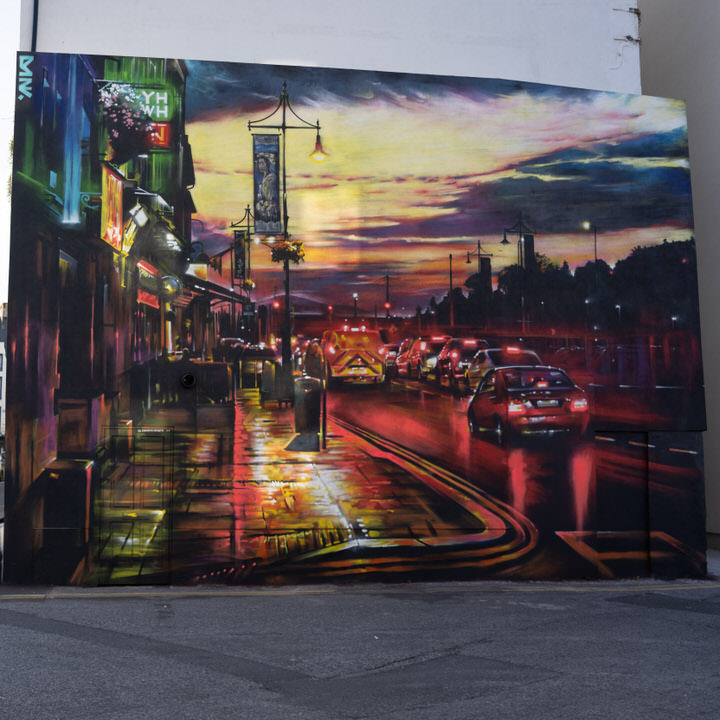
THIS WAS DIFFICULT TO PHOTOGRAPH
* In The Year 2008 * In The Year 2011 * In The Year 2017 * Henrietta Back In 2010
This was difficult to photograph because of traffic and the cherry picker blocking my view and I visited the area about five times and used a Leica Q3 and a Sony A7RVI with three different lenses and as soon as I got a clear view my last battery was exhausted.
A casual query to a passer-by about the subject of this vibrant mural quickly turned into a prolonged, hour-long monologue on the trials of modern life and the perceived shortcomings of public art. Yet, the scene on the wall could hardly be more recognisable: it is a striking, rain-slicked study of Waterford's own Quays at dusk, illuminated in a blaze of amber, neon, and ruby light looking along the river corridor towards the iconic Thomas Francis Meagher Bridge spanning the Suir.
Rose Lane & Its Historic Setting
Rose Lane sits within the historic core of Waterford, threading back from the broad sweep of the North Wharf and the city's ancient quays. For centuries, the quayside formed the beating heart of Waterford's maritime trade, receiving ships laden with wine, timber, provisions, and dry goods. The narrow laneways flanking the waterfront, like Rose Lane, served as vital arteries connecting merchant storehouses, domestic tenements, and trade yards to the riverbank. Today, these historic passages provide an atmospheric canvas where ancient stone footprints meet dynamic, large-scale contemporary street art.
Dan Kitchener—often signing simply as DANK—is a renowned British urban artist, illustrator, and painter whose distinct visual language is celebrated across the globe. Known internationally for his cinematic "liquid lights" and Tokyo-inspired rainy nightscapes, Kitchener blends impressionistic brushwork with precise spray techniques. His works capture the kinetic energy of urban transit, masterfully rendering light diffusions through raindrops, reflections on wet asphalt, and the warm glow of vehicle tail-lights and illuminated shopfronts.
Connection to Waterford Walls
Kitchener has been a cherished, recurring contributor to the Waterford Walls International Street Art Festival. Over multiple editions of the festival, his monumental murals have transformed plain gable walls across the city into cinematic visual journeys. While celebrated worldwide for his neon-drenched East Asian metropolitan scenes, his pieces for Waterford often pay direct homage to the host city itself—capturing local urban landscapes and familiar quayside vistas through his signature, atmospheric lens.
Location: Vulcan Street (just off O'Connell Street, Waterford
There is a much repeated story that the artist had difficulty completing because of constant rain
The story likely conflates two distinct elements: the notorious weather during the 2018 festival and the backstory of the scene depicted in the mural itself.
Festival Weather in 2018: The 2018 edition of Waterford Walls was plagued by persistent, heavy rain almost every day. Several visiting international artists faced severe disruptions and struggled with wet render and dripping paint, forcing artists and organisers to battle the conditions throughout the event.
The Mural's Three-Day Window: Kitchener spent three dedicated days executing the 35 ft × 20 ft wall. While local weather during the festival week caused havoc across many sites, he was able to take advantage of dry breaks to pack in a remarkably dense level of fine spray detail compared to his rapid single-day pieces.
The Origin of the "Laying in the Rain" Story: The primary anecdote associated with Neon Waves comes from the original photograph Kitchener used for the composition. He spent over a year searching for the right wall to recreate a specific memory from Shinjuku, Tokyo, where he lay directly in a flooded street puddle during a downpour to capture neon light reflecting in the gutter while a passer-by under an umbrella looked down at him.
The persistent downpours during the 2018 festival—paired with Kitchener’s own well-publicised story of lying in the pouring rain in Tokyo to capture the source image—frequently merge into local lore that he battled constant washouts on Vulcan Street.
WHAT WAS REPLACED BY NEON WAVES
Rendered in his signature, high-contrast, luminous style, the monumental portrait depicts a Japanese geisha looking gently towards a glowing, iridescent blue butterfly resting delicately near her fingertips. Her elaborate headdress and kimono are woven with detailed botanical flourishes, including white cherry blossoms, hydrangea blooms, and layered butterflies. The artist's iconic block-letter tag, DANK, is visible in the top left-hand corner, with his social handle @DANKITCHENER stencilled below the subject’s hands.
2023 (The Mary Street Gable Execution): Dan Kitchener painted this towering geisha mural on the previously blank, multistory Mary Street gable as one of the flagship pieces of Waterford Walls 2023. Around the lower perimeter, carpark entrances, and adjacent street elevations, artists including Curtis Hylton contributed organic and botanical elements, creating a continuous visual corridor around the hotel's base.
What Remains Today: Kitchener’s upper gable mural remains fully preserved and unobstructed, serving as a prominent urban landmark visible along the length of Mary Street, while the street-level hoarding and surrounding ground elevations continue to evolve with festival cycles.
Location: Rose Lane, Waterford Description: Departing from his usual East Asian metropolises, this mural directly depicts Waterford's own quayside at dusk. The scene captures evening commuter traffic, wet pavements reflecting shopfront neon, and the Thomas Francis Meagher Bridge silhouetted against a vivid sunset sky.
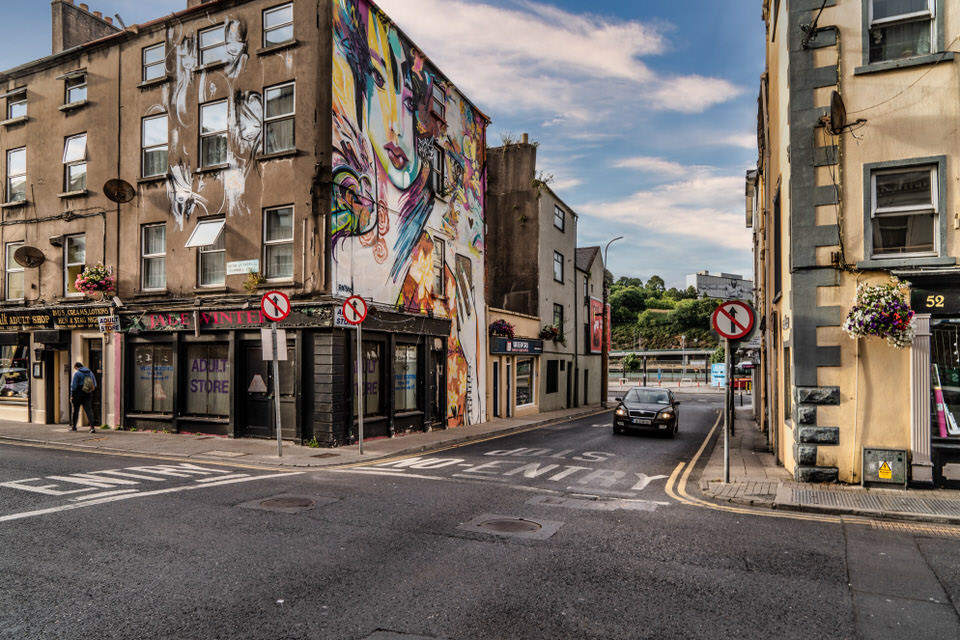
Dan Kitchener Overpainted His 2015 Mural On Vulcan Street In August 2018
Main Mural & Artist
Artist: Dank It / Dan Kitchener (often signing as DANK) painted the vibrant geisha selfie mural during the Waterford Walls street art festival in August 2015. You can spot his signature tag @DANKITW and the Waterford Walls 15 festival marking near the lower-left and bottom right of the piece.
Replacement: Kitchener returned to this exact wall in August 2018 (shortly after I captured these July 2018 shots) during the 2018 edition of Waterford Walls to repaint the site with his updated rainy Japanese street scene, Neon Waves.
Annual Earnings
International street artists and muralists have highly variable annual incomes depending on their career tier and revenue diversity:
Emerging to Mid-Tier Artists: Typically earn between €25,000 and €55,000 per year, largely combining small festival fees, community commissions, private interior jobs, and print sales.
Established Global Muralists: Generally earn between €60,000 and €150,000+ per year. Their income stems primarily from high-end corporate facades, commercial brand partnerships, gallery canvas sales, limited-edition screenprints, and private architectural commissions.
Revenue Breakdown: Pure street art festivals rarely represent the majority of an artist’s income; instead, they serve as high-profile portfolios that attract lucrative commercial and private clients.
Travel & Accommodation Funding
For official festival bookings it is standard industry practice for travel, accommodation, and materials to be covered:
Flights & Transit: Curators typically provide round-trip flights or train travel, along with airport transfers.
Accommodation & Per Diems: Festivals supply local hotel, guest-house, or artist-residency lodging, alongside a daily stipend (per diem) for meals and local expenses.
Production & Materials: The host organisation furnishes access equipment (scissor lifts, cherry pickers, scaffolding), primers, aerosol paint, and rollers.
Artist Fees / Honorariums: Reputable festivals pay an artist honorarium (commonly ranging from €1,000 to €5,000+ per wall, depending on wall square-footage and artist prestige).
In contrast, when artists paint in unsanctioned or fringe spaces like Glass House Lane, work is self-funded—artists use leftover spray cans and personal supplies purely for creative freedom and peer collaboration.
Under Irish tax law, the Artists’ Exemption (governed by Section 195 of the Taxes Consolidation Act 1997) permits individuals to earn up to €50,000 per year exempt from Income Tax on profits generated directly from qualifying original and creative works.
Whether this applies to street artists depends on residency status, how the work is legally defined, and how the artist is contracted and paid.
The €50,000 Cap and Statutory Taxes
Income Tax Only: The exemption applies strictly to Income Tax up to the statutory limit of €50,000 per annum. Any creative earnings exceeding €50,000 in a given tax year are taxed at standard marginal rates.
USC and PRSI Still Apply: Earnings are not exempt from the Universal Social Charge (USC) or Pay Related Social Insurance (PRSI).
Residency Requirement: To qualify for a determination from the Revenue Commissioners, the artist must be tax resident (or ordinarily resident and domiciled) in Ireland, the EU/EEA, or the UK. An international artist visiting temporarily on a tourist visa or short trip cannot claim this relief.
Qualifying vs Non-Qualifying Street Art Work
To qualify under the visual arts category, Revenue requires the piece to be an "original and creative work" that possesses "cultural or artistic merit" within the definition of "paintings or other like pictures".
What Typically Qualifies:
Fine-Art Murals and Public Art Commissions: Large-scale original installations and curated festival walls where the artist retains creative freedom and conceptual authorship.
Limited-Edition Fine Art Prints: Signed and numbered print editions (strictly capped at 200 copies) derived from street murals or original artwork.
Studio Canvases and Original Works: Physical paintings and studio pieces sold via private collectors, exhibitions, or gallery representation.
Arts Council Grants and Direct Bursaries: Public funding and stipends awarded specifically to facilitate the production of an original creative work.
What Does Not Qualify:
Commercial Branding and Advertising: Murals commissioned to promote a corporate brand, commercial product, storefront signage, or marketing campaign.
Signwriting and Utilitarian Painting: Decorative, trade-based, or functional exterior painting where the primary purpose is civic maintenance or commercial shopfitting.
Hourly Labour or Tradesperson Rates: Standard day-rate services where an artist works under direction without copyright retention or creative autonomy.
Commercial Merchandise: Mass-produced apparel, stickers, postcards, non-limited posters, or commercial licensing fees.
The Determination Process and Practical Realities
Formal Revenue Approval Required: Revenue does not grant automatic tax-exempt status. An artist must submit an application form along with a portfolio, evidence of public exhibition, and testimonials to secure a formal determination for their work.
Scrutiny on Urban Murals: Outdoor public art and utility-box projects are assessed carefully. Projects classified as purely decorative, functional, or community-maintenance tasks can be refused if they fail to meet the threshold of standalone artistic or cultural merit.
Payment and Invoicing: The exemption applies only to income received by an individual sole trader directly from the qualifying work. It does not apply to fees billed through a limited company or intermediary production agency.
Zabou (France)
VILE (Portugal)
TELMO MIEL (Netherlands)
MR CENZ (UK)
MR.DHEO (Portugal)
Fintan Magee (Australia)
Dan Kitchener / DANK (UK)
L7MATRIX (France/Brazil)
Fio Silva (Argentina)
DAN FERRER (Spain)
CONSE (Spain)
SPEKER (Italy) & SILYME (Italy)
NOL (Netherlands)
ADOR (France)
KMG (Scotland)
WRN (Brazil) & MARIE (Brazil)
DAN LEO (Ireland)
ROB HILKEN (Northern Ireland)
SHANE HA (Ireland)
RASK (Ireland)
SOAK (Ireland)
STAYLO (Ireland)
MUL (UK/Ireland)
OMIM (Ireland), NOVICE (Ireland), RO (Ireland), NIALLOL (Ireland), LAIDBACK (Ireland)
EMBER (Ireland), KONE (Ireland), KAROL (Ireland), HMC (Ireland), ANDYMC (Ireland)
Ailbhe Larsen (Ireland)
* Clontarf Railway Station * Docklands Railway Station * Malahide Railway Station
Ballybeg Park
Mount Sion Avenue
Stephen Street
Thomas Street
O'Connell Street
Parnell Street
The Forum Hub
Multi-Site & Citywide Installations
O'Connell Cultural Quarter (O'Connell St / George's St / Gladstone St)
The Glen / Ballybricken
The Apple Market / Railway Square
Millers Marsh / Waterside
New Street / Apple Market
O'Connell Street & Cultural Quarter
Stephen Street / Mayor's Walk
The Mall / Waterfront
The Glen & Green Street
Ballybricken
Barrack Street / Mount Sion
City Centre & Quays