GOING FORWARD PHOTONIQUE WILL BE ADVERTISMENT FREE
GOING FORWARD PHOTONIQUE WILL BE ADVERTISMENT FREE
Originally Photographed 4 July 2026
THIS IS A LITTLE KNOWN RESOURCE
* In The Year 2008 * In The Year 2011 * In The Year 2017 * Henrietta Back In 2010
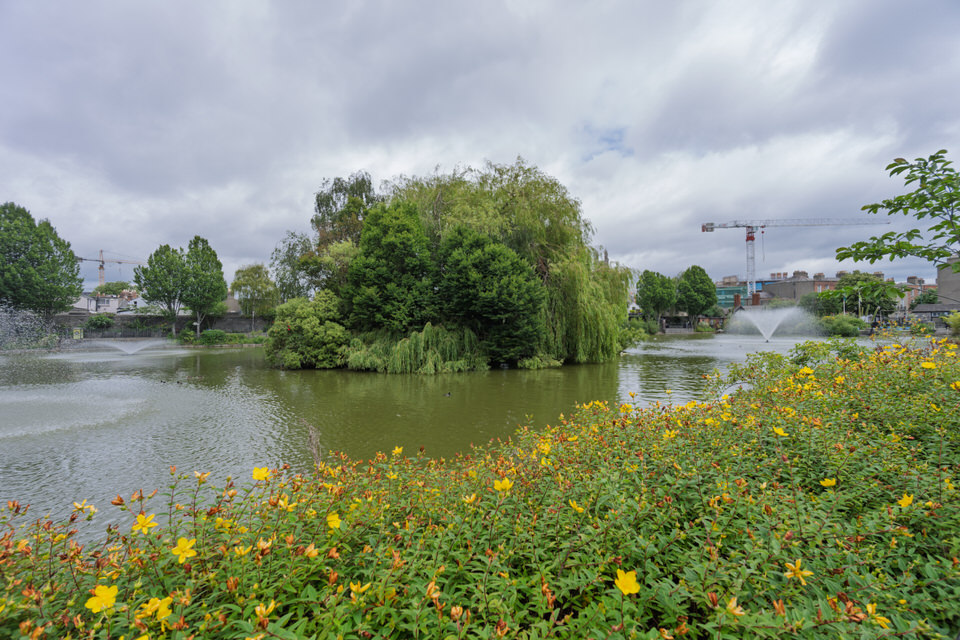
Tucked away at the end of a residential street in Phibsborough, Dublin 7, lies the Blessington Street Basin (commonly known to Dubliners simply as "the Basin"). Dubbed the city's "secret garden," this walled urban oasis has transitioned from a vital piece of 19th-century industrial infrastructure into one of the capital's most tranquil public parks.
History of the Basin
The Blessington Street Basin was originally constructed by the Dublin Corporation between 1803 and 1810 to serve as a drinking water reservoir for the rapidly expanding Northside of the city.
The Royal Connection: Opened officially as the Royal George Reservoir in honour of King George III, the name was largely ignored by locals who preferred "the Basin". The Engineering: It holds roughly 15 million litres (4 million gallons) of water. The supply was fed from Lough Owel in County Westmeath via a branch line of the Royal Canal, running through a two-mile pipe into the site.
The Whiskey Era: By the late 1860s, the domestic water needs of the city outgrew the Basin, and the cleaner Vartry Reservoir system in County Wicklow took over. However, the Basin found a second purpose: supplying water exclusively to the iconic Jameson Distillery (Bow Street) and Powers Distillery (John’s Lane) until the mid-1970s.
Current Status
After the distilleries stopped using the water in the 1970s, the site fell into severe neglect and stagnation. However, a massive refurbishment by Dublin City Council in 1993–1994 completely rejuvenated the area.
Today, the Basin is a beautifully preserved, high-walled public park. The deep rectangular reservoir covers about 80% of the site and features a linear series of fountains to oxygenate the water, running alongside an artificial wooded island that serves as a protected sanctuary for wild fowl (including swans, tufted ducks, and mallards). A picturesque 5-metre-wide perimeter pathway, bordered by historic calp limestone walls, mature trees, and a beautifully restored 1811 Tudor-style gate lodge, makes it a popular sanctuary for locals.
The Connection to Iris Murdoch
While exploring the perimeter, you will encounter a commemorative plaque dedicated to one of the 20th century's most brilliant literary and philosophical minds: Dame Iris Murdoch.
Murdoch was born just outside the park gates at 59 Blessington Street on 15 July 1919. Though her family moved to London when she was a baby, she remained fiercely proud of her Irish roots throughout her life, famously noting, "I'm profoundly Irish and I've been conscious of this all my life."
Life and Cultural Importance
Iris Murdoch was a towering figure in post-war British and Irish culture, breaking barriers as both a vanguard academic philosopher and a wildly successful novelist.
The Oxford Quartet: Alongside contemporaries like Elizabeth Anscombe and Philippa Foot, Murdoch belonged to a remarkable wartime cohort of female philosophers at Oxford who challenged the dominant, sterile Western views of human nature, advocating instead for an ethics centred on love, virtue, and looking at reality without the bias of the "fat relentless ego."
Literary Titan: She wrote 26 novels, renowned for their intricate psychological plots, dark humour, and intense moral dilemmas. Her mastery of the form earned her six Booker Prize nominations, winning it in 1978 for The Sea, the Sea.
Her Legacy: Murdoch's later life became a poignant public touchstone for Alzheimer's awareness. Her battle with the disease was chronicled by her husband, John Bayley, in memoirs that were later adapted into the Oscar-winning 2001 biographical film Iris. The plaque near her birthplace honours her enduring intellectual rigour, her contribution to late 20th-century literature, and her philosophical exploration of goodness.
Rediscovering the Manual Prime: Voigtländer’s Heritage and the 15mm f/4.5 Super Wide Heliar III
There is a distinct phase in every photographer’s journey where the allure of lightning-fast autofocus and corporate lens ecosystems dominates the kit bag. For years, my native Sony G and GM lenses, alongside a full suite of Zeiss Batis primes, filled that role perfectly. But a funny thing happens when you pair classic manual glass with high-resolution sensors.
Reviewing older manual lenses on a high-resolving sensor is an eye-opening experience. Lenses that once seemed frustrating or underwhelming on older bodies are suddenly showing their true capabilities. The Voigtländer primes—specifically the 15mm, 40mm, and 65mm—are not just holding their own; they are outperforming some of my favourite AF glass, demonstrating an organic micro-contrast and edge-to-edge rendering that is hard to match.
With a photography trip to Belfast on the horizon, the Voigtländer 15mm f/4.5 Super Wide Heliar III E-mount has officially earned its place in my travel kit. Here is why this classic focal length deserves a spot on modern high-resolution mirrorless bodies.
A Brief History: From Vienna to Nagano
The Voigtländer name carries massive historical weight, being one of the oldest names in optics. Founded by Johann Christoph Voigtländer in Vienna in 1756, the company initially produced precision mechanical instruments before creating the world’s first mathematically calculated photographic lens (designed by Josef Petzval) in 1840.
[1756: Founded in Vienna]
[1840: First Petzval Portrait Lens]
[1999: Cosina Revitalisation in Japan]
While the name evokes classic European optical heritage, modern Voigtländer lenses are purely Japanese precision instruments. In 1999, the German brand was effectively revitalised when the rights were acquired by Cosina, a highly respected optical manufacturer based in Nagano, Japan. Cosina preserved the classic naming conventions—like Heliar, Skopar, and Nokton—but combined them with state-of-the-art Japanese glass manufacturing, tight manufacturing tolerances, and native electronic integrations.
Technical Review: Voigtländer 15mm f/4.5 Super Wide Heliar III (E-Mount)
Build and Handling
Optical Performance
Sharpness: In the center, sharpness is outstanding from wide open at f/4.5. On demanding modern sensors, mid-frame details hold up remarkably well. The extreme corners display minor softness wide open but sharpen up beautifully when stopped down to f/8 or f/11.
Distortion & Sunstars: Straight lines stay impressively straight. For architectural and interior work, the optical distortion is exceptionally low for a 110-degree field of view. Furthermore, the 10-blade straight aperture design produces the signature, razor-sharp 10-pointed "Voigtländer sunstars" that add a beautiful geometric element to points of light.
Flare Resistance: The coating handles direct, harsh sunlight extremely well. Ghosting is minimal, and contrast remains incredibly high even when shooting directly into the sun. Common Criticisms & Forum Feedback
To keep an objective view, a deep dive into user forums (such as Fred Miranda and DPReview) reveals a few consistent notes to keep in mind:
Vignetting: Due to its ultra-compact design, peripheral light fall-off is heavy wide open (sometimes exceeding 2 to 3 stops in the absolute corners). While Lightroom correction profiles fix this easily, lifting the exposure in the corners can introduce noise if you are shooting in low-light environments.
The Fixed Hood Advantage vs. The Batis Ecosystem
nline forums occasionally debate the lens's permanently attached, petal-shaped metal hood—particularly landscape shooters looking to mount large, square filter systems. However, for active street and urban documentation, this fixed design is a massive practical asset.
My personal shooting philosophy is to never use filters or lens covers. It keeps the camera instantly responsive, eliminates unnecessary glass layers, and ensures the unadulterated optical rendering of the prime isn't compromised. Because the front element is completely exposed, a hood must function as a structural shield. This design was proven in the most brutal way during a previous trip to Belfast city centre. A heavy fall resulted in me crashing to the ground directly on top of my Sony body and the 15mm prime. While the fixed metal hood took a distinct dent, it fully absorbed the kinetic energy and completely saved the glass.
Contrast this with the Zeiss Batis line:
Losing two Batis hoods to busy city traffic because they simply won't stay clicked into place is an incredibly frustrating design flaw. That highlights a massive, practical contrast in engineering philosophies between the two brands.
While the Zeiss Batis line delivers lovely optical performance, those smooth, plastic, bayonet-mount hoods rely on a relatively weak friction click. When you are moving dynamically through a city, brushing against a jacket or a camera strap is often all it takes to unintentionally twist the hood right off its mount. If you don't use lens caps, a lost hood leaves the front element completely exposed to the elements and physical impacts with absolutely no buffer.
* Clontarf Railway Station * Docklands Railway Station * Malahide Railway Station