GOING FORWARD PHOTONIQUE WILL BE ADVERTISMENT FREE
GOING FORWARD PHOTONIQUE WILL BE ADVERTISMENT FREE
Originally Photographed July 2018
I USED A SONY A7RII IN JULY 2018
In 2017, Waterford Walls was still only an emerging blip on my radar. It was not until my return in July 2018 that I appreciated its true scale: a vibrant, recurring summer festival with immense creative ambition. Having arrived a month ahead of the August 2018 programme, I missed the live painting that summer, but the visit cemented a long-standing routine: making an annual pilgrimage to Waterford every August or September.
St John’s Presbytery
The architectural anchor of the street is an austere, imposing 18th-century residence known locally as St John’s Presbytery (or the Parochial House). Constructed around 1765 as an ambitious multi-bay townhouse for a prosperous Waterford merchant family, it reflects the zenith of the city’s Georgian maritime trade. In later years, it passed into ecclesiastical hands, housing clergy from St John’s Parish for generations.
Local lore often attributes the site to the legend of "two charitable sisters," who were reputed to have bequeathed the house, its grounds, or the adjacent vacant plot to the community. While evocative, this folklore weaves together real, entangled historical threads. This quarter was steeped in 18th- and 19th-century religious charity: Blessed Edmund Rice famously opened his first rudimentary classroom inside a converted stable on New Street in 1802 alongside the Presentation Sisters, and municipal records document multiple wealthy Catholic benefactresses endowing local almshouses, schools, and orphanages.
Over decades of vacancy, as the presbytery lay quiet and adjacent plots vanished beneath brambles, local memory did what oral tradition so often does: it merged half-remembered historic philanthropy with the sudden arrival of a new, grassroots community project on the exact same ground.
The Reality: Celtic Tiger Relics and "Meanwhile Use"
The true origin of the New Street Community Garden was far more contemporary, bureaucratic, and grounded in the realities of modern urban decay.
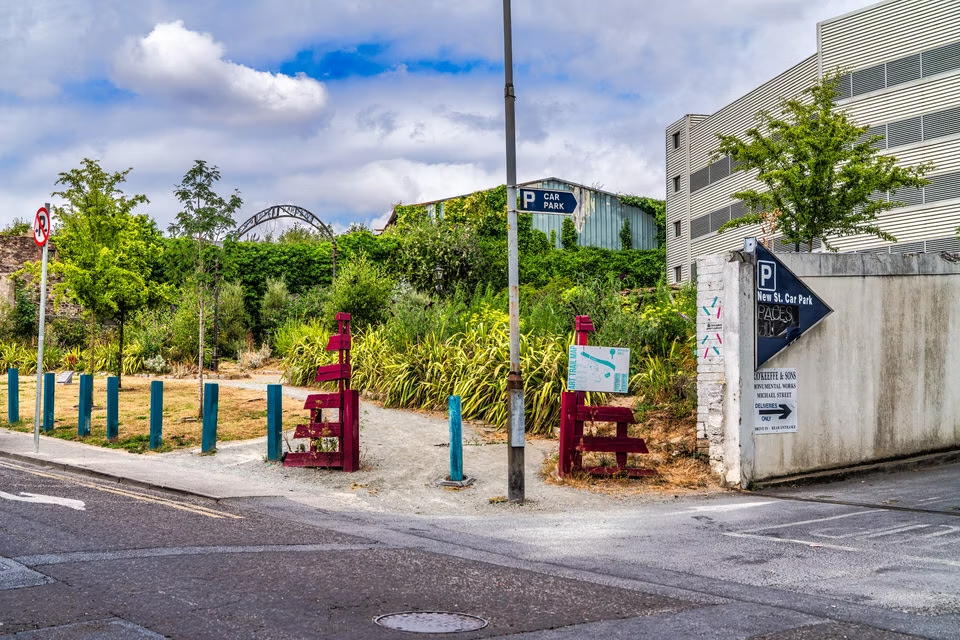
During the mid-2000s Celtic Tiger boom, private speculative developers acquired a terrace of domestic and commercial premises on New Street to assemble a prime inner-city retail site. Following the 2008 financial crash, the project collapsed. The properties sat derelict, succumbed to structural decay, fostered anti-social activity, and were ultimately levelled by the local authority for public safety. The result was neither a pious gift nor a family endowment, but an eyesore: a barren, gravel-strewn brownfield expanse behind corrugated hoardings and boundary walls.
In 2014, local primary school teacher Edel Tobin resolved to reclaim the derelict space. Rather than relying on an ancient land grant, her voluntary team negotiated a temporary "meanwhile-use" lease directly from the commercial receivers holding the distressed assets, supported by Waterford City and County Council.
Constructed through sheer community effort, crowdfunding, and repurposed industrial salvage, the New Street Community Garden took shape with brightly painted shipping pallets, cable-reel tables, raised timber planting beds, and volunteer labour. Crucially, it was the revitalisation of this very site in 2014 that provided the spark and headquarters for Tobin to launch the inaugural Waterford Walls
Key Artists & Mural Locations (Pre-August 2018)
Prior to August 2018 (during the 2015, 2016, and 2017 festival editions), New Street Garden served as the central festival hub and canvas, while nearby streets received major pieces: