GOING FORWARD PHOTONIQUE WILL BE ADVERTISMENT FREE
GOING FORWARD PHOTONIQUE WILL BE ADVERTISMENT FREE
Originally Photographed August 2026
LEICA Q3 AND ZONE FOCUSING
This was an unplanned visit and I had great difficulty photographing some of the items on display as the camera had a fixed lens. However I remembered that in another museum a guide had suggested to me that I should use zone focusing as I had a Leica so that is what I tried and this is discussed in detail below.
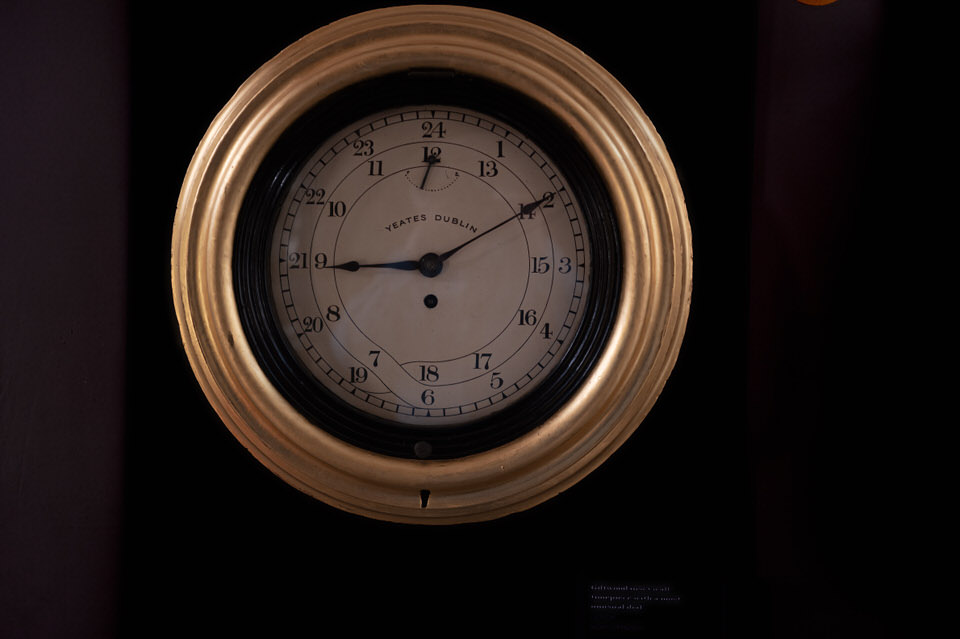
The Irish Museum of Time (Ireland's National Horological Museum) is dedicated to the craft, science, and history of timekeeping. Situated in Waterford—Ireland's oldest city—the museum brings together centuries of domestic and international horological heritage.
Irish Museum of Time in Waterford's Viking Triangle.
The Building: A 19th-Century Neo-Gothic Church
Origins: The main structure was erected in the 1880s as a Methodist Church, constructed in the Neo-Gothic style with pointed-arch windows, cut-stone masonry, and vaulted timber ceilings.
Deconsecration & Reuse: After serving its congregation for decades, the church ceased active religious worship and fell disused.
Restoration: Between 2018 and 2021, Waterford City and County Council, alongside the Waterford Treasures collective, comprehensively restored and refitted the church into a modern museum space while preserving its architectural character.
Expansion (Central Hall): The museum expanded into the adjoining 19th-century Central Hall (a former church and later arts venue) to create additional gallery spaces and an audio-visual theatre.
Inception and Creation of the Museum
The museum was born from the vision of long-standing Irish horologists David Boles, Colman Curran, and Curran's wife Elizabeth Clooney.
The Vision (2013–2015): Realising their irreplaceable personal collections risked dispersal at auction, Curran and Boles sought a permanent national home.
Partnership with Waterford Treasures: In 2015, Curran met Eamonn McEneaney, Director of Waterford Treasures. Alongside Waterford City Council CEO Michael Walsh, the project found its location on Greyfriars Street.
Opening: The Irish Museum of Time officially opened on 14 June 2021.
Funding Model
The museum operates on a public-philanthropic partnership:
Philanthropic Endowment: The core assets were entirely gifted. The initial horological donations by David Boles, Colman Curran, and Elizabeth Clooney were valued at hundreds of thousands of euros. Further benefaction by Boles funded major international acquisitions and the Central Hall gallery fit-out.
Civic and Public Investment: Restoration of the historic buildings, ongoing maintenance, and operations are managed under Waterford Treasures with capital and infrastructure backing from Waterford City & County Council and national heritage development schemes.
Self-Generated Revenue: Admissions through single tickets and the consolidated "Freedom of Waterford" museum pass help sustain ongoing conservational and administrative costs.
International Relevance
The Black Forest Cuckoo Clock Collection: Following the acquisition and restoration of the famous Piekarski collection (formerly of England's Cuckooland Museum), the museum exhibits over 400 19th-century Black Forest cuckoo clocks and automata, representing one of the largest public collections in the world.
Global Comparative Holdings: Alongside Irish makers (such as master craftsmen from Dublin, Cork, and Belfast), the museum displays items from the UK, the US, Switzerland, Austria, France, Germany, the Netherlands, Russia, and Japan, with pieces dating back to 1551.
Local and National Significance
Locally, it is a key anchor of the Waterford Treasures trail (which includes Reginald's Tower, the Medieval Museum, the Bishop's Palace, the Irish Wake Museum, and the Silver Museum). It generates cultural tourism across Ireland's Ancient East, drawing international collectors, historians, and school groups engaged in STEM education through its mechanical exhibits.
Leica Q3 And Zone Focusing* **
Recommended Exposure Settings
Why This Setup Works on the Q3
Freezing Motion at 60MP: High-resolution sensors reveal motion blur far more quickly than lower-resolution bodies. Locking a fast minimum shutter speed ensures your pre-set zone yields crisp, sharp edges when viewing files closely.
Letting Floating Auto ISO Take the Strain: Zone focusing requires fixing your physical aperture (f/5.6–f/8) and locking down shutter speed to prevent motion smear. Auto ISO becomes your variable safety net, adjusting instantly as you walk between bright avenues and shaded side lanes.
Sensor Noise Tolerance: The BSI CMOS sensor delivers clean files at higher sensitivities. Allowing the camera to float up to ISO 6400 in low ambient light is far preferable to widening the aperture (which shrinks your zone) or dragging the shutter (which introduces motion blur).
True Mechanical Manual Focus Ring: Pressing the unlock pin on the lens tab smoothly disengages autofocus into a tactile, mechanical focus ring with hard stops at minimum focus and infinity.
Engraved Depth-of-Field (DoF) Scale: The Summilux 28mm f/1.7 ASPH features clear, high-contrast distance and aperture alignment markings directly on the metal barrel. You can check or adjust your focus zone at a glance without powering on the camera or looking at the EVF/LCD.
Inherently Deep 28mm Field of View: Wide-angle focal lengths naturally yield significantly more depth of field at any given aperture than standard or telephoto lenses. At f/8, a 28mm lens renders almost the entire immediate street environment sharp.
Tactile Focus Tab: The integrated finger tab allows you to know your exact focus distance purely through muscle memory—for example, tab pointing straight down typically aligns close to 1.5–2 meters.
Key Advantages
Zero Shutter Latency: Eliminates AF acquisition time, eye-tracking hesitation, and focus hunting in complex or backlit scenes. The shutter trips the exact millisecond you press the button.
Complete Discretion: Enables accurate shooting from the hip, waist level, or chest height without needing to raise the viewfinder to your eye or tap a touchscreen to acquire focus.
Predictable Decisive Moments: In documentary and street work, you can pre-visualize where an interaction or stride will happen, align your composition, and capture the subject precisely as they cross into your distance envelope.
When and Where to Use It
Fast-Paced Urban Sidewalks: Moving through high-density pedestrian traffic where subjects pass by too quickly for autofocus point selection.
Fleeting Moments & Gestures: Capturing fleeting expressions, quick hand movements, or street interactions where half-pressing to focus causes you to miss the peak action.
Challenging Lighting & High Contrast: Shooting directly into harsh backlight, deep shadows, or nighttime streetscapes where contrast-detect and phase-detect AF points tend to hunt.
Pre-Framed Traps: Composing a shot around a specific backdrop, patch of light, or architectural element and waiting for someone to walk directly through the pre-set focus plane.
Museums dedicated to horology—like the Irish Museum of Time in Waterford—present a classic autofocus trap: highly reflective glass display cabinets, polished brass clock movements, dark lacquered timber cases, and low ambient spotlighting.
In those conditions, modern hybrid autofocus systems often struggle because:
Glass Reflections Confuse Phase/Contrast AF: The sensor frequently locks onto the reflection on the glass surface (or a specular highlight bouncing off a spotlight) rather than the clock face sitting 10 to 30 cm behind it.
Low Contrast on Dial Faces: Subtle, intricate details on antique dials under dim gallery light give AF algorithms very little high-contrast edge data to grab quickly.
Focus Hunting & Latency: In low indoor light, the lens hunts back and forth through its focus range, frustrating handheld framing.
In street photography, zone focusing is usually used at a distance (1.5 m to infinity at f/8). In a museum setting, you adapt the concept to close-range manual pre-focusing:
Pre-set Your Physical Distance:
Decide your comfortable working distance from the vitrine (for example, standing exactly 0.7 m or 1.0 m away).
Unlock the Q3’s focus ring and set the distance marker to match that distance.
Choose the Right Aperture for Depth:
Stop down to f/4 or f/5.6. At a close working distance like 0.7 m on a 28mm lens, f/5.6 gives you a sharp depth of roughly 0.6 m to 0.85 m (~25 cm of total depth). This ensures the clock face, hands, and the movement behind the glass are completely sharp, while ignoring glass reflections.
Use Your Feet to "Micro-Adjust":
Leverage Focus Peaking / Focus Magnification:
Key Advantages in Low-Light Galleries
Completely Bypasses Glass Reflections: The lens focus plane is fixed behind the vitrine glass, ensuring the camera cannot accidentally focus on surface dust, fingerprint smudges, or overhead light glare.
Instant Shutter Release: No focus confirmation delay or hunting in dim gallery corners; the shutter trips the millisecond you find your frame.
Consistent Compositions: Working at a fixed focal distance keeps the perspective and scale of sequential exhibits uniform across a gallery series.
How can I minimize glass reflections and glare when shooting museum display cases handheld?
Circular Polarizer (CPL):
* In The Year 2008 * In The Year 2011 * In The Year 2017 * Henrietta Back In 2010
* Clontarf Railway Station * Docklands Railway Station * Malahide Railway Station
Ballybeg Park
Mount Sion Avenue
Stephen Street
Thomas Street
O'Connell Street
Parnell Street
The Forum Hub
Multi-Site & Citywide Installations
O'Connell Cultural Quarter (O'Connell St / George's St / Gladstone St)
The Glen / Ballybricken
The Apple Market / Railway Square
Millers Marsh / Waterside
New Street / Apple Market
O'Connell Street & Cultural Quarter
Stephen Street / Mayor's Walk
The Mall / Waterfront
The Glen & Green Street
Ballybricken
Barrack Street / Mount Sion
City Centre & Quays