GOING FORWARD PHOTONIQUE WILL BE ADVERTISMENT FREE
GOING FORWARD PHOTONIQUE WILL BE ADVERTISMENT FREE
Originally Photographed July 2025
I WAS DISAPPOINTED BY THE FUJIFILM GFX100EF
The Urban Cartographer Presents:
Photographed By William Murphy Using A Fujifilm GFX100RF
For decades, the memory of Limerick’s historic Corbally Baths lingered on the periphery of my architectural itineraries—a legendary municipal institution cut into the riverbank, yet strangely elusive to map from afar.
In July 2025, I set out to document the site once and for all. Basing myself at the Absolute Hotel, I planned a methodical walking route north towards Athlunkard Bridge, intending to trace the south-eastern bank of the Shannon along the mill race. Pinpointing the exact waterline, however, proved an unexpected exercise in local misdirection.
Conversations along the way consistently produced one of two outcomes: either an honest, uncomprehending shrug from younger residents who had never heard of the baths, or well-intentioned advice from older locals that sent me onto the wrong bank altogether, over towards Shannon Banks on the County Clare side of the river.
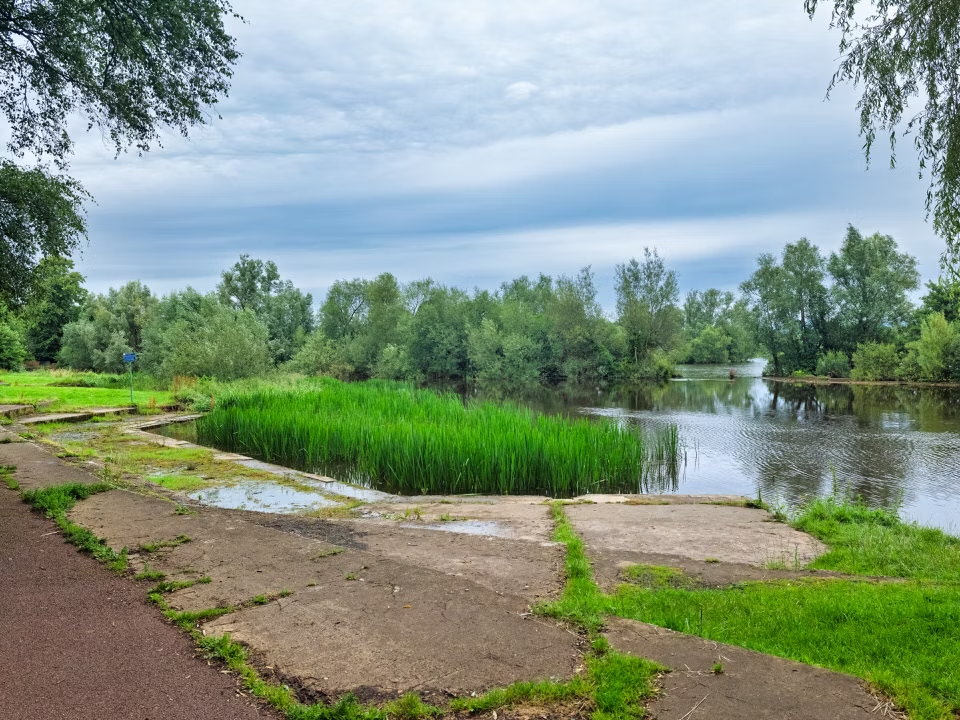
Decades of structural neglect and vigorous re-wilding have effectively hidden the site in plain sight; with the original changing pavilions long gone, passers-by routinely treat the remaining concrete footprint as nothing more than a curious riverside terrace.
The search was compounded by atrocious Irish summer weather and an ill-timed camera deployment. I was testing a newly delivered Fujifilm GFX100RF. While the camera body offered reliable weather sealing, the fixed 28mm-equivalent lens presented an immediate stumbling block: a maximum aperture of f/4 combined with the total absence of In-Body Image Stabilisation.
Handholding a dense 102-megapixel sensor beneath dark, rain-swollen skies requires unforgivingly fast shutter speeds to prevent micro-shake, and pushing the ISO in dreary, contrast-free light eroded the very medium-format fidelity I was seeking.
To worsen matters, the front element repeatedly caught drifting moisture, and—as is often the case with brand-new releases—third-party RAW support had not yet caught up, leaving the files locked away until software updates arrived months down the line. It was an uncompromising reminder that high-resolution studio and landscape sensors are seldom built for the improvisational grit of a wet Irish street shoot.
Downstream along the mill race and backwater path lies the physical basin of the Corbally Baths, once a cornerstone of Limerick’s civic recreation.
Origins to Municipal Institution
Developed initially in the late nineteenth century and significantly formalised by Limerick Corporation in the 1940s, the open-air baths were engineered to provide a controlled, communal swimming environment. They offered a vital refuge from the treacherous undertows, erratic channels, and whirlpools that made swimming in the main navigation channel of the Shannon notoriously hazardous.
The Architecture of the Basin
Rather than relying on a static, chlorinated tank, the baths made ingenious use of the mill race diversion. The river provided a continuous, free-flowing flush of fresh water through a masonry and concrete basin. Tiered viewing steps, diving platforms, and concrete slipways were cut directly into the bank, flanked by timber and masonry changing cubicles. It was a utilitarian triumph of civic engineering, responding directly to the natural contours and currents of the river.
From the 1930s through to the 1970s, the baths served as the pulsating heart of outdoor life during Limerick summers. They hosted water polo fixtures, school swimming galas, and intensive training sessions for local clubs like the Limerick Swimming Club, drawing crowds of spectators who packed the concrete tiers. It was also the spiritual home of the city's annual competitive Christmas Day swim, cementing its place in local folklore.
The eventual demise of the baths mirrored broader national shifts. During the late 1970s and 1980s, modern indoor, heated municipal pools emerged across the city, rendering unheated river bathing obsolete for general leisure. Simultaneously, evolving public liability standards, fluctuating water quality, and the hydrologic changes wrought upstream by the Ardnacrusha scheme placed the facility under strain. Limerick Corporation eventually withdrew maintenance, leaving the structures vulnerable to vandalism. In the late 1990s, the derelict changing pavilions were unceremoniously bulldozed into the pool basin to eliminate safety liabilities, allowing nature to swallow the masonry.
Today, the tiered concrete terraces remain embedded in the bank, framed by mature willows and reeds—a quiet, contemplative stop along the riverside walking trail. Fortunately, the site faces no risk from private developers; its location within the Shannon floodplain and the Lower River Shannon Special Area of Conservation guarantees its public status.
In recent years, an energetic revival campaign spearheaded by the Limerick Narwhals and supported by municipal feasibility studies has explored restoring the basin as an open-water swimming amenity and community viewing deck. Whether or not the basin ever formally welcomes swimmers again, the worn concrete steps endure as a poignant monument to an era when civic infrastructure worked in direct harmony with the natural river.