John O'Donovan (25 July 1806 – 10 December 1861)
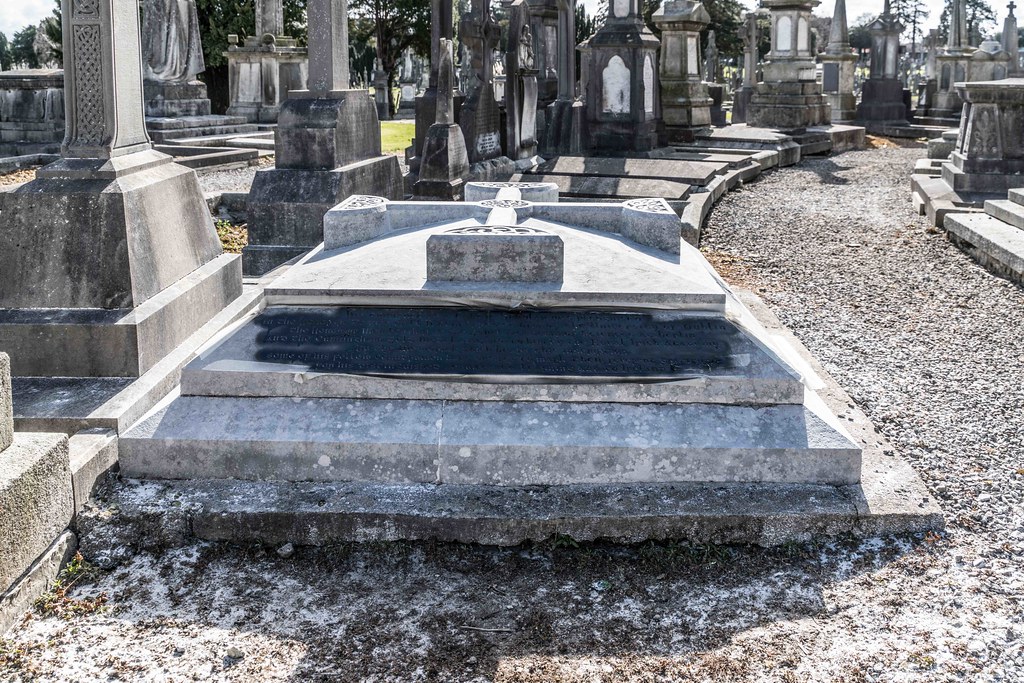
John O'Donovan (25 July 1806 – 10 December 1861)[Glasnevin Cemetery]
I do not remember seeing this before so I do not know what sort of condition it was in before it was restored. I found it very difficult to read the inscriptions because of the fresh black paint and I think that that the dates included in the inscription are incorrect.
John O'Donovan (25 July 1806 – 10 December 1861), from Atateemore, in the parish of Kilcolumb, County Kilkenny, and educated at Hunt's Academy, Waterford, was an Irish language scholar from Ireland.
Inscriptions:
His eminence as a Celtic Scholar was recognised
in the Honorary Degree of LL.D. conferred on him by the University of Dublin
the Honorary Membership of the Royal Academy of Sciences at Berlin
and the Cunningham Gold Medal awarded to him by the Royal Irish Academy
by the Memorial which bears this inscription
some of his fellow countrymen have desired to mark their reverent gratitude
for his distinguished services to Learning and to Ireland.
John O'Donovan, LL.D.
Born Atatateemore, Co. Kilkenny
ix July mdcccix [9 July 1809 should be 25 July 1806]
died in Dublin
ix Dec. mdccclxi [9 Dec 1861 Should be 10 December 1861]
by his Irish Grammar his Edition of the Annals of the Four Masters
his labours on the transcription and translation of the Brehon Laws
and his invaluable contributions to our knowledge of the topography and local history
of his country made during his connection with the Ordnance Survey
he laid a sure foundation for sound and scientific Celtic studies
and established his position as
a Master of Irish Philology and Archaeology
John was the fourth son of Edmond O'Donovan and Eleanor Hoberlin of Rochestown. His early career may have been inspired by his uncle Parick O'Donovan. He worked for antiquarian James Hardiman researching state papers and traditional sources at the Public Records Office. He also taught Irish to Thomas Larcom for a short period in 1828 and worked for Myles John O'Reilly, a collector of Irish manuscripts.
Following the death of Edward O'Reilly in August 1830, he was recruited to the Topographical Department of the first Ordnance Survey of Ireland under George Petrie in October 1830. Apart from a brief period in 1833, he worked steadily for the Survey on place-name researches until 1842, unearthing and preserving many manuscripts. After that date, O'Donovan's work with the Survey tailed off, although he was called upon from time to time to undertake place-name research on a day-to-day basis. He researched maps and manuscripts at many libraries and archives in Ireland and England, with a view to establishing the correct origin of as many of Ireland's 63,000 townland names as possible. His letters to Larcom are regarded as an important record of the ancient lore of Ireland for those counties he documented during his years of travel throughout much of Ireland.
By 1845, O'Donovan was corresponding with the younger scholar William Reeves, and much of their correspondence to 1860 survives.
O'Donovan became professor of Celtic Languages at Queen's University, and was called to the Bar in 1847. His work on linguistics was recognised in 1848 by the Royal Irish Academy, who awarded him their prestigious Cunningham Medal. On the recommendation of Grimm, he was elected a corresponding member of the Royal Academy of Prussia in 1856.
Never in great health, he died shortly after midnight on 10 December 1861 at his residence, 36 Upper Buckingham Street, Dublin. He was buried on 13 December 1861 in Glasnevin Cemetery, where his tombstone inscription has slightly wrong dates of both birth and death.
He married a sister-in-law of Eugene O'Curry and was father of nine children (all but one of whom died without issue). His wife received a small state pension after his death.
In a letter to Jeremiah O'Donovan Rossa of 29 May 1856 John O'Donovan gave his lineage as follows:
*O'Donovan Road in the Tenters area of Dublin 8 is named in his honour.
An interesting feature of John O'Donovan's works is that he found himself unable to resist asserting the claims of the O'Donovan family to ancient glory, in numerous footnotes and appendices. Thankfully for Irish scholarship, this small, personal failing does not affect the overall quality of O'Donovan's pioneering research;other criticism of his works were much more substantive. While it has not been possible to prove the great scholar's descent specifically from the Lords of Clancahill, and not from another O'Donovan sept, it was nonetheless something in which he stoutly believed. O'Donovan was also undecided and in other notes contended Edmond was a son of Donal II by his first wife Helena de Barry.
I do not remember seeing this before so I do not know what sort of condition it was in before it was restored. I found it very difficult to read the inscriptions because of the fresh black paint and I think that that the dates included in the inscription are incorrect.
John O'Donovan (25 July 1806 – 10 December 1861), from Atateemore, in the parish of Kilcolumb, County Kilkenny, and educated at Hunt's Academy, Waterford, was an Irish language scholar from Ireland.
Inscriptions:
His eminence as a Celtic Scholar was recognised
in the Honorary Degree of LL.D. conferred on him by the University of Dublin
the Honorary Membership of the Royal Academy of Sciences at Berlin
and the Cunningham Gold Medal awarded to him by the Royal Irish Academy
by the Memorial which bears this inscription
some of his fellow countrymen have desired to mark their reverent gratitude
for his distinguished services to Learning and to Ireland.
John O'Donovan, LL.D.
Born Atatateemore, Co. Kilkenny
ix July mdcccix [9 July 1809 should be 25 July 1806]
died in Dublin
ix Dec. mdccclxi [9 Dec 1861 Should be 10 December 1861]
by his Irish Grammar his Edition of the Annals of the Four Masters
his labours on the transcription and translation of the Brehon Laws
and his invaluable contributions to our knowledge of the topography and local history
of his country made during his connection with the Ordnance Survey
he laid a sure foundation for sound and scientific Celtic studies
and established his position as
a Master of Irish Philology and Archaeology
John was the fourth son of Edmond O'Donovan and Eleanor Hoberlin of Rochestown. His early career may have been inspired by his uncle Parick O'Donovan. He worked for antiquarian James Hardiman researching state papers and traditional sources at the Public Records Office. He also taught Irish to Thomas Larcom for a short period in 1828 and worked for Myles John O'Reilly, a collector of Irish manuscripts.
Following the death of Edward O'Reilly in August 1830, he was recruited to the Topographical Department of the first Ordnance Survey of Ireland under George Petrie in October 1830. Apart from a brief period in 1833, he worked steadily for the Survey on place-name researches until 1842, unearthing and preserving many manuscripts. After that date, O'Donovan's work with the Survey tailed off, although he was called upon from time to time to undertake place-name research on a day-to-day basis. He researched maps and manuscripts at many libraries and archives in Ireland and England, with a view to establishing the correct origin of as many of Ireland's 63,000 townland names as possible. His letters to Larcom are regarded as an important record of the ancient lore of Ireland for those counties he documented during his years of travel throughout much of Ireland.
By 1845, O'Donovan was corresponding with the younger scholar William Reeves, and much of their correspondence to 1860 survives.
O'Donovan became professor of Celtic Languages at Queen's University, and was called to the Bar in 1847. His work on linguistics was recognised in 1848 by the Royal Irish Academy, who awarded him their prestigious Cunningham Medal. On the recommendation of Grimm, he was elected a corresponding member of the Royal Academy of Prussia in 1856.
Never in great health, he died shortly after midnight on 10 December 1861 at his residence, 36 Upper Buckingham Street, Dublin. He was buried on 13 December 1861 in Glasnevin Cemetery, where his tombstone inscription has slightly wrong dates of both birth and death.
He married a sister-in-law of Eugene O'Curry and was father of nine children (all but one of whom died without issue). His wife received a small state pension after his death.
In a letter to Jeremiah O'Donovan Rossa of 29 May 1856 John O'Donovan gave his lineage as follows:
- From the senior branch of Clann-Cahill, descended from the elder son Donnell II O'Donovan, married Joanna MacCarthy Reagh of Castle Donovan and who died 1638
- Edmond, married Catherine de Burgo, killed 1643.
- Conor, married Rose Kavanagh.
- William, married Mary Oberlin, a Puritan, died 1749.
- Edmond, married to Mary Archdeacon, died 1798.
- Edmond, married Mary Oberlin, died 1817.
- John O'Donovan, L.L.D. married to Mary Ann Broughton, a descendant of Cromwellian settlers.
- Edmond 1840 d. 1842, John 1842, Edmond 1844 later War Correspondent (died in Sudan) 1882, William 1846, Richard 1846, Henry dead 1850, Henry 1852, Daniel 1856, Morgan Kavanaugh O'C 1859 d.1860.[5] See Edmund O'Donovan.
- (O'Curry and O'Donovan were married to the sisters Anne and Mary Anne Broughton respectively, daughters of John Broughton of Killaderry near Broadford, County Clare.)
*O'Donovan Road in the Tenters area of Dublin 8 is named in his honour.
An interesting feature of John O'Donovan's works is that he found himself unable to resist asserting the claims of the O'Donovan family to ancient glory, in numerous footnotes and appendices. Thankfully for Irish scholarship, this small, personal failing does not affect the overall quality of O'Donovan's pioneering research;other criticism of his works were much more substantive. While it has not been possible to prove the great scholar's descent specifically from the Lords of Clancahill, and not from another O'Donovan sept, it was nonetheless something in which he stoutly believed. O'Donovan was also undecided and in other notes contended Edmond was a son of Donal II by his first wife Helena de Barry.
SORRY FOR THE DELAY
-

John O'Donovan (25 July 1806 – 10 December 1861)
-

John O'Donovan (25 July 1806 – 10 December 1861)
-
John O'Donovan (25 July 1806 – 10 December 1861)
-

John O'Donovan (25 July 1806 – 10 December 1861)