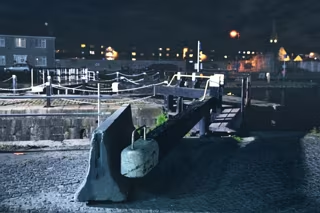
I WAS A COLD AND DARK NIGHT JUST BEFORE CHRISTMAS
FOLKLORE, FACT, AND THE WATER - THE ANATOMY OF A DUBLIN GRAND CANAL MYTH
The three sea locks at the eastern end of Hanover Quay—connecting Grand Canal Dock to the River Liffey—were built in 1796 and named after three former Lords Lieutenant of Ireland (British Viceroys).
1. Names of the Three Locks (from West to East)
Westmoreland Lock (closest to Hanover Quay): Named after John Fane, 10th Earl of Westmorland (Lord Lieutenant 1789–1794).
Buckingham Lock (the middle lock): Named after George Nugent-Temple-Grenville, 1st Marquess of Buckingham (Lord Lieutenant 1782–1783 and 1787–1789).
Camden Lock (furthest east, closest to Ringsend): Named after John Pratt, 1st Marquess Camden (Lord Lieutenant 1795–1798, who officially opened the docks in April 1796).
2. Why There Are Three Locks
When Grand Canal Dock opened in 1796, it was the largest floating dock in the world and served as the vital interchange between Ireland's inland canal network and international maritime trade. Three separate, parallel locks of graduated sizes were built for two main reasons:
Accommodating Different Vessel Sizes:
Westmoreland Lock (the smallest) was built specifically for inland canal barges and lighters transferring goods between the Grand Canal and the river.
Buckingham Lock (medium-sized, at roughly 120 ft long by 25 ft wide) handled medium-sized coastal trading vessels and smaller schooners.
Camden Lock (the largest, originally 35 ft wide and later widened to 50 ft in the 1880s) was designed to admit full-sized ocean-going merchant ships directly into the sheltered basin.
Water Conservation and Traffic Efficiency:
Because Grand Canal Dock is a non-tidal basin separated from the tidal River Liffey, every time a lock is cycled, a massive volume of freshwater is lost from the dock into the river. Having three differently sized chambers meant lock-keepers didn't have to drain a massive ocean-liner lock just to let a small canal barge through—saving both water and significant time during peak 18th- and 19th-century commercial traffic.
Folklore, Fact, and the Water: The Anatomy of a Dublin Canal Myth
Standing by the heavy timber balance beams and iron gearboxes of the Grand Canal Basin sea locks after dark, the water takes on a thick, impenetrable quality under the sodium and LED spill of the quays. It is quiet down here at night, save for the hum of the city and the occasional lapping of water against stone ashlar sills.
During a recent evening walk with the camera, a passer-by stopped to offer a word of local advice: pack up and move along, because it was dangerous around the locks after hours. The warning came with an ominous piece of neighbourhood folklore: A young man was pushed into the water right here years ago, and his body was never found.
It is a striking, cinematic warning, but it is also a textbook example of a conflated Dublin urban myth—a story assembled from genuine tragedy, local unease, and the dark magnetism of open water.
The Real Case: Trevor Deely
The kernel of truth behind the stranger’s warning points to one of the most haunting and enduring missing persons cases in modern Irish history: the disappearance of 22-year-old Trevor Deely.
In the small hours of Friday, 8 December 2000, amidst a national taxi strike and a fierce winter storm, Trevor was walking home to his flat in Ballsbridge after a Christmas party. He called into his workplace at Bank of Ireland Asset Management on Wilton Terrace to dry off, collect a large golf umbrella, and check his emails. He left just after 4:00 AM, phoning a friend to say he was on his way home. At 4:14 AM, CCTV footage captured him walking past an ATM at the corner of Baggot Street Bridge and Haddington Road.
That brief fragment of security tape remains the last confirmed sighting of him.
Because his intended route tracked along and crossed waterways—the Grand Canal and the River Dodder—the Garda Sub-Aqua Unit and emergency services undertook monumental searches. Divers methodically swept the canal reaches, lock chambers, and the Grand Canal Dock basin itself. They found nothing: no trace of Trevor, no phone, no wallet, and not a single shred of the conspicuous green-and-yellow golf umbrella he carried.
Over the decades, that total lack of closure created an emotional and psychological void in the city’s collective memory.
How the Myth Was Built
Over time, informal street talk has welded separate threads together into a cautionary ghost story.
First, the geography shifted. The exhaustive diver sweeps of Grand Canal Dock became fused with the site of disappearance itself. In popular memory, the place where teams searched morphed into the place where the event must have occurred.
Second came the persistent "pusher" trope. Cities with industrial canal systems—Dublin and Manchester alike—frequently spawn dark legends of shadowy figures shoving pedestrians into lock cuts. While Dublin’s waterways have tragically seen accidental drownings after late nights out, along with the occasional altercation, the notion of a serial predator operating on the towpaths belongs firmly to urban folklore.
Finally, the myth ignores basic canal hydrology. The Grand Canal Basin and its sea locks are a strictly controlled, artificial system of gates, sluices, and sills. It is not an open, tidal estuary where an object is effortlessly swept to the Atlantic. Had someone entered the water at the lock gates, the physical infrastructure of the basin would have retained them.
Urban myths thrive on a simple formula: an unsolved tragedy, an intimidating dark stretch of urban infrastructure, and genuine local caution regarding nighttime anti-social behaviour. Blended together, fact dissolves into folklore. The locks remain a somber, evocative piece of our industrial past, but the ghostly tale of the pushed boy who vanished into the deep belongs entirely to the mythology of the towpath.


THE THREE LOCKS