I USED A SIGMA 105MM LENS
Two Sides of the Liffey: The Story Behind Dublin’s Luke Kelly Memorials
On 30 January 2019—the 35th anniversary of the passing of legendary Dubliners frontman Luke Kelly—President Michael D. Higgins unveiled two remarkably different tributes to the singer on opposite sides of the River Liffey.
Standing in the crowd at the Northside unveiling on the corner of Guild Street and Sheriff Street Upper, I overheard a local parish priest standing right beside me remark quietly: "I am willing to bet that this will not survive more than a few months."
Looking back, his prediction was both eerily prescient and ultimately proven wrong by the fierce loyalty of the local community.
The Northside Portrait: Guild Street and Sheriff Street Upper
This is very much a favourite of mine.
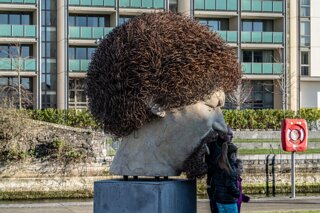
Commissioned by Dublin City Council and championed by former Lord Mayor Christy Burke, the monumental Northside bust is the work of visual artist Vera Klute. Standing over two metres tall, the sculpture captures Kelly mid-song with his eyes tightly shut in raw vocal passion. Carved from Irish marble on a concrete plinth, it is crowned with an expressive, intricate tangle of patinaed copper wire replicating Kelly’s unmistakable fiery curls and beard.
The location—at the northern end of Luke Kelly Park beside the Royal Canal in Dublin’s North Wall—could hardly be more fitting. Luke Kelly was born just streets away on Lattimore Street in November 1940 and spent his formative years growing up in the close-knit working-class community around Sheriff Street. Positioned where the historic red-brick terraces meet the modern glass developments of the Dublin Docklands, the monument anchors Kelly squarely in his home parish.
Vandalism, Arrests, and a Community’s Resolve
Unfortunately, the parish priest’s pessimism was quickly tested. Between mid-2019 and July 2020, Vera Klute’s sculpture was defaced seven times with spray paint, marker graffiti, and paint-filled balloons. Each attack provoked genuine fury across Dublin, nowhere more so than among the longtime residents of Sheriff Street who had been Luke’s neighbours and viewed the damage as a deeply personal insult to their community.
As the incidents mounted in the summer of 2020, public commentary inevitably turned to whether the sculpture should be relocated to a more heavily policed site. Local representatives and neighbours flatly rejected any suggestion of moving it away from Sheriff Street. Instead, Dublin City Council and Gardaí upgraded lighting, installed dedicated CCTV, and applied protective anti-graffiti coatings to keep the monument where it belonged.
Following the seventh attack in July 2020—when blue paint was thrown over the marble face—Gardaí arrested and charged a 47-year-old local man, Michael Dunne. After delays in the courts, Dunne pleaded guilty to criminal damage and was sentenced to nine months in prison in January 2024. (In a gentler, albeit still damaging, twist, Dublin City Council has also had to carry out specialist repairs after over-enthusiastic admirers pulled strands of copper wire from Kelly’s hair and beard as keepsakes.)
The Southside Counterpart and a Persistent Dublin Myth
Later on that same afternoon in January 2019, President Higgins unveiled a second memorial on South King Street, just off Grafton Street and outside the Gaiety Theatre. Privately funded and donated to the city by the late businessman Gerry Hunt, this life-size bronze statue by sculptor John Coll portrays Kelly seated on a stool, leaning forward over his five-string banjo.
In the years since, a familiar Dublin narrative has taken hold: the claim that vandalism to public art is strictly a Northside problem, and that the South King Street statue has remained completely untouched while its Sheriff Street counterpart bore the brunt of anti-social behaviour.
In reality, that assumption is incorrect. On the night of 23 June 2020—during the exact same wave of incidents—John Coll’s bronze statue on South King Street was also targeted, having white paint poured and sprayed across its face and glasses. Sculptor John Coll remarked at the time that he had felt like he was "dodging a bullet a bit" before the attack finally reached the Southside. (Michael Dunne was initially charged in connection with the South King Street incident as well, though the Director of Public Prosecutions later withdrew that specific charge in 2021 while proceeding with the Northside case.)
Why do so many people forget that the Southside statue was also hit? Primarily because the South King Street bronze sits in one of the busiest commercial and pedestrian corridors in the country. It was cleaned rapidly, suffered only a single incident rather than a recurring cycle, and never became the centre of a prolonged public debate over relocation. As a result, the single Southside attack faded quickly from public memory, leaving behind a tidy—if inaccurate—north-versus-south cliché.
From the "Bokeh Master" to Practical Street Glass: Evolving My Sony Kit for Urban Photography
When I attended the unveiling of Vera Klute’s Luke Kelly sculpture on Guild Street in January 2019, I was shooting with a Sony A7R III paired with the Sigma 105mm f/1.4 DG HSM Art. Optically, that lens—rightly nicknamed the "Bokeh Master"—is extraordinary. It isolated Kelly’s patinaed copper curls and marble features against the Dublin Docklands skyline with effortless separation and crisp detail.
In practical terms, however, it taught me an immediate lesson about the realities of street photography.
The Heavyweight Lesson: Why Massive Glass Fails on the Street
At over 1.6 kilograms on its own—bringing the combined camera and lens setup to roughly 2.3 kilograms—the Sigma 105mm f/1.4 is simply too large and front-heavy for long urban walks. When you are covering 15 to 20 kilometres on foot without a tripod, carrying that kind of weight quickly turns from a pleasure into an endurance test.
Beyond the physical strain, oversized glass creates social friction. Raising a massive barrel in narrow lanes or busy public squares immediately signals "commercial assignment" rather than quiet street observation. People freeze up, turn away, or ask questions. Today, that Sigma rarely leaves the shelf.
Even when I later acquired the remarkable Sony FE 50–150mm f/2 GM, which replaces a bag full of fast primes in a single internal-zoom barrel, the same street reality applied. Despite its sensational rendering and much superior balance, at 1,340g with a prominent white barrel, I am inclined to avoid taking it into dense urban areas where discretion and agility matter most.
My Current Approach: Flagship Bodies and Purpose-Built Zooms
Today, my primary workhorses are the Sony A1 II and the Sony A7R VI, operated strictly on a single-lens-per-session basis. Rather than swapping lenses in dusty streets or carrying a heavy shoulder bag, I choose one lens before heading out that matches the specific streets, light, and architecture I intend to document that day:
Sony FE 16–35mm f/2.8 GM: My go-to choice for tight urban corridors, narrow lanes, and full building facades where stepping back simply isn't an option.
Sony FE 28–70mm f/2 GM: When light levels drop or overcast Dublin skies roll in, this lens delivers prime-like f/2 speed across the classic street focal lengths while keeping a sleek, low-profile black finish.
Sony FE 24–105mm f/4 G OSS: An older optical design, yet still one of the most reliable all-purpose walk-around lenses ever made—wide enough for street-level context at 24mm and long enough at 105mm to pick out upper-storey stonework.
Sony FE 70–200mm f/4 Macro G OSS II: Far lighter and more compact when retracted than the 50–150mm f/2 GM, this lens excels along open quays and parks while offering half-macro capability for architectural plaques and fine details.
Sony FE 100–400mm f/5.6–8 OSS: Sony’s lightweight, budget-friendly super-telephoto has become a surprising favourite for urban surveys. While there is an inevitable trade-off in ultimate micro-contrast and speed compared to G Master glass, the quality is more than acceptable—and getting 400mm of reach in a compact black barrel that weighs roughly the same as a standard zoom is a revelation on long walking days.
Optical Perfection vs. The Shot You Actually Take
Looking back at the images from the Luke Kelly unveiling in 2019 alongside my work today, the biggest shift in my kit hasn't been chasing sharper test-chart numbers—modern high-resolution sensors already deliver more detail than any web gallery could ever need. Instead, it has been about removing physical barriers between seeing a moment and capturing it. A slightly lighter, quieter, more manageable lens that stays comfortably in your hand all day will always beat a heavy optical masterpiece left behind in the bag.
The Teleconverters Work Very Well With The 70–200mm f/4 Macro G OSS II
That is one of the standout upgrades Sony introduced with the Mark II version of the 70–200mm f/4 Macro G OSS II—whereas the original Mark I did not accept teleconverters at all, the Mark II takes both the 1.4x and 2x extenders and holds onto remarkably crisp image quality across the frame.
A few practical bonuses make that combination especially useful:
Full 1:1 Life-Size Macro: Because the bare lens already delivers 0.5x half-macro across its entire zoom range, adding the 2x teleconverter turns it into a genuine 1:1 (1.0x) macro zoom—giving you generous working distance for small architectural carvings, commemorative plaques, or botanical details without crowding the subject.
A Compact 140–400mm f/8 Option: Paired with the 2x extender, you effectively get a 140–400mm f/8 telephoto that still weighs under a kilogram combined (roughly 794g for the lens plus 207g for the SEL20TC) and packs down far smaller than a traditional 100–400mm GM. With the 1.4x extender, you get 98–280mm f/5.6 with virtually zero perceptible drop in sharpness or autofocus speed.
Seamless Modern AF: On bodies like the A1 II and A7R VI, Sony’s modern phase-detect autofocus systems handle f/8 effortlessly in daylight, keeping subject tracking snappy even at 400mm.
Between the 70–200mm f/4 G II with teleconverters and the lightweight 100–400mm f/5.6–8, I have two completely different ways to hit 400mm on a walking day depending on whether I want macro flexibility and G-series bite or an ultra-compact black barrel.
LUKE KELLY STATUE