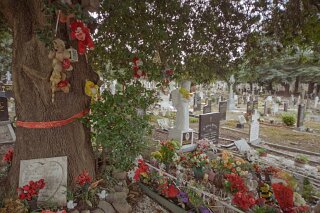
PHOTOGRAPHED THE DAY AFTER ST PATRICK'S DAY 2009
Shadows and Sanctuary: Documenting the Evolution of Glasnevin’s Angels Plot
Reviewing an old photography catalogue revealed a recurring personal inclination: a tendency to visit and photograph Dublin's historic Glasnevin Cemetery on the day after St Patrick's Day.
Looking back at files from 18 March 2008 brings mixed technical memories. Using a Canon 1Ds at the time, it became increasingly apparent that something was amiss with the body; a Canon 5D consistently outperformed it in every aspect that mattered on the ground. Yet, that specific spring day marked a more significant shift in subject matter. Though the cemetery had been photographed on numerous previous occasions, the "Angels Plot"—the resting place for stillborn and unbaptised infants—had always been avoided out of a sense of photographic decorum. That boundary was crossed only after learning of new proposals regarding the future management and structural control of that highly sensitive section.
1. The Context of 2009: A Plot Under Strain
Visits to the plot in March and December 2009 captured a profound, distressing sight: the physical manifestation of raw, unregulated family grief colliding with a historic lack of institutional infrastructure.
The Historic Problem
Historically, the thousands of stillborn or unbaptised babies buried in the Angels Plot were placed in communal graves without individual headstones. Legally and logistically, parents were not permitted to erect permanent stonework on these shared plots.
The Resulting Tributes
To reclaim their children's identity, families began leaving temporary, highly personal tokens: soft toys, miniature plastic fencing, teddy bears, solar-powered lights, and footballs. Because no official framework existed to display these items, they naturally spread across the grass. Over time, exposed to the harsh Irish weather, the area became incredibly overcrowded, disorganised, and exceptionally difficult for ground staff to sensitively maintain.
2. The Transformation (2010–2011)
Just months after that December 2009 visit, the Glasnevin Trust (now the Dublin Cemeteries Trust), working in close partnership with A Little Lifetime Foundation (formerly ISANDS), stepped in to completely renovate the space. Recognizing that the weathered, chaotic state of the plot was deeply distressing for visitors and lacked appropriate dignity, they undertook a sensitive structural overhaul.
Ground Levelling: To eliminate severe subsidence and uneven terrain, the Trust carefully added between 300mm and 600mm of fresh topsoil over the existing grounds. Crucially, families were explicitly assured that absolutely no historic graves were disturbed during this process.
Transition to a Remembrance Garden: The open lawn was landscaped into a uniform, peaceful Angels Remembrance Garden. Weather-worn plastic structures and degraded toys were gently removed to restore a clean, dignified landscape.
Uniform Inscribed Plaques: To resolve the core issue—the parental need to individually mark a child's resting place without a full headstone—the Trust partnered with an Irish foundry to design small, discreet, uniform bronze plaques. Instead of being placed randomly on the grass, these plaques were organized and mounted gracefully along the boundaries and designated memorial walls enclosing the plot.
3. The Modern Sanctuary
Today, the space is managed with a strict balance of empathy and order. It is no longer an overloaded field of loose plastic and plush toys; it functions as a structured, quiet sanctuary.
The Trust permits highly discreet, uniform, and officially approved markers, ensuring that every child is individually named and remembered, while the landscaping itself is kept immaculate. Joint remembrance services are hosted there twice a year, every May and December, maintaining a communal bond of support for the families.
The early instinct to re-evaluate or even cut those specific 2009 images from a public portfolio makes perfect sense. What those photographs captured was a poignant but painful moment of transition in the cemetery's history—one that has since been beautifully resolved into a place of quiet dignity.
The Broader Historical and Legal Realities
The heartbreaking landscape witnessed at Glasnevin in 2009 was not an isolated Irish anomaly. It was a worldwide phenomenon across the Western world, deeply embedded in the historical intersection of theology, medical practice, and institutional bureaucracy until the late 20th century.
The practice of burying stillborn infants in unmarked, communal graves—and restricting individual monuments—spanned Europe and North America, driven by two distinct pillars:
1. The Theological Aspect
For centuries, Roman Catholic doctrine dictated that because of Original Sin, baptism was strictly necessary for entry into Heaven. Infants who died before receiving the sacrament could not be buried in consecrated ground. Instead, they were believed to enter Limbus Infantium (the Limbo of the Infants)—a marginal state of natural happiness, yet eternally separated from the vision of God.
The Global Impact: This theological stance was enforced globally. If a baby was stillborn, they could not occupy the consecrated ground of a traditional churchyard.
The Irish Specificity: In rural Ireland, this led to the creation of cillíní—unconsecrated, secret burial grounds located in boundary ditches, cliffs, or ancient ruins where infants were buried under cover of darkness. In large urban landscapes like Glasnevin in Dublin or Milltown in Belfast, cemeteries created dedicated, separate "unconsecrated" zones, which became known as the Angels Plots.
The Papal Shift: It was only in 2007 that the Vatican's International Theological Commission formally clarified a shift away from the historical hypothesis of Limbo, officially emphasising hope for the salvation of unbaptised infants and introducing formal funeral rites.
2. The Institutional Aspect
Outside of religious doctrine, secular management of stillbirths across the UK, the US, Canada, and Europe followed a brutally clinical protocol from the early 1900s until the mid-1980s.
Clinical Erasure: For decades, medical professionals believed the most compassionate path for a mother was immediate erasure. Infants were swiftly taken away before parents could see or hold them, under the paternalistic assumption that it was "for the best" to forget and move on.
Mass Communal Graves: Because these babies were not legally viewed as citizens (in the UK and Ireland, stillbirths were not officially registered until the early 1990s), hospitals assumed control of the remains. They contracted local cemeteries to bury these babies in bulk, unmarked communal plots.
The Headstone Restriction: Because a single plot might contain dozens of infants over a few weeks, no single family owned the plot. Structurally, cemeteries could not allow one family to erect a permanent stone monument over an earth shared by many others. This rule applied just as strictly in municipal cemeteries in London, Manchester, New York, and Toronto as it did in Dublin.
This international anonymity is why organisations like Sands in the UK and A Little Lifetime Foundation in Ireland campaigned heavily in the late 20th century to trace these unmarked graves, gradually transforming raw fields of makeshift tokens into uniform memorial walls and beautifully landscaped gardens of remembrance.
A Personal Connection: The Concealment of Birth
This history carries a profound, deeply personal resonance. Family lore includes a story passed down by a grandmother that her husband—my grandfather—was jailed for seven days for burying a stillborn child in a local cemetery. While family accounts vary slightly—with my father claiming the burial actually involved a suicide victim—the legal and social mechanisms of the era remain identical. A week in prison was not merely a consequence of religious friction; it was a head-on collision with the rigid, secular laws of the state.
While the Church enforced spiritual exile from consecrated ground, the British Crown (and later the Irish Free State) prosecuted the physical act of secret burials under a heavy-handed statutory law: Section 60 of the Offences Against the Person Act 1861.
This statute made it a criminal offence to "endeavour to conceal the birth of a child by any secret disposition of the dead body," regardless of whether the child died before, during, or after birth. Though originally enacted to detect infanticide before modern forensics, it was ruthlessly applied to any unregistered, clandestine burial.
THE HISTORIC CATCH-22 FOR FAMILIES
When a family suffered a stillbirth and was refused access to the parish graveyard, they were forced into traditional folk practices—burying the child at dusk or dawn in a local cillín or hedgerow boundary. The moment they did so without a medical certificate or outside a legally sanctioned registry, they broke state law.
The extraordinary longevity and weaponisation of this law became clear to the world decades later during the 1984 "Kerry Babies" scandal. In that landmark case, the state apparatus used Section 60 (Concealment of Birth) as a legal wedge against Joanne Hayes after she suffered a tragic, unassisted birth on her family farm and privately buried her deceased infant. The case exposed how, well into the late twentieth century, the state continued to treat the hidden tragedies of pregnancy and private family grief not as healthcare crises, but as criminal conspiracies against bureaucratic and moral registry.
Because a grieving, postpartum mother was bedridden, and a devastated father was often paralyzed by social stigma, the duty of a clandestine burial frequently fell to a trusted, brave neighbour or family member. My grandfather's actions were an act of immense communal solidarity, bearing the legal and physical risk so that a grieving family would not have to face the police or the courts. If a local constable caught wind of a midnight burial, a short prison sentence was commonly issued as a sharp deterrent to bypass state registries.
The chaotic landscape photographed at Glasnevin in 2009 was simply the modern, urban continuation of the exact same struggle my grandfather faced in the countryside: a persistent, deeply human rebellion against institutions that demanded an anonymous, forgotten death.
Reviewing an old photography catalogue revealed a recurring personal inclination: a tendency to visit and photograph Dublin's historic Glasnevin Cemetery on the day after St Patrick's Day.
Looking back at files from 18 March 2008 brings mixed technical memories. Using a Canon 1Ds at the time, it became increasingly apparent that something was amiss with the body; a Canon 5D consistently outperformed it in every aspect that mattered on the ground. Yet, that specific spring day marked a more significant shift in subject matter. Though the cemetery had been photographed on numerous previous occasions, the "Angels Plot"—the resting place for stillborn and unbaptised infants—had always been avoided out of a sense of photographic decorum. That boundary was crossed only after learning of new proposals regarding the future management and structural control of that highly sensitive section.
1. The Context of 2009: A Plot Under Strain
Visits to the plot in March and December 2009 captured a profound, distressing sight: the physical manifestation of raw, unregulated family grief colliding with a historic lack of institutional infrastructure.
The Historic Problem
Historically, the thousands of stillborn or unbaptised babies buried in the Angels Plot were placed in communal graves without individual headstones. Legally and logistically, parents were not permitted to erect permanent stonework on these shared plots.
The Resulting Tributes
To reclaim their children's identity, families began leaving temporary, highly personal tokens: soft toys, miniature plastic fencing, teddy bears, solar-powered lights, and footballs. Because no official framework existed to display these items, they naturally spread across the grass. Over time, exposed to the harsh Irish weather, the area became incredibly overcrowded, disorganised, and exceptionally difficult for ground staff to sensitively maintain.
2. The Transformation (2010–2011)
Just months after that December 2009 visit, the Glasnevin Trust (now the Dublin Cemeteries Trust), working in close partnership with A Little Lifetime Foundation (formerly ISANDS), stepped in to completely renovate the space. Recognizing that the weathered, chaotic state of the plot was deeply distressing for visitors and lacked appropriate dignity, they undertook a sensitive structural overhaul.
Ground Levelling: To eliminate severe subsidence and uneven terrain, the Trust carefully added between 300mm and 600mm of fresh topsoil over the existing grounds. Crucially, families were explicitly assured that absolutely no historic graves were disturbed during this process.
Transition to a Remembrance Garden: The open lawn was landscaped into a uniform, peaceful Angels Remembrance Garden. Weather-worn plastic structures and degraded toys were gently removed to restore a clean, dignified landscape.
Uniform Inscribed Plaques: To resolve the core issue—the parental need to individually mark a child's resting place without a full headstone—the Trust partnered with an Irish foundry to design small, discreet, uniform bronze plaques. Instead of being placed randomly on the grass, these plaques were organized and mounted gracefully along the boundaries and designated memorial walls enclosing the plot.
3. The Modern Sanctuary
Today, the space is managed with a strict balance of empathy and order. It is no longer an overloaded field of loose plastic and plush toys; it functions as a structured, quiet sanctuary.
The Trust permits highly discreet, uniform, and officially approved markers, ensuring that every child is individually named and remembered, while the landscaping itself is kept immaculate. Joint remembrance services are hosted there twice a year, every May and December, maintaining a communal bond of support for the families.
The early instinct to re-evaluate or even cut those specific 2009 images from a public portfolio makes perfect sense. What those photographs captured was a poignant but painful moment of transition in the cemetery's history—one that has since been beautifully resolved into a place of quiet dignity.
The Broader Historical and Legal Realities
The heartbreaking landscape witnessed at Glasnevin in 2009 was not an isolated Irish anomaly. It was a worldwide phenomenon across the Western world, deeply embedded in the historical intersection of theology, medical practice, and institutional bureaucracy until the late 20th century.
The practice of burying stillborn infants in unmarked, communal graves—and restricting individual monuments—spanned Europe and North America, driven by two distinct pillars:
1. The Theological Aspect
For centuries, Roman Catholic doctrine dictated that because of Original Sin, baptism was strictly necessary for entry into Heaven. Infants who died before receiving the sacrament could not be buried in consecrated ground. Instead, they were believed to enter Limbus Infantium (the Limbo of the Infants)—a marginal state of natural happiness, yet eternally separated from the vision of God.
The Global Impact: This theological stance was enforced globally. If a baby was stillborn, they could not occupy the consecrated ground of a traditional churchyard.
The Irish Specificity: In rural Ireland, this led to the creation of cillíní—unconsecrated, secret burial grounds located in boundary ditches, cliffs, or ancient ruins where infants were buried under cover of darkness. In large urban landscapes like Glasnevin in Dublin or Milltown in Belfast, cemeteries created dedicated, separate "unconsecrated" zones, which became known as the Angels Plots.
The Papal Shift: It was only in 2007 that the Vatican's International Theological Commission formally clarified a shift away from the historical hypothesis of Limbo, officially emphasising hope for the salvation of unbaptised infants and introducing formal funeral rites.
2. The Institutional Aspect
Outside of religious doctrine, secular management of stillbirths across the UK, the US, Canada, and Europe followed a brutally clinical protocol from the early 1900s until the mid-1980s.
Clinical Erasure: For decades, medical professionals believed the most compassionate path for a mother was immediate erasure. Infants were swiftly taken away before parents could see or hold them, under the paternalistic assumption that it was "for the best" to forget and move on.
Mass Communal Graves: Because these babies were not legally viewed as citizens (in the UK and Ireland, stillbirths were not officially registered until the early 1990s), hospitals assumed control of the remains. They contracted local cemeteries to bury these babies in bulk, unmarked communal plots.
The Headstone Restriction: Because a single plot might contain dozens of infants over a few weeks, no single family owned the plot. Structurally, cemeteries could not allow one family to erect a permanent stone monument over an earth shared by many others. This rule applied just as strictly in municipal cemeteries in London, Manchester, New York, and Toronto as it did in Dublin.
This international anonymity is why organisations like Sands in the UK and A Little Lifetime Foundation in Ireland campaigned heavily in the late 20th century to trace these unmarked graves, gradually transforming raw fields of makeshift tokens into uniform memorial walls and beautifully landscaped gardens of remembrance.
A Personal Connection: The Concealment of Birth
This history carries a profound, deeply personal resonance. Family lore includes a story passed down by a grandmother that her husband—my grandfather—was jailed for seven days for burying a stillborn child in a local cemetery. While family accounts vary slightly—with my father claiming the burial actually involved a suicide victim—the legal and social mechanisms of the era remain identical. A week in prison was not merely a consequence of religious friction; it was a head-on collision with the rigid, secular laws of the state.
While the Church enforced spiritual exile from consecrated ground, the British Crown (and later the Irish Free State) prosecuted the physical act of secret burials under a heavy-handed statutory law: Section 60 of the Offences Against the Person Act 1861.
This statute made it a criminal offence to "endeavour to conceal the birth of a child by any secret disposition of the dead body," regardless of whether the child died before, during, or after birth. Though originally enacted to detect infanticide before modern forensics, it was ruthlessly applied to any unregistered, clandestine burial.
THE HISTORIC CATCH-22 FOR FAMILIES
When a family suffered a stillbirth and was refused access to the parish graveyard, they were forced into traditional folk practices—burying the child at dusk or dawn in a local cillín or hedgerow boundary. The moment they did so without a medical certificate or outside a legally sanctioned registry, they broke state law.
The extraordinary longevity and weaponisation of this law became clear to the world decades later during the 1984 "Kerry Babies" scandal. In that landmark case, the state apparatus used Section 60 (Concealment of Birth) as a legal wedge against Joanne Hayes after she suffered a tragic, unassisted birth on her family farm and privately buried her deceased infant. The case exposed how, well into the late twentieth century, the state continued to treat the hidden tragedies of pregnancy and private family grief not as healthcare crises, but as criminal conspiracies against bureaucratic and moral registry.
Because a grieving, postpartum mother was bedridden, and a devastated father was often paralyzed by social stigma, the duty of a clandestine burial frequently fell to a trusted, brave neighbour or family member. My grandfather's actions were an act of immense communal solidarity, bearing the legal and physical risk so that a grieving family would not have to face the police or the courts. If a local constable caught wind of a midnight burial, a short prison sentence was commonly issued as a sharp deterrent to bypass state registries.
The chaotic landscape photographed at Glasnevin in 2009 was simply the modern, urban continuation of the exact same struggle my grandfather faced in the countryside: a persistent, deeply human rebellion against institutions that demanded an anonymous, forgotten death.