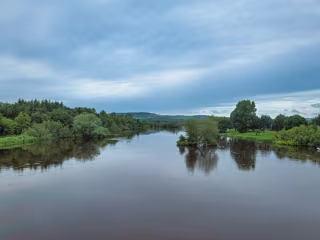
SEARCHING FOR THE OLD CORBALLY OPEN AIR BATHS ON THE WRONG SIDE OF THE SHANNON
Searching For The Corbally Baths Along The Wrong Side Of The Shannon
The Red Path and the Lost Baths of Corbally
For some time, I had wanted to track down the remnants of the old Corbally open-air baths along the River Shannon. Once a lively community amenity, the baths have long since fallen into dereliction, reclaimed by the riverbank and fading quietly out of modern consciousness. Finding them on the ground, however, proved to be an exercise in navigating both physical hazards and fragmented local memory.
Lost Along the County Clare Bank
Pinpointing the exact site proved surprisingly difficult. Asking for directions in the area produced one of two outcomes: a blank look accompanied by an honest "never heard of them," or well-meaning instructions that sent me entirely to the wrong side of the water, over at Shannon Banks.
Because the Shannon marks the county boundary here, I found myself walking the riverbank in County Clare rather than County Limerick. The contrast between the two banks could hardly be more pronounced. Wandering through the modern developments of Shannon Banks and Westbury, the landscape feels curiously sterile and disconnected from the river it borders. I once heard a local wryly dismiss the area as little more than "a field with windows"—a biting, accurate summation of the uniform estate sprawl thrown up across the low-lying agricultural washlands from the 1970s onwards.
It is an uneasy, bleak suburban strip, hemmed in by heavy earthen berms and concrete flood walls, living at the perpetual mercy of high water and emergency discharge releases from the ESB's Parteen Weir upstream. Decades of sudden inundations—most notoriously in 2009 and during Storm Desmond in 2015—turned these estate roads into navigable waterways requiring boat evacuations, leaving behind an engineered fringe of defences as a permanent reminder of the river's raw reach. But of the historic swimming baths, there was no sign, nor any crossing point to reach them from this side.
Just as I was about to abandon the search, I struck up a conversation with an elderly local lady. She immediately knew what I was looking for and put me straight: the baths lay along the "Red Path" on the opposite bank in County Limerick, accessible further round via Mill Road. She accompanied her directions with a stern caveat—the path had suffered years of neglect and was badly maintained, waterlogged, and far too slippery to safely navigate in foul weather.
The Old Toll Booth and the Swollen Shannon
Taking her advice, I crossed the bridge with the intention of catching the bus back to the city centre. While waiting, something caught my eye: a dog trotting purposefully behind a derelict stone structure near the bridge head, which had originally served as an old toll booth.
Even though it was July, the rain was heavy and relentless. Curiosity got the better of me, and following behind the dog, I discovered a hidden, steep flight of stone steps leading down towards the water’s edge. Reaching the bottom, the lady’s warning rang entirely true. The mud was thick, slick, and precarious underfoot, while the river itself had swollen from the downpour, churning high against the bank. With the rain closing in and the trail so badly washed out, pushing along the overgrown margins felt like an invitation for a bad fall.
I turned back to make my way up to the bus stop, only to encounter a local dog walker heading down. When I mentioned the treacherous state of the trail, he smiled and remarked that he and his dog tackled the Red Path every single day without fail, looping all the way back around through Mill Road.
A Disappearing Landscape
It is striking how quickly significant municipal landmarks can vanish from collective local knowledge. Between the administrative divide of Clare and Limerick, the sprawl of modern estates across the washlands, and the physical decay of the unmaintained Red Path itself, the Corbally baths have shifted from a bustling public amenity into an almost mythical secret—kept alive only by long-standing elders and the hardy few who walk the muddy river margins every day.