I USED A SONY A7RII
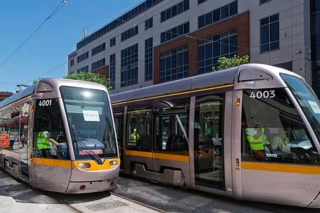
THE FIRST GAUGE TEST OF THE LUAS CROSS CITY EXTENSION 17 JUNE 2017
Living at the junction of Bolton Street and Henrietta Place meant that for years, our immediate surroundings were effectively a continuous construction site. The civil engineering required for Luas Cross City was formidable: historic Georgian cellars running beneath the streetscape had to be backfilled or structurally reinforced, utilities were extensively relocated, and traffic diversions were constant. While the completion of the line brought long-awaited relief, it also fundamentally reshaped the architectural fabric and socio-economic character of Dublin’s north inner city.
The Gauge Run vs The Official Launch
On the morning of 17 June 2017, a major operational milestone took place: the first landmark gauge test run of the Luas Cross City extension. Under strict low-speed trial conditions, the first test trams navigated the freshly laid tracks between St Stephen’s Green and Broombridge to assess physical clearances, platform margins, overhead catenary alignments, and turning geometry.
The official passenger launch followed nearly six months later, welcoming the public on Saturday, 9 December 2017, at 2:00 PM.
The Built Environment: A Corridor in Transformation
The arrival of the Luas acted as an urban catalyst across Dublin 1 and Dublin 7, accelerating massive capital investment, urban renewal, and civic re-planning:
Bolton Street & Henrietta Place: Once an overlooked transitional strip between the city centre and the north-western arteries, the streetscape has densified rapidly. Purpose-built student accommodation and new hotels have sprung up, including The Bolton Hotel directly opposite Henrietta Place. The corridor now serves as a key pedestrian gateway to the consolidated TU Dublin Grangegorman University Campus, which is directly integrated into the network via two dedicated stops (Broadstone - University and Grangegorman).
Broadstone & King’s Inns: The engineering works at Broadstone transformed the precinct around John Skipton Mulvany’s imposing 19th-century railway terminus. What had long been an inward-facing Bus Éireann depot was breached to establish the cutting for the tramline and the contemporary Broadstone Plaza. This created a scenic urban axis, enabling pedestrians to walk seamlessly through the verdant grounds of King’s Inns Park to access the Broadstone stop.
Dominick Street Lower: In 2017, the 1960s Dublin Corporation flat blocks were in a semi-derelict, liminal state; the ground floors were tinned and boarded up for security as rehousing proceeded, even as residents on upper tiers celebrated the test tram passing outside. Under the Dominick Street Regeneration Project, Dublin City Council replaced those blocks with 72 modern, highly insulated homes (a blend of apartments and houses), coupled with ground-level community spaces and retail units activating the Luas alignment.
Dorset Street Upper & St Mary’s Place: Mirroring Dominick Street, the dated mid-century flat complexes along Dorset Street and St Mary's Place entered a comprehensive social regeneration programme. The scheme delivers over 160 modern, energy-efficient (NZEB) municipal homes alongside a community sports facility, while sensitively preserving the historic red-brick Dorset Street Fire Station as a civic focal point.
Capel Street: Running parallel south of Bolton Street, Capel Street absorbed changing commuter flows from the new light rail line. The dramatic uptick in pedestrian movement culminated in the street's permanent pedestrianisation in 2022, creating Dublin's longest traffic-free dining and cultural strip.
Photographing with the Sony A7R II: The Dust Dilemma
The photographs from the 17 June 2017 gauge run were captured on the Sony A7R II—a milestone 42.4-megapixel full-frame camera released in 2015.
While its sensor delivered exceptional dynamic range and resolving power, early mirrorless bodies were notorious for attracting sensor dust. Without a DSLR’s mirror box and shutter curtains shielding the sensor during lens swaps—and lacking the modern firmware feature that drops the mechanical shutter upon power-down—the sensor remained exposed to the ambient air and construction debris of Dublin 1. When stopping down lenses to f/8 or f/16 for street photography, this dust produced countless visible artefacts across the sky. Recent non-destructive retouching techniques have finally made it possible to clean the files and showcase the archive as originally intended.
Operational Trajectory & Cross-City Dynamics
Patronage & Capacity: Luas Cross City exceeded ridership forecasts, breaking the historic disconnect between the Red and Green lines and transforming the Green Line into Dublin’s premier north–south spine. Rapid capacity saturation required lengthening the Alstom Citadis fleet to 55-metre tram sets.
Perceptions of Anti-Social Behaviour: Before the extension, the Green Line enjoyed a quiet reputation as an exclusively southern commuter route serving affluent suburbs. Linking the route through the city centre to Broombridge increased footfall and cross-city permeability, but also drew complaints regarding open substance abuse, fare evasion, and rowdy behaviour spilling into previously quiet southern stops. In response, operators stepped up mobile security patrols and instituted the dedicated 51444 SMS/WhatsApp alert service, enabling commuters to discreetly report on-board disturbances.
Network Operations: Past, Present, and Transition
Original Operator (2004): Connex (later rebranded Veolia Transport) was awarded the inaugural five-year concession by the Railway Procurement Agency (RPA) prior to the system's debut in 2004.
Consolidation & Long-Term Tenure (2011–2026): In 2011, Veolia Transport merged with Transdev to form Veolia Transdev, which subsequently rebranded as Transdev. Operating locally as Transdev Dublin Light Rail Ltd, the firm managed the network for 22 consecutive years.
Current Operator (2026–Present): Following a competitive public procurement process administered by Transport Infrastructure Ireland (TII) and the National Transport Authority (NTA), the contract was awarded to KeolisAmey—a joint venture between French operator Keolis and British infrastructure provider Amey. The consortium formally assumed operations and asset maintenance on 1 September 2026, concluding Transdev's long-standing stewardship.
Is the change in operator expected to result in improvements
The transition to KeolisAmey was designed specifically to target chronic pain points that emerged in the later years of Transdev’s contract, though transport authorities view it as an upgrade in operational standards rather than an overnight overhaul.
Key improvements expected under the new contract structure:
Stricter Performance & Penalty Mechanisms: The new operating contract awarded by Transport Infrastructure Ireland (TII) operates on a gross-cost model tied directly to aggressive Key Performance Indicators (KPIs). Bonuses and financial deductions are linked to Excess Waiting Time (EWT), headway regularity, cleanliness audits, and ticket machine uptime, giving the new operator direct financial pressure to reduce gaps in service.
TII Publications
Safety, Anti-Social Behaviour, and Revenue Protection: One of the heaviest public criticisms of the network following the Cross City opening was security. KeolisAmey’s remit places heavier emphasis on visible onboard security presence, roving inspection teams, and tighter enforcement to curb fare evasion and anti-social behaviour.
Fleet Modernisation & Capacity Readiness: KeolisAmey is tasked with managing the phased introduction of the new Red Line fleet replacement and supporting testing for planned extensions (such as the Finglas and Lucan routes). Keolis also operates high-density tram networks across the UK and mainland Europe (such as Manchester Metrolink and Melbourne’s Yarra Trams), and TII has leaned on that track record to manage Dublin’s severe peak-hour crowding.
Passenger Information & Cleanliness: NTA mystery-shopper and quarterly audits had highlighted slipping standards in onboard real-time information displays and vehicle cleanliness during high-volume periods. The incoming operator faces dedicated quotas and response-time SLAs to keep trams and stops maintained.
The underlying physical infrastructure—tracks, signalling, and the trams themselves—remains state-owned under TII, and frontline drivers and station staff transferred over under TUPE regulations. As a result, day-to-day service delivery depends heavily on whether KeolisAmey's managerial oversight and security enforcement can resolve the capacity and street-level disruptions that challenged Transdev.
LUAS CROSS CITY