THIS WAS PHOTOGRAPHED USING A SONY NEX-7
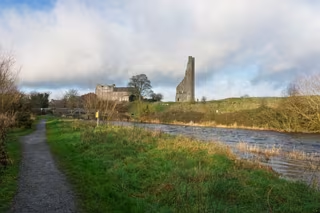
THE YELLOW STEEPLE IN TRIM COUNTY MEATH - PHOTOGRAPHED CHRISTMAS 2014
I am planning to spend a week at Christmas, 2026, in Trim and a before a week in Belfast so I am now reviewing my older photo catalogs.
The Yellow Steeple is the towering, seven-storey ruin of a bell tower that dominates the skyline of Trim on the northern bank of the River Boyne, directly overlooking the Porchfields and facing Hugh de Lacy's Norman stronghold. The golden yellow hue of its weathered limestone masonry at dawn and sunset gives the landmark its enduring name.
Rising roughly forty metres above the northern bank of the River Boyne, the Yellow Steeple is one of the most striking medieval silhouettes in County Meath. Positioned on an elevated ridge directly overlooking the historic Porchfields, the fractured seven-storey tower stands in silent dialogue with Hugh de Lacy's Norman castle across the water. The ruin takes its enduring name from the warm, golden-yellow hue that its weathered limestone masonry assumes when caught in the low rake of dawn or late-afternoon sunlight.
From Monastic Belfry to Fractured Ruin
The steeple was never conceived as an isolated watchtower; it was the monumental bell tower of St Mary’s Augustinian Abbey. While Christian worship on this ground dates back to the fifth century, the Augustinian priory was refounded in the late twelfth century and quickly grew into one of the most prominent pilgrimage destinations in medieval Ireland. It was particularly revered for housing the "Idol of Trim"—a carved wooden statue of Our Lady of Trim widely credited with miraculous intercessions.
Following fires that damaged the complex in the fourteenth and fifteenth centuries, the current bell tower was erected around 1368 (and likely rebuilt or extended around 1447) in the English Perpendicular Gothic manner. At its peak, it stood as a soaring statement of monastic wealth and civic authority.
The abbey’s fortune ended with Henry VIII’s Dissolution of the Monasteries in 1540. The community was suppressed, the lands were seized by the Crown, and the celebrated wooden statue of the Virgin was brought into the town and publicly burned. The church fabric deteriorated through the late sixteenth century, but the final, catastrophic ruination of the belfry came during the Confederate Wars in the 1640s.
Parliamentary forces under Sir Charles Coote systematically undermined and blasted the structure with gunpowder to prevent it from serving as a defensive look-out and garrison. The explosion sheared the massive tower cleanly in two: the eastern half collapsed into rubble, leaving the western wall, spiral stair turrets, and interior vaults permanently exposed to the elements.
The Castle Footbridge: Timber Rot and Steel Replacement
Pedestrian movement between Trim Castle and the northern riverbank has undergone substantial change over the past decade. For many years, pedestrian access across the Boyne to the Porchfields relied on a timber footbridge—often referred to as the Millennium Bridge—installed in the early 2000s directly opposite the castle curtain walls.
By 2022, severe timber decay and structural deterioration forced Meath County Council to close the crossing on safety grounds, followed shortly by complete demolition in August of that year. To maintain town connectivity while a permanent design moved through planning, a temporary military-grade Bailey bridge was installed. A permanent, modern 30-metre steel truss footbridge was subsequently approved and erected, fully reinstating the pedestrian route linking the castle grounds, the river walk, and the perimeter of the abbey ruins.
Questions & Answers
Why is the structure called the Yellow Steeple?
The name derives from the distinctive ochre and yellow tones of the cut limestone and aged mortar when illuminated by direct morning or evening sun.
What architectural details remain visible today?
The surviving western elevation retains seven distinct stages of masonry, punctuated by trefoil-headed belfry lancets, square window openings, springers for groin vaults, and fragmentary spiral stairs visible along the jagged fracture line.


THE YELLOW STEEPLE IN TRIM