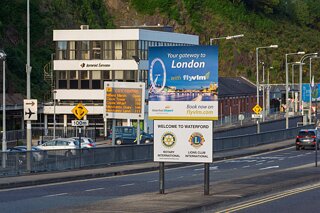
WATERFORD TRAIN STATION AS IT WAS IN MAY 2016
BACK IN MAY 2016 I PHOTOGRAPHED WATERFORD RAILWAY STATION AND THE PIETA ROCK [I USED A SONY NEX-7]
As I had a Sony A7RII with me I do not know why I used the Sony NEX-7. The problem was that sunset happened much quicker than I had expected and the camera could not cope with low light as you can see from some of the images.
The rock face painted bright yellow with "PIETA" in bold text is situated directly on the steep cliffside of Mount Misery overlooking Plunkett Station.
Significance & Background
Pieta House Awareness: The painting serves as a prominent mental health awareness monument supporting Pieta House (the Irish suicide and self-harm prevention charity).
Prominent City Landmark: Placed on the rocky outcrop above the train lines, it was deliberately positioned to be clearly visible to commuters arriving at the station, travellers crossing Rice Bridge, and people looking north from the Quay.
Community Tradition: Mount Misery’s exposed rock faces have a long-standing local tradition of community painting and political or social expression—most notably featuring the large Irish Tricolour rock nearby marked "1848" (commemorating the year Thomas Francis Meagher first raised the Irish Flag at 33 The Mall in Waterford).
History of the Old Station & Signal Box
Waterford’s existing railway station (renamed Plunkett Station in 1966 in memory of 1916 Rising leader Joseph Mary Plunkett) was established in 1864 on the north bank of the River Suir at Mountmisery.
A standout feature of the heritage site is its distinctive signal box, constructed around 1930. Unlike standard ground-level cabins, Waterford Signal Box is a elevated, timber-clad five-bay structure built directly spanning across the active railway lines on a single-span steel gantry. This unique architectural design makes it a recognized landmark of Irish railway engineering heritage.
Why Build Such a Large New Station?
Despite modest historical service frequencies, the new station is part of the €500m+ Waterford North Quays Strategic Development Zone (SDZ) and Project Ireland 2040 plan.
Integrated Transport Hub: The new facility consolidates rail, local and regional buses, taxi ranks, electric vehicle charging, and cycling routes into a single multi-modal transit hub.
Severe Flood Mitigation: The old Plunkett Station suffers from recurring river flooding during high tides. Moving 1 km east onto elevated, flood-protected ground ensures long-term operational resilience.
Greenway Connectivity: It acts as the direct interchange between national rail and Ireland's expanding active travel network, including the Waterford Greenway and the South East Greenway.
City Expansion: It underpins a brand-new urban quarter on the North Quays featuring retail, hotel, commercial, and residential developments.
Bridge vs. Station: Which Came First?
The bridge exists because of the station.
When planners chose to relocate the railway station 1 km east along the North Quays, a major obstacle emerged: the rail hub would be separated from Waterford's main city centre on the south bank. To solve this, the Sustainable Transport Bridge was designed specifically as an active-travel crossing for pedestrians, cyclists, and a public courtesy bus. It directly links the new station's concourse on the North Quays across the Suir to the city's historic Quays on the South side.
Granville Hotel, Future of the Old Site & Twin-Tracking
My Stay at the Granville: The historic Granville Hotel sits prominently on Meagher's Quay on the south side of the river. I will be positioned right at the landing point of the new Sustainable Transport Bridge, placing me directly opposite the new North Quays Transport Hub development. I booked the hotel a year ago as I had believed that the new bridge would be operational
Future of the Old Station: The existing station building and elevated signal box are protected structures under Ireland's National Inventory of Architectural Heritage (NIAH). While passenger services will transition entirely to the new terminal, the heritage architecture will be retained, integrated alongside new flood defense walls and realigned access routes.
National Inventory of Architectural Heritage
Twin-Track Upgrades: Yes. The project includes realigning the track approach and restoring double-track sections around the new station complex, replacing old mechanical levers with modern electronic signalling to allow greater train capacity and higher frequency in the future.
Both the new station and the Sustainable Transport Bridge are expected to become operational in late 2026 (that is what I was told last year) to 2027.
Expected Timelines
The Sustainable Transport Bridge: Physical structure installation and major deck spans across the River Suir were completed in 2025. Finishing works—such as public realm paving, lighting, glass balustrades, and landing integration at South Quays Plaza—are progressing toward an expected public opening in late 2026.
The New Transport Hub (Station): Building construction on the main terminal concourse, platforms, and plazas is substantially advanced, but the overall complex requires extensive track laying, modern electronic signalling installation, and formal regulatory safety certification. The rail terminal is targetting completion in Q3/Q4 2026, with first passenger services and full operational handover scheduled for late 2026 / 2027.
Returning next year (2027) will give me the chance to cross the active bridge on foot directly from the Granville Hotel into the fully functioning North Quays Transport Hub.
As I had a Sony A7RII with me I do not know why I used the Sony NEX-7. The problem was that sunset happened much quicker than I had expected and the camera could not cope with low light as you can see from some of the images.
The rock face painted bright yellow with "PIETA" in bold text is situated directly on the steep cliffside of Mount Misery overlooking Plunkett Station.
Significance & Background
Pieta House Awareness: The painting serves as a prominent mental health awareness monument supporting Pieta House (the Irish suicide and self-harm prevention charity).
Prominent City Landmark: Placed on the rocky outcrop above the train lines, it was deliberately positioned to be clearly visible to commuters arriving at the station, travellers crossing Rice Bridge, and people looking north from the Quay.
Community Tradition: Mount Misery’s exposed rock faces have a long-standing local tradition of community painting and political or social expression—most notably featuring the large Irish Tricolour rock nearby marked "1848" (commemorating the year Thomas Francis Meagher first raised the Irish Flag at 33 The Mall in Waterford).
History of the Old Station & Signal Box
Waterford’s existing railway station (renamed Plunkett Station in 1966 in memory of 1916 Rising leader Joseph Mary Plunkett) was established in 1864 on the north bank of the River Suir at Mountmisery.
A standout feature of the heritage site is its distinctive signal box, constructed around 1930. Unlike standard ground-level cabins, Waterford Signal Box is a elevated, timber-clad five-bay structure built directly spanning across the active railway lines on a single-span steel gantry. This unique architectural design makes it a recognized landmark of Irish railway engineering heritage.
Why Build Such a Large New Station?
Despite modest historical service frequencies, the new station is part of the €500m+ Waterford North Quays Strategic Development Zone (SDZ) and Project Ireland 2040 plan.
Integrated Transport Hub: The new facility consolidates rail, local and regional buses, taxi ranks, electric vehicle charging, and cycling routes into a single multi-modal transit hub.
Severe Flood Mitigation: The old Plunkett Station suffers from recurring river flooding during high tides. Moving 1 km east onto elevated, flood-protected ground ensures long-term operational resilience.
Greenway Connectivity: It acts as the direct interchange between national rail and Ireland's expanding active travel network, including the Waterford Greenway and the South East Greenway.
City Expansion: It underpins a brand-new urban quarter on the North Quays featuring retail, hotel, commercial, and residential developments.
Bridge vs. Station: Which Came First?
The bridge exists because of the station.
When planners chose to relocate the railway station 1 km east along the North Quays, a major obstacle emerged: the rail hub would be separated from Waterford's main city centre on the south bank. To solve this, the Sustainable Transport Bridge was designed specifically as an active-travel crossing for pedestrians, cyclists, and a public courtesy bus. It directly links the new station's concourse on the North Quays across the Suir to the city's historic Quays on the South side.
Granville Hotel, Future of the Old Site & Twin-Tracking
My Stay at the Granville: The historic Granville Hotel sits prominently on Meagher's Quay on the south side of the river. I will be positioned right at the landing point of the new Sustainable Transport Bridge, placing me directly opposite the new North Quays Transport Hub development. I booked the hotel a year ago as I had believed that the new bridge would be operational
Future of the Old Station: The existing station building and elevated signal box are protected structures under Ireland's National Inventory of Architectural Heritage (NIAH). While passenger services will transition entirely to the new terminal, the heritage architecture will be retained, integrated alongside new flood defense walls and realigned access routes.
National Inventory of Architectural Heritage
Twin-Track Upgrades: Yes. The project includes realigning the track approach and restoring double-track sections around the new station complex, replacing old mechanical levers with modern electronic signalling to allow greater train capacity and higher frequency in the future.
Both the new station and the Sustainable Transport Bridge are expected to become operational in late 2026 (that is what I was told last year) to 2027.
Expected Timelines
The Sustainable Transport Bridge: Physical structure installation and major deck spans across the River Suir were completed in 2025. Finishing works—such as public realm paving, lighting, glass balustrades, and landing integration at South Quays Plaza—are progressing toward an expected public opening in late 2026.
The New Transport Hub (Station): Building construction on the main terminal concourse, platforms, and plazas is substantially advanced, but the overall complex requires extensive track laying, modern electronic signalling installation, and formal regulatory safety certification. The rail terminal is targetting completion in Q3/Q4 2026, with first passenger services and full operational handover scheduled for late 2026 / 2027.
Returning next year (2027) will give me the chance to cross the active bridge on foot directly from the Granville Hotel into the fully functioning North Quays Transport Hub.
THE OLD STATION IN WATERFORD