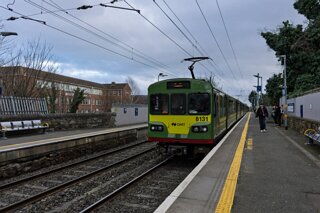
I HAD TO WAIT FOR ABOUT AN HOUR FOR A TRAIN
The Long Wait: Navigating Dublin’s Holiday Transport Gridlock
For any urban explorer or photographer, the allure of a quiet city on a Bank Holiday is often tempered by the logistical labyrinth of the transport network. St. Patrick’s Day 2026 proved to be a case study in this frustration. While the city centre becomes a focal point for parades and festivities, the infrastructure supporting those who wish to venture further afield—such as a walk across the Sandymount strand—can be surprisingly fragile.
The Holiday Constraint: A Predictable Disconnect
It is a recurring irony in Irish transport: on the days when the public has the most time to travel, the services are at their most restricted. Bank Holidays frequently see the implementation of "Sunday Service" schedules, which, while predictable on paper, often fail to account for the actual flow of people displaced by event closures.
The Regional Split: It is often the case that engineering works or revised schedules result in no train services operating on either the northside or the southside lines. This effectively bisects the city, turning a simple cross-town journey into an endurance test of walking or waiting for elusive buses.
The Cross-Border Gap: Even the flagship Enterprise service is not immune. On several Bank Holidays throughout the year, there are no train services operating between Dublin and Belfast, severing the primary rail link between the two cities just when leisure travel is at its peak.
Lansdowne Road: A Station of Heritage and Transition
Finding oneself stranded at Lansdowne Road station for an hour provides a rare moment of stillness in a location usually defined by high-velocity transit and match-day crowds.
Opened in 1870, Lansdowne Road is one of the oldest commuter stations in the world. Its historical importance is inextricably linked to the development of the Dublin and Kingstown Railway. It serves as the primary gateway to the Aviva Stadium, but beyond the modern steel and glass of the arena, the station sits at a fascinating architectural crossroads. It bridges the gap between the grand Victorian terraces of Dublin 4 and the industrial echoes of the nearby Dodder River.
For the digital archivist, an hour’s delay here isn't just lost time; it is an opportunity to document the "built environment" in its most dormant state—the empty platforms and the silent tracks offering a stark contrast to the chaos of the city centre parade.
For any urban explorer or photographer, the allure of a quiet city on a Bank Holiday is often tempered by the logistical labyrinth of the transport network. St. Patrick’s Day 2026 proved to be a case study in this frustration. While the city centre becomes a focal point for parades and festivities, the infrastructure supporting those who wish to venture further afield—such as a walk across the Sandymount strand—can be surprisingly fragile.
The Holiday Constraint: A Predictable Disconnect
It is a recurring irony in Irish transport: on the days when the public has the most time to travel, the services are at their most restricted. Bank Holidays frequently see the implementation of "Sunday Service" schedules, which, while predictable on paper, often fail to account for the actual flow of people displaced by event closures.
The Regional Split: It is often the case that engineering works or revised schedules result in no train services operating on either the northside or the southside lines. This effectively bisects the city, turning a simple cross-town journey into an endurance test of walking or waiting for elusive buses.
The Cross-Border Gap: Even the flagship Enterprise service is not immune. On several Bank Holidays throughout the year, there are no train services operating between Dublin and Belfast, severing the primary rail link between the two cities just when leisure travel is at its peak.
Lansdowne Road: A Station of Heritage and Transition
Finding oneself stranded at Lansdowne Road station for an hour provides a rare moment of stillness in a location usually defined by high-velocity transit and match-day crowds.
Opened in 1870, Lansdowne Road is one of the oldest commuter stations in the world. Its historical importance is inextricably linked to the development of the Dublin and Kingstown Railway. It serves as the primary gateway to the Aviva Stadium, but beyond the modern steel and glass of the arena, the station sits at a fascinating architectural crossroads. It bridges the gap between the grand Victorian terraces of Dublin 4 and the industrial echoes of the nearby Dodder River.
For the digital archivist, an hour’s delay here isn't just lost time; it is an opportunity to document the "built environment" in its most dormant state—the empty platforms and the silent tracks offering a stark contrast to the chaos of the city centre parade.


LANDSDOWNE TRAIN STATION