POHOTOGRAPHED USING A SONY A7RVI
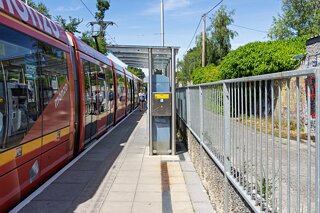
COWPER LUAS TRAM STOP [PHOTOGRAPHED 21 JUNE 2026]
Cowper is a key station on the Green Line of the Luas, Dublin’s light rail system. Situated in the suburb of Rathmines, it provides a vital transit link for local residents and commuters. The stop officially opened on 30 June 2004 as part of the initial Green Line service, which connected St Stephen's Green to Sandyford.
While the Luas line itself makes extensive use of the disused alignment of the former Harcourt Street railway, Cowper was not an original station on the historical line that once served the route towards Bray. The Harcourt Street railway originally ran from Harcourt Street to Dún Laoghaire (then Kingstown) and later to Bray, but Cowper was specifically developed as a new infrastructure point for the modern Luas network. The stop is characterised by its two entrances—one on Merton Road and one on Tudor Road—which lead to platforms nestled behind residential properties.
The surrounding area is a well-established residential enclave. It offers excellent connectivity to nearby hubs like Ranelagh and Rathmines, where residents access an array of amenities including banks, post offices, supermarkets, and a variety of dining and coffee shops. The locale is highly regarded for its blend of quiet, tree-lined streets and proximity to the vibrant services of south Dublin.
The Proposed Metrolink
The proposed MetroLink (formerly Metro North/South) project has had a complex history regarding the Cowper area.
Was the Metro intended to serve Cowper?
Yes, in earlier iterations of the plan, the project was intended to extend significantly further south than its current proposed terminus. Specifically, the original vision for Metro South involved upgrading the existing Luas Green Line infrastructure to a full "metro standard."
Under those earlier proposals, the metro line would have emerged from an underground portal near the Ranelagh/Beechwood area and continued overground, effectively subsuming the existing Luas Green Line tracks through to Sandyford. Had this proceeded, Cowper would have been upgraded from a tram stop to a high-capacity metro station. However, this sparked significant local opposition due to the required infrastructure changes—such as grade-separated crossings, longer platforms, and the potential for extensive service closures—which led to the scaling back of the project.
Future transport plans for the area
With the project now formally confirmed to terminate at Charlemont, the future of transport for the Cowper and Rathmines area relies on the continued operation and potential capacity enhancement of the existing Luas Green Line.
No Metro Expansion: The current Railway Order for MetroLink authorises the line to run from Estuary (Swords) to Charlemont only. There are no active plans to extend MetroLink through the Cowper area.
The "Green Line" Future: The focus has shifted toward maintaining the Luas as the primary high-capacity transit corridor for the south city. Instead of a full metro upgrade, future transport strategy for this corridor is governed by the Greater Dublin Area (GDA) Transport Strategy. This emphasises "bus-based system" improvements, such as the BusConnects programme, to provide better orbital connectivity and feed into the existing Luas/Metro hubs.
Charlemont as a Hub: Charlemont is set to become the critical interchange point. The strategy aims to integrate the high-capacity MetroLink (arriving from the north and city centre) with the existing Luas network. Passengers traveling from Cowper will continue to use the Green Line to reach Charlemont, where they can transfer to the MetroLink for rapid access to the city centre, Dublin Airport, and the northern suburbs.
Essentially, the "metro" element for the area remains the existing light rail infrastructure, with the new MetroLink serving as a separate, northern-focused artery that terminates where the light rail network begins to provide the bulk of the suburban service.
Luas latforms were extended a few years ago—this was the Green Line Capacity Enhancement (GLCE) project, which saw platforms lengthened to approximately 53 metres to accommodate the longer 55-metre Citadis 502 trams.
Is there space for further extension?
Technically, yes, it is possible to extend them further, but it is highly problematic and currently not part of the active transport strategy.
During the planning stages for the MetroLink project (when there was a proposal to upgrade the Green Line to a full metro standard), Transport Infrastructure Ireland (TII) conducted detailed engineering assessments. Those reports highlighted significant constraints specifically for stations like Cowper:
The Land Take Issue: To extend the platforms to the 90-metre lengths required for full metro-style vehicles, TII noted that they would have to acquire land from private back gardens. In the case of Cowper, extending the platforms northward would require taking approximately 2.5 metres of land from nine private residential gardens.
Structural Impacts: Extending southward at Cowper would displace the existing pedestrian crossing, creating a new safety risk for commuters. Other stations, such as Ranelagh, would face even more complex issues, including the demolition and reconstruction of passenger access buildings, lift shafts, and stairwells.
Operational Disruption: Beyond the physical space, extending platforms would require "major and extended" closures of the line, which was a primary reason the plan to convert the Green Line into a metro was abandoned in favour of the current "terminate at Charlemont" model.
Why the conversation about "longer" platforms persists
You may be hearing about "longer" trams or platforms because of the contrast between the current light rail system and the proposed MetroLink specifications:
Light Rail (Current): The current system uses 55-metre trams. The platforms are already at their functional limit for this vehicle class.
MetroLink (Future): The new MetroLink system is designed for 90-metre trains. If the Green Line were ever to be converted to a "metro" (a project that is effectively off the table), those 90-metre platforms would be mandatory.
In summary: There is no "spare" land at Cowper to accommodate longer platforms without significant encroachment on private property and costly structural alterations. Since the MetroLink project has been scaled back to terminate at Charlemont, there is currently no legislative or operational pressure to pursue these difficult and intrusive extensions. The focus remains on maximising the efficiency of the existing 55-metre platform configuration.
Cowper is a key station on the Green Line of the Luas, Dublin’s light rail system. Situated in the suburb of Rathmines, it provides a vital transit link for local residents and commuters. The stop officially opened on 30 June 2004 as part of the initial Green Line service, which connected St Stephen's Green to Sandyford.
While the Luas line itself makes extensive use of the disused alignment of the former Harcourt Street railway, Cowper was not an original station on the historical line that once served the route towards Bray. The Harcourt Street railway originally ran from Harcourt Street to Dún Laoghaire (then Kingstown) and later to Bray, but Cowper was specifically developed as a new infrastructure point for the modern Luas network. The stop is characterised by its two entrances—one on Merton Road and one on Tudor Road—which lead to platforms nestled behind residential properties.
The surrounding area is a well-established residential enclave. It offers excellent connectivity to nearby hubs like Ranelagh and Rathmines, where residents access an array of amenities including banks, post offices, supermarkets, and a variety of dining and coffee shops. The locale is highly regarded for its blend of quiet, tree-lined streets and proximity to the vibrant services of south Dublin.
The Proposed Metrolink
The proposed MetroLink (formerly Metro North/South) project has had a complex history regarding the Cowper area.
Was the Metro intended to serve Cowper?
Yes, in earlier iterations of the plan, the project was intended to extend significantly further south than its current proposed terminus. Specifically, the original vision for Metro South involved upgrading the existing Luas Green Line infrastructure to a full "metro standard."
Under those earlier proposals, the metro line would have emerged from an underground portal near the Ranelagh/Beechwood area and continued overground, effectively subsuming the existing Luas Green Line tracks through to Sandyford. Had this proceeded, Cowper would have been upgraded from a tram stop to a high-capacity metro station. However, this sparked significant local opposition due to the required infrastructure changes—such as grade-separated crossings, longer platforms, and the potential for extensive service closures—which led to the scaling back of the project.
Future transport plans for the area
With the project now formally confirmed to terminate at Charlemont, the future of transport for the Cowper and Rathmines area relies on the continued operation and potential capacity enhancement of the existing Luas Green Line.
No Metro Expansion: The current Railway Order for MetroLink authorises the line to run from Estuary (Swords) to Charlemont only. There are no active plans to extend MetroLink through the Cowper area.
The "Green Line" Future: The focus has shifted toward maintaining the Luas as the primary high-capacity transit corridor for the south city. Instead of a full metro upgrade, future transport strategy for this corridor is governed by the Greater Dublin Area (GDA) Transport Strategy. This emphasises "bus-based system" improvements, such as the BusConnects programme, to provide better orbital connectivity and feed into the existing Luas/Metro hubs.
Charlemont as a Hub: Charlemont is set to become the critical interchange point. The strategy aims to integrate the high-capacity MetroLink (arriving from the north and city centre) with the existing Luas network. Passengers traveling from Cowper will continue to use the Green Line to reach Charlemont, where they can transfer to the MetroLink for rapid access to the city centre, Dublin Airport, and the northern suburbs.
Essentially, the "metro" element for the area remains the existing light rail infrastructure, with the new MetroLink serving as a separate, northern-focused artery that terminates where the light rail network begins to provide the bulk of the suburban service.
Luas latforms were extended a few years ago—this was the Green Line Capacity Enhancement (GLCE) project, which saw platforms lengthened to approximately 53 metres to accommodate the longer 55-metre Citadis 502 trams.
Is there space for further extension?
Technically, yes, it is possible to extend them further, but it is highly problematic and currently not part of the active transport strategy.
During the planning stages for the MetroLink project (when there was a proposal to upgrade the Green Line to a full metro standard), Transport Infrastructure Ireland (TII) conducted detailed engineering assessments. Those reports highlighted significant constraints specifically for stations like Cowper:
The Land Take Issue: To extend the platforms to the 90-metre lengths required for full metro-style vehicles, TII noted that they would have to acquire land from private back gardens. In the case of Cowper, extending the platforms northward would require taking approximately 2.5 metres of land from nine private residential gardens.
Structural Impacts: Extending southward at Cowper would displace the existing pedestrian crossing, creating a new safety risk for commuters. Other stations, such as Ranelagh, would face even more complex issues, including the demolition and reconstruction of passenger access buildings, lift shafts, and stairwells.
Operational Disruption: Beyond the physical space, extending platforms would require "major and extended" closures of the line, which was a primary reason the plan to convert the Green Line into a metro was abandoned in favour of the current "terminate at Charlemont" model.
Why the conversation about "longer" platforms persists
You may be hearing about "longer" trams or platforms because of the contrast between the current light rail system and the proposed MetroLink specifications:
Light Rail (Current): The current system uses 55-metre trams. The platforms are already at their functional limit for this vehicle class.
MetroLink (Future): The new MetroLink system is designed for 90-metre trains. If the Green Line were ever to be converted to a "metro" (a project that is effectively off the table), those 90-metre platforms would be mandatory.
In summary: There is no "spare" land at Cowper to accommodate longer platforms without significant encroachment on private property and costly structural alterations. Since the MetroLink project has been scaled back to terminate at Charlemont, there is currently no legislative or operational pressure to pursue these difficult and intrusive extensions. The focus remains on maximising the efficiency of the existing 55-metre platform configuration.
COWPER TRAM STOP