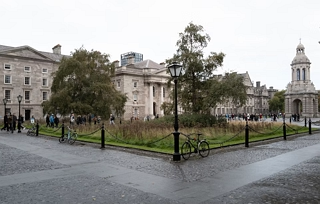
I TESTED THE CHANGES TO MY LEICA Q3 BY PHOTOGRAPHING THE TRINITY COLLEGE CAMPUS
Tomorrow I travel to Limerick in order to photograph the City and County and I am still trying to decide what equipment to bring with me. As already mention I have had many issues with the Leica Q3 and have been reluctant to depend on it so i spent the last week trying to migrate all issues. However, I found that I could not depend on my photographs being accurately geo-taggesd so I decided to try installing a Geo Tagging app on my new iPhone 18 Pro and importing the resulting files into Lightroom Classic and it worked much better that I had expected.
Alongside the logging test, I revisited classic zone focusing (or scale focusing) on the fixed 28mm Summilux. For candid street documentation, zone focusing remains an indispensable technique. Fleeting moments along urban thoroughfares rarely afford you the luxury of lifting the viewfinder to your eye, waiting for an autofocus point to acquire contrast, and then framing the shot. By manually pre-setting the focus tab to a predetermined distance—say, two to three metres—and stopping the aperture down to f/8 or f/11, the optical depth of field creates a reliable zone of acceptable sharpness. If a subject enters that spatial window, all that remains is framing and tripping the shutter cleanly.
Field tests with both methods yielded solid, usable results, though the optical setup highlighted two practical caveats:
Avoid Hard Infinity: Setting the distance scale hard against the infinity stop wastes a significant portion of the hyperfocal depth of field behind the horizon. Instead, pulling back slightly—aligning infinity with the far marker of your chosen working aperture on the depth-of-field scale—maximises near-distance sharpness without sacrificing background definition.
Focus Creep: Walking with the camera handheld or on a sling inevitably causes the smooth manual focusing ring and focus tab to drift out of position through friction against clothing. Regular thumb checks against the distance scale, or applying a subtle friction band or a small piece of gaffer tape across the barrel once the zone is locked, are essential to prevent unprompted shifts during active walking.
What About Using Fill Flash - As Was Recommended To Me By A Leica User
Technical Investigation: Why High Shutter Speeds Work Best
My observation about needing high shutter speeds with the Godox iT30Pro L TTL Mini Flash on the Leica Q3 aligns directly with two interrelated photographic principles: the Leica Q3’s leaf shutter mechanics and flash-to-ambient balance in street photography.
1. Leaf Shutter Sync Advantage
Unlike focal-plane shutters (standard mirrorless/DSLRs) that limit regular flash sync to 1/200s or 1/250s before requiring power-draining High-Speed Sync (HSS), the Leica Q3 uses an in-lens leaf shutter capable of syncing with flash all the way up to 1/2000s natively. At 1/2000s, the Godox iT30Pro delivers its full burst without pulsing in HSS mode.
2. Why Slow Shutter Speeds Fall Short in Zone-Focused Street Work
Ghosting & Motion Blur: In zone focusing at f/8 or f/11, you are shooting from the hip or moving on the fly. If your shutter speed is moderate (e.g., 1/125s–1/250s), ambient daylight records street motion or camera shake alongside the flash burst, producing double-contours and blurry ghost edges around your subject.
Ambient Overpowering: Daylight at f/8 often overpowers the modest guide number of a pocket flash (GN 15). A high shutter speed (1/1000s–1/2000s) cuts daylight ambient exposure down by 2 to 3 stops, allowing the iT30Pro burst to freeze your subject cleanly with punchy micro-contrast.
Recommended Settings
Daytime Candid Street (Direct Fill / Gilden Aesthetic)
Mode: Manual exposure on camera, TTL with −0.7 to −1.3 EV Flash Exposure Compensation (FEC).
Aperture: f/8 (keeps 1.5 m to 4 m pin-sharp on the 28mm Summilux).
Shutter Speed: 1/1000s to 1/2000s (harness the leaf shutter to drop daylight ambient and eliminate ghosting).
ISO: Base ISO 100 (or Auto ISO capped at 400).
Focus Distance: Pre-set manually to 2.0 m−2.5 m.
Flash Head: Flip-out diffuser deployed to soften direct harshness and match the wide 28mm field of view.
Night & Low-Light Photography
Mode: Manual exposure, TTL flash set to 0.0 to +0.3 EV.
Aperture: f/4 to f/5.6 (preserves working depth of field without depleting the mini flash's capacitor).
Shutter Speed:
Crisp / Black Backgrounds: 1/500s to 1/1000s (subject isolated, background falls into deep shadow).
Cinematic "Dragged Shutter" (Neon/City Lights): 1/15s to 1/60s set to Rear-Curtain Sync. The flash freezes subject motion cleanly, while the slow shutter allows Limerick streetlights and storefront neon to burn into the background.
ISO: ISO 800 to 1600 (gives the iT30Pro fast recycle times and preserves battery on cold nights).
Focus Distance: Pre-set to 1.8 m−2.2 m.
A Brief Summary
Here is what works, what failed, and the field settings making the final cut.
1. Geo-Tagging Without Frustration
Relying entirely on passive background GPS pairing via manufacturer apps frequently leads to missed coordinates or battery drain. Before packing for Limerick, I switched to logging tracks directly via a dedicated GPS tracker on my iPhone 18 Pro. Exporting the GPX tracklog and synchronising timestamps in Lightroom Classic’s Map module proved exponentially faster and 100% reliable. If you rely on archival precision for regional documentation, external GPX logging remains the cleanest workflow.
2. Mastering the 28mm Zone Focus Window
Candid street photography rarely offers the luxury of waiting on autofocus contrast detection. The mechanical focus tab on the fixed 28mm Summilux is designed for speed:
The Setup: Setting the aperture to f/8 and the distance index to approximately 2.2 metres gives an immediate depth-of-field window roughly spanning 1.4 to 4.5 metres.
Avoid Hard Infinity: Jamming the ring against the hard infinity stop throws away half your optical depth of field into the sky. Align infinity with your working aperture’s far depth-of-field mark instead to pull sharpness closer to your feet.
Countering Focus Creep: Movement on a neck strap or sling easily rubs the focus tab out of alignment. A regular thumb check against the barrel—or a discrete strip of gaffer tape across the distance scale once locked—is mandatory during active walking.
3. Why the Godox iT30Pro L Demands High Shutter Speeds
Mounting the miniature Godox iT30Pro L TTL onto the Q3 opened up a powerful creative dynamic. Because the Leica Q3 features an in-lens leaf shutter, it can sync flash natively up to an astonishing 1/2000s.
When shooting zone-focused candid scenes, keeping shutter speeds high (1/1000s–1/2000s) produces the crispest results:
Separates Ambient from Subject: Shutter speed controls ambient light, while aperture and flash duration control the subject. High shutter speeds suppress bright daylight backgrounds, letting the punchy mini flash pop your subject forward.
Eliminates Ghosting: Moving rapidly with pre-focused lenses at slow shutter speeds leads to double-imaging. Cranking the shutter takes full advantage of the leaf shutter, freezing motion instantly with zero HSS power penalty.
For night shoots along Limerick's riverfront and docks, dial the shutter down to 1/30s with rear-curtain sync to drag ambient city ambient light, or stay at 1/500s at f/5.6 to cleanly freeze nightlife subjects against dramatic low-key backdrops.
Alongside the logging test, I revisited classic zone focusing (or scale focusing) on the fixed 28mm Summilux. For candid street documentation, zone focusing remains an indispensable technique. Fleeting moments along urban thoroughfares rarely afford you the luxury of lifting the viewfinder to your eye, waiting for an autofocus point to acquire contrast, and then framing the shot. By manually pre-setting the focus tab to a predetermined distance—say, two to three metres—and stopping the aperture down to f/8 or f/11, the optical depth of field creates a reliable zone of acceptable sharpness. If a subject enters that spatial window, all that remains is framing and tripping the shutter cleanly.
Field tests with both methods yielded solid, usable results, though the optical setup highlighted two practical caveats:
Avoid Hard Infinity: Setting the distance scale hard against the infinity stop wastes a significant portion of the hyperfocal depth of field behind the horizon. Instead, pulling back slightly—aligning infinity with the far marker of your chosen working aperture on the depth-of-field scale—maximises near-distance sharpness without sacrificing background definition.
Focus Creep: Walking with the camera handheld or on a sling inevitably causes the smooth manual focusing ring and focus tab to drift out of position through friction against clothing. Regular thumb checks against the distance scale, or applying a subtle friction band or a small piece of gaffer tape across the barrel once the zone is locked, are essential to prevent unprompted shifts during active walking.
What About Using Fill Flash - As Was Recommended To Me By A Leica User
Technical Investigation: Why High Shutter Speeds Work Best
My observation about needing high shutter speeds with the Godox iT30Pro L TTL Mini Flash on the Leica Q3 aligns directly with two interrelated photographic principles: the Leica Q3’s leaf shutter mechanics and flash-to-ambient balance in street photography.
1. Leaf Shutter Sync Advantage
Unlike focal-plane shutters (standard mirrorless/DSLRs) that limit regular flash sync to 1/200s or 1/250s before requiring power-draining High-Speed Sync (HSS), the Leica Q3 uses an in-lens leaf shutter capable of syncing with flash all the way up to 1/2000s natively. At 1/2000s, the Godox iT30Pro delivers its full burst without pulsing in HSS mode.
2. Why Slow Shutter Speeds Fall Short in Zone-Focused Street Work
Ghosting & Motion Blur: In zone focusing at f/8 or f/11, you are shooting from the hip or moving on the fly. If your shutter speed is moderate (e.g., 1/125s–1/250s), ambient daylight records street motion or camera shake alongside the flash burst, producing double-contours and blurry ghost edges around your subject.
Ambient Overpowering: Daylight at f/8 often overpowers the modest guide number of a pocket flash (GN 15). A high shutter speed (1/1000s–1/2000s) cuts daylight ambient exposure down by 2 to 3 stops, allowing the iT30Pro burst to freeze your subject cleanly with punchy micro-contrast.
Recommended Settings
Daytime Candid Street (Direct Fill / Gilden Aesthetic)
Mode: Manual exposure on camera, TTL with −0.7 to −1.3 EV Flash Exposure Compensation (FEC).
Aperture: f/8 (keeps 1.5 m to 4 m pin-sharp on the 28mm Summilux).
Shutter Speed: 1/1000s to 1/2000s (harness the leaf shutter to drop daylight ambient and eliminate ghosting).
ISO: Base ISO 100 (or Auto ISO capped at 400).
Focus Distance: Pre-set manually to 2.0 m−2.5 m.
Flash Head: Flip-out diffuser deployed to soften direct harshness and match the wide 28mm field of view.
Night & Low-Light Photography
Mode: Manual exposure, TTL flash set to 0.0 to +0.3 EV.
Aperture: f/4 to f/5.6 (preserves working depth of field without depleting the mini flash's capacitor).
Shutter Speed:
Crisp / Black Backgrounds: 1/500s to 1/1000s (subject isolated, background falls into deep shadow).
Cinematic "Dragged Shutter" (Neon/City Lights): 1/15s to 1/60s set to Rear-Curtain Sync. The flash freezes subject motion cleanly, while the slow shutter allows Limerick streetlights and storefront neon to burn into the background.
ISO: ISO 800 to 1600 (gives the iT30Pro fast recycle times and preserves battery on cold nights).
Focus Distance: Pre-set to 1.8 m−2.2 m.
A Brief Summary
Here is what works, what failed, and the field settings making the final cut.
1. Geo-Tagging Without Frustration
Relying entirely on passive background GPS pairing via manufacturer apps frequently leads to missed coordinates or battery drain. Before packing for Limerick, I switched to logging tracks directly via a dedicated GPS tracker on my iPhone 18 Pro. Exporting the GPX tracklog and synchronising timestamps in Lightroom Classic’s Map module proved exponentially faster and 100% reliable. If you rely on archival precision for regional documentation, external GPX logging remains the cleanest workflow.
2. Mastering the 28mm Zone Focus Window
Candid street photography rarely offers the luxury of waiting on autofocus contrast detection. The mechanical focus tab on the fixed 28mm Summilux is designed for speed:
The Setup: Setting the aperture to f/8 and the distance index to approximately 2.2 metres gives an immediate depth-of-field window roughly spanning 1.4 to 4.5 metres.
Avoid Hard Infinity: Jamming the ring against the hard infinity stop throws away half your optical depth of field into the sky. Align infinity with your working aperture’s far depth-of-field mark instead to pull sharpness closer to your feet.
Countering Focus Creep: Movement on a neck strap or sling easily rubs the focus tab out of alignment. A regular thumb check against the barrel—or a discrete strip of gaffer tape across the distance scale once locked—is mandatory during active walking.
3. Why the Godox iT30Pro L Demands High Shutter Speeds
Mounting the miniature Godox iT30Pro L TTL onto the Q3 opened up a powerful creative dynamic. Because the Leica Q3 features an in-lens leaf shutter, it can sync flash natively up to an astonishing 1/2000s.
When shooting zone-focused candid scenes, keeping shutter speeds high (1/1000s–1/2000s) produces the crispest results:
Separates Ambient from Subject: Shutter speed controls ambient light, while aperture and flash duration control the subject. High shutter speeds suppress bright daylight backgrounds, letting the punchy mini flash pop your subject forward.
Eliminates Ghosting: Moving rapidly with pre-focused lenses at slow shutter speeds leads to double-imaging. Cranking the shutter takes full advantage of the leaf shutter, freezing motion instantly with zero HSS power penalty.
For night shoots along Limerick's riverfront and docks, dial the shutter down to 1/30s with rear-curtain sync to drag ambient city ambient light, or stay at 1/500s at f/5.6 to cleanly freeze nightlife subjects against dramatic low-key backdrops.
TESTING MY LEICA Q3