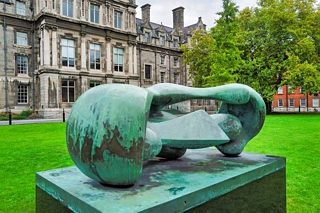
ONCE MORE I USED A HENRY MOORE SCULPTURE TO TEST MY LEICA Q3 BEFORE I BRING IT WITH ME TO LIMERICK
While I am still weighing up which interchangeable lenses to pack for my upcoming trip to Limerick, one decision is settled: the Leica Q3 is coming with me. The primary deciding factor is the weather forecast. With persistent rain on the cards, the Q3’s IP52 weather sealing provides essential peace of mind when working on damp, exposed quays and city streets where changing lenses would simply invite moisture into a sensor chamber.
My history with the Q3 on extended, week-long city assignments has not been without frustration. Prior to the Version 4 firmware updates, the camera proved notoriously temperamental. It suffered from random lockups and would abruptly trigger video mode, refusing to return to stills capture even after pulling the battery to force a hard reboot. While subsequent firmware releases resolved those catastrophic stability crashes, they unfortunately exacerbated background geotagging headaches via the Leica FOTOS app, which frequently dropped connections or drained battery reserves.
To overcome this, I tested an alternative workflow today: offloading location duties entirely to a dedicated standalone GPS logger running on my iPhone, synchronising the track log against the camera’s internal clock in post-processing. Decoupling the camera from a continuous Bluetooth and Wi-Fi tether not only preserves camera battery life in colder weather but ensures an unbroken, accurate spatial record of every street walked.
Alongside the logging test, I revisited classic zone focusing (or scale focusing) on the fixed 28mm Summilux. For candid street documentation, zone focusing remains an indispensable technique. Fleeting moments along urban thoroughfares rarely afford you the luxury of lifting the viewfinder to your eye, waiting for an autofocus point to acquire contrast, and then framing the shot. By manually pre-setting the focus tab to a predetermined distance—say, two to three metres—and stopping the aperture down to f/8 or f/11, the optical depth of field creates a reliable zone of acceptable sharpness. If a subject enters that spatial window, all that remains is framing and tripping the shutter cleanly.
Field tests with both methods yielded solid, usable results, though the optical setup highlighted two practical caveats:
Avoid Hard Infinity: Setting the distance scale hard against the infinity stop wastes a significant portion of the hyperfocal depth of field behind the horizon. Instead, pulling back slightly—aligning infinity with the far marker of your chosen working aperture on the depth-of-field scale—maximises near-distance sharpness without sacrificing background definition.
Focus Creep: Walking with the camera handheld or on a sling inevitably causes the smooth manual focusing ring and focus tab to drift out of position through friction against clothing. Regular thumb checks against the distance scale, or applying a subtle friction band or a small piece of gaffer tape across the barrel once the zone is locked, are essential to prevent unprompted shifts during active walking.
Reclining and Connected Forms by Henry Moore - Trinity College Dublin
For some strange reason, this sculpture appears to be largely ignored by visitors and tourists—the same crowds who obsessively photograph almost everything else on campus bypass this astonishingly complex work. However on a previous visit many years ago I did overhear a few passers-by refer to it as "obscene."
While that comment might sound surprising today, reactions of discomfort or moral outrage toward Henry Moore's art are far from new. Throughout his career, Moore’s abstract, organic interpretations of the human form—characterized by undulating contours, pierced cavities, and suggestive curves—frequently provoked strong reactions from traditionalists who found his sensual, hollowed-out figures unsettling or even vulgar. What some view as a graceful dialogue between geometry and the human body, others still perceive through a lens of visual awkwardness or anatomical impropriety.
The Journey to Library Square
The presence of Reclining Connected Forms at Trinity College Dublin came after a prolonged search for the right artistic fit:
The King and Queen: Years ago, Henry Moore generously loaned a sculpture known as The King and Queen, which was placed on the Library forecourt. However, Moore was dissatisfied with the setting—feeling the piece conflicted with the forecourt lanterns and suffered from a lack of sunlight on the north-facing site—and requested its return.
The Pomodoro Replacement: Trinity worked persistently to find a suitable replacement. They eventually selected Arnaldo Pomodoro’s Sphere Within Sphere, which now stands permanently on the forecourt and feels as though it were custom-made for the location—a perfect outcome.
A Permanent Home: Trinity ultimately secured another work by Moore, agreeing on a site in Library Square where Reclining Connected Forms has proudly remained ever since.
About the Artist
Henry Spencer Moore OM CH FBA (30 July 1898 – 31 August 1986) was an acclaimed English artist, world-renowned for his semi-abstract monumental bronze sculptures installed in public spaces globally. Alongside his sculpture, Moore produced extensive graphic works, including a famous series of drawings depicting Londoners sheltering in the Underground during the Blitz.
Moore’s forms are typically abstractions of the human figure, most notably reclining figures and mother-and-child motifs. Aside from a phase in the 1950s focused on family groups, his works are heavily suggestive of the female form, often pierced or containing hollow spaces. Many art historians liken the undulating contours of his figures to the rolling hills and landscape of his native Yorkshire.
Instrumental in introducing a distinct form of modernism to the United Kingdom, Moore achieved immense international recognition. His ability to fulfil large-scale commissions made him exceptionally wealthy in later life, yet he maintained a frugal lifestyle—directing the majority of his earnings into endowing the Henry Moore Foundation, which continues to support arts education and promotion today.
HENRY MOORE SCULPTURE