I USED A LEICA Q3 TODAY AT TRINITY COLLEGE CAMPUS
Black Cactus at Trinity College Dublin - Alexander Calder’s Masterclass in Steel
A Black Stabile on Fellows’ Square
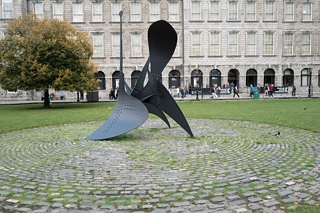
In the high-energy landscape of urban public art, certain works command attention not through saturated colour or sprawling scale, but through pure structural authority. Positioned on the circular lawn of Fellows’ Square at Trinity College Dublin, Alexander Calder’s 1967 sculpture Cactus Provisoire stands as an exemplar of form, material weight, and spatial discipline.
Framed through the Summilux 28mm f/1.7 lens of a Leica Q3, the piece reveals its dual nature instantly. Executed in heavy welded sheet steel and finished in an absorbent, flat matt black, it serves as an uncompromising visual anchor against the board-marked concrete of Paul Koralek’s Brutalist Berkeley Library.
The 60-megapixel sensor resolves the subtle tactile contrast: where the library asserts rigid horizontal mass and geometric rhythm, Calder’s biomorphic silhouette cuts through the frame like an organic entity arrested mid-growth. Rather than reflecting the shifting Irish sky, the monochrome surface absorbs the ambient light, allowing its perimeter to carve crisply into the background of historic granite ashlar and manicured lawn.
Unlike Calder’s kinetic ‘mobiles’—which Marcel Duchamp named in 1931 to describe suspended structures that drift on delicate air currents—Cactus Provisoire belongs to the genre of ‘stabiles’. Coined by Jean Arp in 1932, the term denotes static, ground-anchored steel compositions. Calder relied here on intersecting planar plates bound by prominent, industrial rivets. Rather than grinding the welds smooth or concealing fasteners, he celebrated the engineering, converting structural necessity into decorative detail.
Documenting the sculpture on foot underscores how dynamic it remains despite being bolted to the earth. Circling Fellows’ Square causes the planar voids to shift constantly against the camera's viewfinder, selectively framing distant collegiate colonnades and paving stones through apertures in the dark steel.
Alexander Calder: Engineering the Static and the Kinetic
Alexander Calder (1898–1976) occupied an uncommon vantage point in twentieth-century art, seamlessly bridging mechanical discipline and sculptural abstraction. Having completed a mechanical engineering degree at the Stevens Institute of Technology before studying fine art across New York and Paris, he brought an intuitive grasp of vectors, equilibrium, and tensile limits to modern sculpture.
Calder reshaped the public sphere through three pivotal shifts:
Movement as Medium: His suspended mobiles introduced real-time kinetic motion to modernism, relinquishing static form to the chance drafts of the room.
Monumental Scale: Alongside delicate kinetic pieces, his ground-based stabiles introduced bold, abstract planes to university quads and civic plazas worldwide.
Industrial Foundry Collaboration: He pioneered direct partnerships with heavy steel fabricators—most notably the Établissements Biémont in Tours, France—translating modest sheet-metal maquettes into multi-tonne monuments built to withstand severe wind loads.
Calder consistently resisted over-theorising his work, noting that artistic theories belong strictly to the practitioner and need not burden the viewer. He preferred to let raw industrial presence speak directly to the open air.
Beyond the ‘Red Metal Yoke’: Dublin’s Modernist Contrast
In Irish vernacular, the word yoke serves as an affectionate catch-all for any curious object that eludes immediate definition. Across Irish commuter bypasses, regional campuses, and corporate forecourts, bright, primary-coloured steel sculptures—frequently dubbed ‘red metal yokes’—have long been standard fixtures of the public realm.
The prevalence of these primary-hued structures stems from a specific set of twentieth-century conditions:
Post-War Civic Modernisation: From the late 1960s through the 1980s, expanding universities and local authorities commissioned abstract steel to project forward-looking economic vitality.
The ‘Percent for Art’ Scheme: Statutory rules earmarking a fixed percentage of capital infrastructure funds for public art frequently prompted catalogue selections from commercial foundries, occasionally yielding visual repetition across civic spaces.
The Influence of ‘Calder Red’: Calder’s celebrated vermilion pigment (seen on monumental works such as Chicago's Flamingo) set an international benchmark, offering sharp visual relief against Brutalist grey aggregate.
Material Resilience: Marine-grade polyurethane finishes over structural mild steel provided cash-strapped councils with long-term, low-maintenance weather resistance.
Yet Cactus Provisoire avoids the generic trap. By eschewing signature reds in favour of an uncompromising black silhouette, Calder sidestepped corporate decoration. Encountered on a brisk October afternoon in Dublin, the work demonstrates how disciplined engineering and photographic clarity converge—transforming a collegiate lawn into an enduring architectural dialogue.
A Black Stabile on Fellows’ Square
In the high-energy landscape of urban public art, certain works command attention not through saturated colour or sprawling scale, but through pure structural authority. Positioned on the circular lawn of Fellows’ Square at Trinity College Dublin, Alexander Calder’s 1967 sculpture Cactus Provisoire stands as an exemplar of form, material weight, and spatial discipline.
Framed through the Summilux 28mm f/1.7 lens of a Leica Q3, the piece reveals its dual nature instantly. Executed in heavy welded sheet steel and finished in an absorbent, flat matt black, it serves as an uncompromising visual anchor against the board-marked concrete of Paul Koralek’s Brutalist Berkeley Library.
The 60-megapixel sensor resolves the subtle tactile contrast: where the library asserts rigid horizontal mass and geometric rhythm, Calder’s biomorphic silhouette cuts through the frame like an organic entity arrested mid-growth. Rather than reflecting the shifting Irish sky, the monochrome surface absorbs the ambient light, allowing its perimeter to carve crisply into the background of historic granite ashlar and manicured lawn.
Unlike Calder’s kinetic ‘mobiles’—which Marcel Duchamp named in 1931 to describe suspended structures that drift on delicate air currents—Cactus Provisoire belongs to the genre of ‘stabiles’. Coined by Jean Arp in 1932, the term denotes static, ground-anchored steel compositions. Calder relied here on intersecting planar plates bound by prominent, industrial rivets. Rather than grinding the welds smooth or concealing fasteners, he celebrated the engineering, converting structural necessity into decorative detail.
Documenting the sculpture on foot underscores how dynamic it remains despite being bolted to the earth. Circling Fellows’ Square causes the planar voids to shift constantly against the camera's viewfinder, selectively framing distant collegiate colonnades and paving stones through apertures in the dark steel.
Alexander Calder: Engineering the Static and the Kinetic
Alexander Calder (1898–1976) occupied an uncommon vantage point in twentieth-century art, seamlessly bridging mechanical discipline and sculptural abstraction. Having completed a mechanical engineering degree at the Stevens Institute of Technology before studying fine art across New York and Paris, he brought an intuitive grasp of vectors, equilibrium, and tensile limits to modern sculpture.
Calder reshaped the public sphere through three pivotal shifts:
Movement as Medium: His suspended mobiles introduced real-time kinetic motion to modernism, relinquishing static form to the chance drafts of the room.
Monumental Scale: Alongside delicate kinetic pieces, his ground-based stabiles introduced bold, abstract planes to university quads and civic plazas worldwide.
Industrial Foundry Collaboration: He pioneered direct partnerships with heavy steel fabricators—most notably the Établissements Biémont in Tours, France—translating modest sheet-metal maquettes into multi-tonne monuments built to withstand severe wind loads.
Calder consistently resisted over-theorising his work, noting that artistic theories belong strictly to the practitioner and need not burden the viewer. He preferred to let raw industrial presence speak directly to the open air.
Beyond the ‘Red Metal Yoke’: Dublin’s Modernist Contrast
In Irish vernacular, the word yoke serves as an affectionate catch-all for any curious object that eludes immediate definition. Across Irish commuter bypasses, regional campuses, and corporate forecourts, bright, primary-coloured steel sculptures—frequently dubbed ‘red metal yokes’—have long been standard fixtures of the public realm.
The prevalence of these primary-hued structures stems from a specific set of twentieth-century conditions:
Post-War Civic Modernisation: From the late 1960s through the 1980s, expanding universities and local authorities commissioned abstract steel to project forward-looking economic vitality.
The ‘Percent for Art’ Scheme: Statutory rules earmarking a fixed percentage of capital infrastructure funds for public art frequently prompted catalogue selections from commercial foundries, occasionally yielding visual repetition across civic spaces.
The Influence of ‘Calder Red’: Calder’s celebrated vermilion pigment (seen on monumental works such as Chicago's Flamingo) set an international benchmark, offering sharp visual relief against Brutalist grey aggregate.
Material Resilience: Marine-grade polyurethane finishes over structural mild steel provided cash-strapped councils with long-term, low-maintenance weather resistance.
Yet Cactus Provisoire avoids the generic trap. By eschewing signature reds in favour of an uncompromising black silhouette, Calder sidestepped corporate decoration. Encountered on a brisk October afternoon in Dublin, the work demonstrates how disciplined engineering and photographic clarity converge—transforming a collegiate lawn into an enduring architectural dialogue.
BLACK METAL SCULPTURE