THE CAMERA PERFORMED BETTER THAN EXPECTED
TINY SENSOR IN THE BIG CITY - TODAY I USED AN ELEVEN YEAR OLD SONY HX90V
When I walk the streets of Dublin City Centre, having accurate GPS coordinates embedded directly into every image file is non-negotiable. This set of street photographs was captured today using a camera from 2015 that I still keep in active service: the Sony Cyber-shot DSC-HX90V.
I constantly rotate my older equipment back into my daily walks to see how it holds up in the real world against modern flagship bodies. Putting an eleven-year-old pocket superzoom through its paces on the same streets I shoot with cutting-edge full-frame and medium-format gear is always a revealing exercise.
Why the "V" Variant Mattered
Most people who remember this compact superzoom overlook the crucial distinction between the standard HX90 and the HX90V. That single letter at the end stood for built-in GPS. At its release in 2015, Sony billed it as the world's smallest compact camera with a 30x optical zoom (covering a massive 24–720mm equivalent range) and a pop-up OLED electronic viewfinder. Weighing just 245 grams, it slips effortlessly into a jacket pocket, and having an independent GPS receiver built straight into the body means I can wander through Dublin's lanes and quays without tethering to a phone or carrying extra hardware. Sony eventually dropped built-in GPS on subsequent models like the HX99, making the HX90V one of the last true pocket walkaround cameras with standalone geotagging.
The One Thing I Overlooked: JPEG Only
When I originally bought the camera in 2015, there was one major limitation I completely missed: it shoots JPEG only.
Despite packing a capable 18.2-megapixel 1/2.3-inch Exmor R BSI-CMOS sensor and BIONZ X processor, Sony artificially locked out RAW capture in firmware so the HX90V wouldn't cannibalise sales of its pricier 1-inch RX100 line. Shooting strictly in JPEG today—especially when comparing the files side-by-side with modern 60-megapixel and 100-megapixel RAW sensors—immediately reminds you of the trade-offs. You lose headroom for highlight recovery in bright Dublin skies, and you are locked into Sony's 2015 in-camera sharpening and noise reduction curves. Even so, for quick, opportunistic street documentation, the convenience of that 24–720mm reach and native GPS still makes it a remarkably capable walkaround tool.
Twenty Years of Fighting for Reliable Geotagging
The reason I still appreciate the HX90V's built-in GPS so much comes down to how difficult reliable geotagging has been over the past two decades.
Back in the early digital days around 2005, finding a GPS solution that actually worked in the field was nearly impossible. Dedicated hot-shoe receivers were clunky, battery-hungry, took forever to achieve a cold satellite lock between tall city buildings, and frequently dropped signals the moment you turned a corner.
Eventually, I turned to using my iPhone as the GPS bridge for my main cameras—and that brought a whole new set of headaches. Throughout the Sony A7R II, A7R III, and A7R IV generations, getting Bluetooth location linking to stay connected reliably was a constant battle. The legacy mobile app would routinely lose its background handshake the second the iPhone went to sleep in my pocket, leaving half a day's walk completely untagged or stamped with stale coordinates from three streets back.
Thankfully, Sony finally solved its Bluetooth implementation in its modern bodies. My Sony A1 II and A7R VI lock onto the iPhone cleanly and maintain their connection without any drama.
The same cannot be said for my other modern cameras. Neither my Leica Q3 nor my Fujifilm GFX100RF can be trusted to geotag consistently. Honestly, it is hard to decide which one is worse—both suffer from erratic Bluetooth handshakes, silent background disconnects when the phone locks, and frustrating app dropouts that leave you guessing whether your location data is actually being written to the file.
Because I refuse to lose the geographic record of a walk, I no longer rely solely on camera-to-phone Bluetooth links. "Just in case," I always run dedicated GPS logger apps in the background on my iPhone whenever I am out shooting. Having a continuous, independent GPX track log running in my pocket means that even when the Leica or Fuji drops the ball, I can still match timestamps and geotag the entire session accurately back at my desk.
Tiny Sensor, Big City: Comparing the 2015 Sony HX90V to Modern Flagships on Dublin's Streets
Rotating an eleven-year-old pocket camera back into regular street work alongside modern full-frame, medium-format, and smartphone cameras is one of the best reality checks in photography. On paper, putting the Sony Cyber-shot DSC-HX90V up against bodies like the Sony A1 II, A7R VI, Leica Q3, or Fujifilm GFX100RF seems wildly unfair. Yet when you walk the same Dublin streets with both, the real-world differences reveal as much about how we look at urban photographs as they do about sensor physics.
The Physics of a Fingernail-Sized Sensor
The HX90V relies on an 18.2-megapixel 1/2.3-inch Exmor R BSI-CMOS sensor measuring just 6.17mm by 4.55mm. To put that surface area into perspective, a full-frame sensor is roughly thirty times larger, and the 43.8mm by 32.9mm medium-format sensor inside the Fujifilm GFX100RF is more than fifty times larger.
In practical Dublin street shooting, that disparity in pixel pitch—1.25 microns on the HX90V versus the huge photosites on modern larger formats—shows up the moment you push past base ISO 80 or 100. In bright, even daylight along the Liffey quays or St. Stephen's Green, the HX90V produces surprisingly crisp, punchy colour straight out of camera. The moment you step into narrow, shaded lanes or shoot on a heavy, overcast afternoon where fast shutter speeds push the ISO to 800 or 1600, the small sensor hits a wall. Fine architectural textures—weathered Georgian brickwork, carved limestone lintels, distant shop signage—begin to smear under Sony's 2015 BIONZ X noise-reduction algorithms.
Dynamic Range and the Dublin Sky
Dublin light is notoriously unforgiving. You are constantly dealing with deep shadows at street level beneath bright, low-hanging Atlantic cloud cover.
Modern RAW Latitude: With 14-bit or 16-bit RAW files from the A7R VI, A1 II, or GFX100RF (which offers over 15 stops of dynamic range), you can expose to protect the highlights in the sky and effortlessly lift the shadows in post-production without introducing banding or colour shifts. Modern AI demosaicing tools make those files look almost limitless.
The HX90V JPEG Ceiling: Because Sony locked the HX90V to 8-bit JPEG only, you get one shot at getting exposure right in camera. If a bright patch of sky clips above the roofline, that data is gone permanently. Pushing dark doorways or shadowed alleyways in post quickly exposes compression artefacts and chroma blotching. You have to shoot the HX90V the way you would shoot slide film: respect the highlights, accept deep shadows, and nail the white balance on the street.
Optical Reach vs. Ultimate Acutance
Where the little 2015 compact refuses to back down is sheer versatility. Carrying a 24–720mm equivalent ZEISS Vario-Sonnar T* zoom in a 245-gram pocket body changes how you observe the city. On a single walk, you can capture a wide 24mm street-level frame and immediately punch in to 500mm or 700mm to isolate a high rooftop finial, a clock face, or an upper-storey architectural detail that a fixed 28mm Leica Q3 or 35mm (28mm equivalent) GFX100RF simply cannot reach without aggressive cropping.
Of course, the trade-off is micro-contrast and edge-to-edge bite. A prime lens on a 60-megapixel or 100-megapixel sensor resolves every individual grain of stone and flake of peeling paint across the entire frame. The HX90V's tiny collapsible zoom relies heavily on in-camera distortion and chromatic aberration profiles, delivering files that look clean and cohesive at standard web gallery sizes, even if they soften rapidly when inspected at 100 percent.
Putting It to the Test: A Real-World Frame vs. a Modern Smartphone
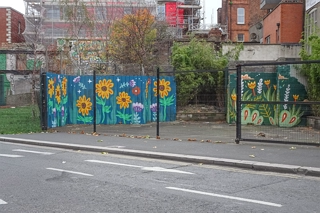
Take the photograph of a painted floral hoarding along a Dublin street as a practical test case. Looking closely at the file, it is easy to see both where a modern flagship smartphone—such as my iPhone 18 Pro—outperforms the 2015 Sony HX90V and where this little pocket zoom still holds its own.
Where a Modern Phone Wins: The biggest giveaway is dynamic range in the upper-left corner, where the overcast Dublin sky clips completely to flat white behind the scaffolding mesh. A modern flagship phone using multi-frame HDR or ProRAW would hold subtle cloud detail there while simultaneously pulling cleaner texture out of the dark doorway on the far left. Inspecting the asphalt road grain, the thin vertical wires of the security fence, and the redbrick mortar on the upper right also reveals the limits of a 2015 1/2.3-inch JPEG—a current phone's larger main sensor and modern demosaicing render those fine micro-textures with noticeably crisper bite and less smoothing.
Where the HX90V Holds Up: Where the HX90V quietly earns its keep is optical framing and natural tonal rendering. Zooming slightly past a standard wide-angle focal length compresses the foreground road markings, the wire fencing, the painted hoarding, and the background buildings cleanly without forcing me to stand in traffic or rely on digital cropping. Just as importantly, because the HX90V captures a single exposure rather than aggressively tone-mapping multiple frames, the contrast across the tarmac, kerb, and painted timber panels looks authentically photographic—and at standard web gallery sizes, the vibrant blues and yellows of the street art hold together every bit as well as a modern phone shot.
What Actually Holds Up
Comparing a 2015 JPEG compact to flagship full-frame, medium-format, and smartphone cameras makes one thing clear: modern sensors and computational pipelines have largely solved technical constraints like low-light noise, highlight recovery, and cropping flexibility. Yet for documentary street work—where speed, discretion, a 30x optical reach, and reliable built-in GPS matter just as much as clinical sharpness—the HX90V still earns its place in the rotation. When viewed at web resolution rather than pixel-peeped on a 27-inch monitor, a well-exposed frame from a decade-old pocket camera tells the exact same story of the street.
SONY HX90V CAMERA