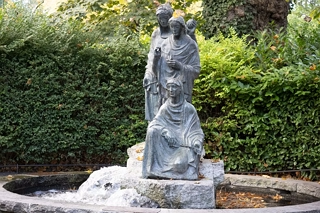
THE REAL THREE FATES STATUE BY JOSEF WACKERLE IS A POST-WAR GERMAN GIF
THE REAL THREE FATES STATUE BY JOSEF WACKERLE IS A POST-WAR GERMAN GIFT
Dublin’s Wandering Women: A Cartography of Fates, Graces, and a Lost Truth
The Divided Landscape of Civic Memory: Belfast Silence vs. Dublin Theatrics
Travel through different cities and you quickly learn that urban memory is unevenly distributed. Ask a resident about a peculiar façade, a worn lintel, or an ornate cornerstone in many industrial towns, and the response is often a shrug: "I never noticed it before," or "It’s just always been there."
In Belfast, this civic silence takes on an entirely different weight. As an urban cartographer, I have found Belfast the most difficult city to navigate in this regard—to the point where I eventually stopped asking locals about buildings altogether.
That reticence is neither apathy nor casual ignorance; it is a learned survival strategy shaped by industrial trauma and decades of intense sectarian conflict. Public conversation in Northern Ireland has long operated under Seamus Heaney’s famous axiom: "Whatever you say, say nothing." In a divided urban landscape built around defensive infrastructure, peace walls, and segmented communal interfaces, buildings and monuments are rarely neutral aesthetic objects. To volunteer an opinion or an unsolicited narrative about a street corner or an edifice risks revealing political allegiances, family backgrounds, or positions on the state. History in Belfast is active, raw, and high-stakes; polite silence or the blank barrier of "It's always been there" serves as a protective shield against stepping on conversational landmines.
Dublin sits at the absolute opposite pole.
In Dublin, there is no stone without a multitude of stories attached, and at times you become convinced they are being invented on the spot. Where Belfast guards its past behind cautious silence, Dublin treats civic history as an open-air theatrical performance. Admitting you don't know the provenance of a building is viewed as an intolerable conversational defeat; offering an extravagant yarn is considered an act of hospitality and verbal craft.
Years ago, while photographing the Three Fates fountain in St Stephen’s Green, I overheard an American visitor ask a passerby how the park got its name. Without missing a beat, the Dubliner replied:
"Stephen Green? Ah, he’s famous because he was executed for taking part in the Easter Rising in 1916."
It was delivered with flawless, straight-faced conviction—entirely bypassing centuries of Anglo-Norman history, the medieval leper hospital of St Stephen, and basic chronology to baptise the green after a completely fictional republican martyr.
Yet this instinct toward vernacular myth-making makes life notoriously treacherous for the urban cartographer. Online searches, pub lore, and council paperwork regularly conflate three entirely distinct sets of classical women scattered across the Liffey. Tracing their wandering paths reveals a masterclass in mistaken identity, shifting plinths, and the fragile survival of street-level heritage.
1. The Real Three Fates: A Post-War Gift in St Stephen’s Green
The true Three Fates stand quietly in the south-west quarter of St Stephen’s Green—named, despite local lore, for a 13th-century leper church rather than a fallen 1916 rebel.
- Location: St Stephen’s Green (South side)
- Sculptor: Josef Wackerle (German, 1880–1959)
- Cast / Sited: c. 1956
- Medium: Cast bronze
Commissioned and presented by the people of West Germany in gratitude for Irish humanitarian relief (such as Operation Shamrock) following the Second World War, the bronze fountain depicts the three mythological sisters spinning, measuring, and cutting the thread of human destiny.
It is an emotive, classically derived continental bronze. Yet when casual walkers or search engines look for The Three Fates or The Three Graces, this post-war memorial is routinely scrambled with two completely different stone groups across the river.
2. The Crossing: O’Connell Bridge and the Ghost of Father Pat Noise
To follow the trail of these wandering figures from the genteel Southside to the working Northside, you must cross the river via O’Connell Bridge. But here, at the physical threshold between two halves of the city, Dublin’s gift for civic myth-making reaches its absolute peak.
As thousands of pedestrians march across the tarmac toward O’Connell Street, their eyes fixed on the distant Spire, virtually all of them miss a bronze monument hidden in plain sight. It is not embedded in the pavement underfoot, but set at chest height into the vertical inner face of the bridge's stone parapet wall.
You will never see it unless you already know it is there.
The plaque occupies a rectangular recess left behind when the control switch for a disastrous municipal stunt—the submerged 1996 "Millennium Countdown Clock," derisively nicknamed The Chime in the Slime—was ripped out. In May 2004, two pranksters wearing high-vis jackets slipped into this dead zone in peripheral vision and cemented a professionally cast bronze plaque into the void.
It commemorates "Father Pat Noise," who allegedly “fell from this bridge March 20th 1919 under the coronation carriage of Monkey Dinsmore.”
The entire inscription is pure invention—a phonetic pun on patois and Pater Noster, a fictional carriage, and a nonexistent coronation. For nearly two years, municipal authorities failed to spot it. When Dublin City Council finally announced its removal from the protected 19th-century granite bridge, the public rallied to protect it. It was quietly pried out, only to be promptly reinstalled in industrial epoxy by its creators.
Today, council announcements that the fake plaque has been removed are routinely contradicted by reality: check the western parapet today and Father Pat is still there. Municipal authority surrendered to vernacular myth. Walking tour guides now use the hidden plaque as an indispensable pivot point, halting groups mid-bridge to reveal the secret bronze before guiding them north toward the General Post Office.
Having paid homage to Dublin’s most successful phantom, you step off the bridge and enter the Northside’s tangled stone.
3. The Domestic Graces: Gabriel Hayes at Cathal Brugha Street
Turn off O’Connell Street toward Cathal Brugha Street, and you encounter the first point of northside confusion on the façade of the former St Mary’s College of Domestic Science.
- Location: Façade of St Mary’s College, Cathal Brugha Street
- Sculptor: Gabriel Hayes (1909–1978)
- Installed: 1941
- Medium: Limestone relief
Commissioned two years after the college opened in 1939, Hayes was tasked with creating a relief reflecting the school's instructional curriculum: domestic economy, housekeeping, and needlecraft. Hayes boldly adapted the classical archetype of the Three Graces—traditionally depicted as bare, idealized daughters of Zeus symbolizing charm, beauty, and creativity.
Instead of classical attributes like apples, myrtle sprigs, or rolling dice, Hayes carved three fully clothed, active young women equipped with a sweeping brush, a spindle, and a sewing basket. Modeled directly on her friends, they represented a rare, life-sized glimpse of real working women in mid-century Irish public art, where nude female figures would not appear on commercial facades for another fifty years.
Inevitably, Hayes’s relief acquired the local moniker The Three Fates. On an educational building dedicated to training young women for life centered on the hearth, the carving could not help but echo mythology’s weavers of destiny: here, stone codified the confessional Irish state’s view that a woman’s primary destiny was domestic duty.
4. The Industrial Wanderers: The 1872 Trio at King’s Inns
Walk further northwest to the Constitution Hill grounds of the Honorable Society of King’s Inns, and you encounter the third point in this sculptural triangle: a freestanding cluster of three weather-worn female allegories mounted on a raw concrete base.
- Location: King’s Inns Park, off Constitution Hill / Henrietta Street
- Commissioned: 1872 (Great Industrial Exhibition, Earlsfort Terrace)
- Subject: Manufactures in Wood, Metal, and Stone
- Medium: Carved stone trio
Local mythology regularly dismissed these figures as leftover props abandoned by a movie crew. Their pedigree, however, is genuine 19th-century industrial heritage. Carved in 1872 for the Great Industrial Exhibition at Earlsfort Terrace (the site of today’s National Concert Hall), the statues were sculpted to celebrate the physical backbone of the nation's economy: Wood, Metal, and Stone.
The Migrations of the Industrial Trio:
- 1872 (Earlsfort Terrace): Installed for the Great Industrial Exhibition.
- Mid-20th Century (Millennium Park / Barnardo Square): Clustered inside an ornamental water fountain on Dame Street, directly beside Dublin City Hall.
- Early 2000s (King’s Inns Grounds): Uprooted during the clearing and repaving of Barnardo Square, then re-sited on a raw concrete plinth near the famous "Hungry Tree".
Their current installation remains visually provocative. Clustered tightly on an uncompromising, heavy concrete base, their soot-blackened Victorian surfaces create a deliberate architectural friction against the pastoral, neoclassical lawns of King’s Inns.
Yet their arrival in this corner of the city is inextricably linked to the violent disappearance of another figure entirely.
5. The Loss of 'Henrietta': When a Film Truck Crushed 230 Years of History
Before the 1872 industrial allegories occupied the lawn, a solitary neoclassical figure graced an isolated plinth just steps from Henrietta Street. Locally christened "Henrietta," she was in fact an allegory of Truth, dating from the 1780s or 1790s.
- Subject: Allegory of "Truth"
- Attribution: Circle of James Gandon & Edward Smyth
- Date & Origin: c. 1780s–1790s; Portland stone; originally Four Courts, Inns Quay
- Status: Shattered in April 2012; fragments preserved in secure storage
"Truth" was born out of Dublin's golden architectural Enlightenment. Perched on the roofline of the Four Courts, she watched over the legal district for well over a century until the outbreak of the Irish Civil War in June 1922. During the catastrophic bombardment and fire that gutted the Four Courts and obliterated centuries of legal records in the Public Record Office, this single Portland stone figure survived without a scratch.
Following the reconstruction of the Four Courts, she was moved north to the safety of the King’s Inns gardens. For nearly nine decades, she endured Dublin's harsh winters in serene quiet.
In April 2012, that two-century survival came to a sudden, absurd end. Henrietta Street and the King’s Inns had become a favored filming location for period dramas standing in for Victorian London. Maneuvering through the park during production logistics, a heavy facilities vehicle reversed into her plinth. The impact tipped the 230-year-old sculpture onto the tarmac, severing her head and shattering her torso.
Following an outcry led by local representatives and conservationists, the surviving fragments were gathered and transferred to internal storage within King’s Inns, leaving the plinth vacant—and paving the way for the 1872 industrial allegories to be moved into her visual wake.
The Lens Across Time: 2010 vs. 2026
Photographing this patch of ground across nearly two decades captures Dublin’s shifting relationship with its past.
Archive frames from the early 2010s capture a solitary, soft-edged Portland stone figure weathering winter snows—the quiet dignity of Gandon and Smyth’s Enlightenment Dublin.
By contrast, modern high-resolution sensors strip away atmospheric nostalgia. In the harsh daylight of the park today, every fissure, industrial soot deposit, and water stain on the 1872 exhibition allegories stands out against the cold right-angles of their 21st-century concrete foundation.
From Wackerle’s bronze Fates on the Green, to Father Pat Noise mortared into the bridge wall, to Hayes’s domestic workers on Cathal Brugha Street, to the industrial wanderers standing where Truth fell, Dublin’s public markers remind us that street-level history is living theater. Stone migrates, absorbs political ideology, hides in plain parapet niches, and—without vigilance—can be unmade in a split second by a reversing bumper.
The stark contrast between Belfast’s guarded hesitation and Dublin’s irrepressible, improvisational mythmaking is rooted in how each city evolved its civic culture, navigated 20th-century political violence, and learned to manage public memory.
Belfast: Contested Ground and the Code of "Whatever You Say, Say Nothing"
Belfast’s civic reticence is neither apathy nor ignorance; it is a learned survival strategy shaped by industrial trauma and thirty years of sectarian conflict.
- Seamus Heaney’s Axiom: In Northern Ireland, public conversation has long operated under an informal doctrine captured by Seamus Heaney: "Whatever you say, say nothing." In a deeply divided society, casual statements about places, street names, buildings, or historical events carry immediate tribal markers. Pointing out the history of an edifice might inadvertently reveal the speaker's political alignment, religious background, or view on the state. Civility and personal safety often depended on strategic neutrality.
- Architecture as a Defensive Apparatus: Unlike Dublin’s sweeping Georgian boulevards, Belfast’s 19th- and 20th-century topography was built around heavy manufacturing (linen, shipbuilding, engineering) and later modified by conflict infrastructure: peace walls, security gates, segmented interfaces, and fortified stations. Public space was rarely neutral ground designed for idle civic curiosity; it was functional, communal, and monitored.
- The High Stakes of Historical Claim: In Belfast, history is not distant folklore—it is active, litigated, and raw. A question about a monument, a demolished corner, or a street name can touch an open wound or an unresolved tragedy. Because historical claims directly underpin modern constitutional arguments, offering an off-the-cuff narrative is risky. Silence, or the polite dismissal—"It's just always been there"—acts as a protective conversational barrier against stepping on a political landmine.
Dublin: The Republic of the "Yarn" and Civic Theatrics
Dublin, by contrast, operates on an oral tradition where truth is rarely permitted to ruin a good story. History here is theatrical, domestic, and continuously performed.
- The Tradition of the Dublin "Chancer" and "The Yarn": Dublin has an ancient, highly evolved street-corner culture where conversational performance confers social status. Admitting to not knowing something—especially about one’s own city—is viewed as a minor conversational failure. Inventing a colorful narrative (like the fictional martyr "Stephen Green") is not intended to deceive; it is a gift of hospitality, an act of verbal improvisation, and an unspoken game between speaker and listener.
- National Capital Confidences: As the undisputed capital of the independent state for over a century, Dublin’s core architectural identity was settled far earlier. While it experienced intense revolutionary violence between 1916 and 1923, the foundational question of the state was resolved locally. Dubliners could afford to be irreverent with their monuments. They gave mocking, affectionate rhyming nicknames to civic public art—from the "Floozie in the Jacuzzi" (Anna Livia) to the "Tart with the Cart" (Molly Malone) and the "Spike in the Park" (the Spire).
- Mythmaking as Popular Sovereignty: For generations under British colonial rule, native Dubliners reclaimed elite imperial landmarks by inventing counter-narratives and vernacular folk legends around them. Subverting formal plaques and academic history in favor of spontaneous urban myth was an everyday assertion of ownership over the streets.
Key Contrasts at a Glance
- Belfast: History is a weapon or a wound; public discourse is cautious, factual, or evasive to preserve social peace.
- Dublin: History is raw material for a performance; public discourse is expansive, irreverent, and eager to entertain.
- The Built Environment: In Belfast, stone marks territory; in Dublin, stone is a backdrop for conversation.
THE REAL THREE FATES