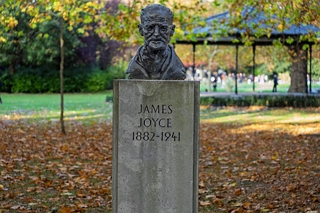
1982 BRONZE PORTRAIT BUST OF JAMES JOYCE
MARJORIE FITZGIBBON'S 1982 BRONZE PORTRAIT BUST OF JAMES JOYCE
Near the southern tree-lined avenues of Dublin’s St Stephen’s Green stands Marjorie Fitzgibbon’s 1982 bronze portrait bust of James Joyce, quietly gazing across towards Newman House. Cast in Dublin during the centenary year of the author’s birth, the monument serves as a direct spatial and historical tribute: Newman House was the original home of University College Dublin, Joyce’s alma mater and the backdrop to formative scenes in A Portrait of the Artist as a Young Man.
The Subject and Its Setting
James Joyce was a titan of literary modernism, reshaping twentieth-century prose through groundbreaking stylistic departures and psychological depth. Set upon a tall limestone plinth amongst the park's lush perimeter, the bust captures Joyce’s unmistakable features: the parted hair, high forehead, and heavy circular spectacles resting above a trim moustache and contemplative expression.
Cast by the Dublin Art Foundry, the bronze conveys both physical likeness and interiority. It holds a distinguished position within the park's collection of civic memorials, balancing Dublin’s turbulent political monuments with a tribute to its most celebrated avant-garde exile.
Marjorie Fitzgibbon and Her Art
Born Marjorie Steele in Reno, Nevada, Fitzgibbon (1930–2018) enjoyed a multifaceted career spanning stage, cinema, and fine art before settling permanently in Ireland in the late 1960s. Encouraged by prominent theatrical and literary figures such as Micheál Mac Liammóir, she turned her creative focus to classical sculpture. Over the following decades, she became an honorary member of the Royal Hibernian Academy (HRHA) and established herself as one of Ireland’s foremost portrait sculptors.
Fitzgibbon’s art is characterised by:
Psychological Insight: Fitzgibbon excelled at capturing not only a sitter’s likeness but their temperament. Her portraits of cultural icons—including Lord Killanin, Eamonn Andrews, and fellow artists commissioned by the Royal Dublin Society—rely on keen observation and emotional presence.
Textured Realism: Rejecting purely idealised forms, her surfaces preserve the tactile marks of the original clay and plaster maquettes, lending organic energy and expressive light play to the finished bronze.
Mastery of Traditional Casting: Working closely with foundries, Fitzgibbon understood how patination and metallurgic texture translate human character into permanent civic art.
Her depiction of Joyce stands out as a restrained, perceptive study of an intellect who, despite living decades abroad, carried Dublin's exact topography in his mind's eye.
1982 BRONZE PORTRAIT BUST OF JAMES JOYCE