JOY STREET AND THE DARK KITCHEN
HIDDEN BELFAST - GEORGIAN GEMS AND A GIANT CRAB MURAL ON JOY STREET [I NOW KNOW WHAT A DARK KITCHEN IS]
Last May I found myself wandering off the beaten track in Belfast city centre, exploring the historic lanes of the Markets area. My visit had a dual purpose: I wanted to trace the history of the interconnected Joy Street and Catherine Street, but I was also on a treasure hunt. I’d been tipped off about an unusual piece of street art hidden somewhere along Joy Street, and I was determined to find it.
A Step Back in Time
The area is steeped in history. Both Joy Street and Catherine Street were developed in the early 19th century on land reclaimed from the dam of a paper mill owned by the influential Joy family—famous for founding the Belfast News Letter and for the United Irishman, Henry Joy McCracken.
Walking down Joy Street from May Street, you are immediately struck by the stunning terrace of houses at numbers 14–26. These are Grade B1 listed Georgian townhouses, a rare and beautiful survival in Belfast that gives you a glimpse of the city’s pre-Victorian elegance.
The connection to Catherine Street is physical and architectural. The striking corner building at No. 26 Joy Street acts as the anchor, turning the corner into the quieter, residential lane of Catherine Street North. It’s a lovely pocket of history that feels distinct from the modern city centre just a few blocks away.
The Hunt for the Crab
Having admired the Georgian architecture, I continued my search for the mural. As you move further down Joy Street, away from the city centre and towards the railway line, the character of the street shifts from residential grandeur to a more functional, industrial feel.
It was right at the far end, at number 106, that I found what I was looking for. It certainly wasn't a traditional mural, but it was well worth the walk.
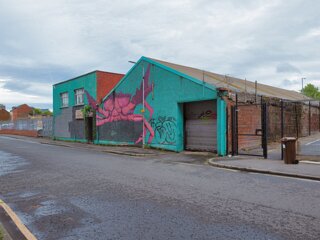
As my photographs show, against a striking teal-painted workshop building sits a massive, vivid pink crab. It’s a brilliant splash of colour in a grey corner of the city.
More Than Meets the Eye
The building itself adds another layer to the story. The rustic wooden sign above the door reads: "Rayles Diners - Filipino Fusion Cuisine."
Naturally, many visitors see this on a map and head down there expecting a sit-down meal. However, as the shuttered appearance suggests, this isn't a conventional restaurant. This building serves as the operational heart—essentially a "dark kitchen" or preparation hub—for Rayles Diners. The giant crab mural is a fantastic nod to the seafood feasts that are a popular part of Filipino cuisine. While the magic happens inside this workshop, their actual dining pop-ups or sit-down venues are usually located elsewhere in the city centre (such as Amelia Street), or they focus on delivery services.
It was a satisfying find. Joy Street managed to provide the full spectrum of Belfast in one short walk: elegant 19th-century history at one end, and a vibrant, hidden piece of modern culinary culture at the other.
Last May I found myself wandering off the beaten track in Belfast city centre, exploring the historic lanes of the Markets area. My visit had a dual purpose: I wanted to trace the history of the interconnected Joy Street and Catherine Street, but I was also on a treasure hunt. I’d been tipped off about an unusual piece of street art hidden somewhere along Joy Street, and I was determined to find it.
A Step Back in Time
The area is steeped in history. Both Joy Street and Catherine Street were developed in the early 19th century on land reclaimed from the dam of a paper mill owned by the influential Joy family—famous for founding the Belfast News Letter and for the United Irishman, Henry Joy McCracken.
Walking down Joy Street from May Street, you are immediately struck by the stunning terrace of houses at numbers 14–26. These are Grade B1 listed Georgian townhouses, a rare and beautiful survival in Belfast that gives you a glimpse of the city’s pre-Victorian elegance.
The connection to Catherine Street is physical and architectural. The striking corner building at No. 26 Joy Street acts as the anchor, turning the corner into the quieter, residential lane of Catherine Street North. It’s a lovely pocket of history that feels distinct from the modern city centre just a few blocks away.
The Hunt for the Crab
Having admired the Georgian architecture, I continued my search for the mural. As you move further down Joy Street, away from the city centre and towards the railway line, the character of the street shifts from residential grandeur to a more functional, industrial feel.
It was right at the far end, at number 106, that I found what I was looking for. It certainly wasn't a traditional mural, but it was well worth the walk.
As my photographs show, against a striking teal-painted workshop building sits a massive, vivid pink crab. It’s a brilliant splash of colour in a grey corner of the city.
More Than Meets the Eye
The building itself adds another layer to the story. The rustic wooden sign above the door reads: "Rayles Diners - Filipino Fusion Cuisine."
Naturally, many visitors see this on a map and head down there expecting a sit-down meal. However, as the shuttered appearance suggests, this isn't a conventional restaurant. This building serves as the operational heart—essentially a "dark kitchen" or preparation hub—for Rayles Diners. The giant crab mural is a fantastic nod to the seafood feasts that are a popular part of Filipino cuisine. While the magic happens inside this workshop, their actual dining pop-ups or sit-down venues are usually located elsewhere in the city centre (such as Amelia Street), or they focus on delivery services.
It was a satisfying find. Joy Street managed to provide the full spectrum of Belfast in one short walk: elegant 19th-century history at one end, and a vibrant, hidden piece of modern culinary culture at the other.

JOY STREET AND THE DARK KITCHEN