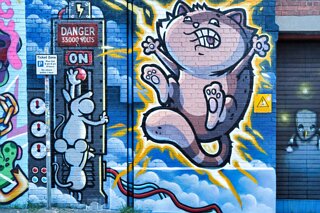
EXAMPLES OF STREET ART MURALS ON TALBOT STREET IN BELFAST MAY 2025
EXAMPLES OF STREET ART MURALS ON TALBOT STREET IN BELFAST MAY 2025 [THE WALLS OF THE BELFAST CITY COUNCIL DUNBAR STREET DEPOT]
When I photographed the street art murals on Talbot Street in Belfast in May 2025 the images were substandard but I have managed to reprocess them since then.
I hope to revisit the area next week starting December 8th, but that depends on the weather.
When you think of street art in Belfast, your mind likely goes to the city's famous political murals—towering images on gable walls that have, for decades, told a story of territory, conflict, and identity. While those murals are an undeniable part of the city's visual history, a different kind of story is being painted on the weathered brick of the Cathedral Quarter.
If you wander down Talbot Street, past the back of warehouses and alongside a working city council depot, you’ll find an open-air gallery where the narratives are more global, the themes more personal, and the messages surprisingly nuanced. This is no accident. It’s the result of a decade-long curatorial project by Seedhead Arts called the Hit the North street art festival, which has brought artists from around the world to create a new visual language for Belfast. Here, on canvases of Victorian brick, are five of the most compelling stories those walls are telling right now.
1. A Tale of Two Children: How a Dead Dove Gave Way to Ice Cream
Two of the most powerful murals in the area, created a decade apart, are locked in a silent, profound conversation about the city's identity.
First, within the narrow, shadowed canyon of Talbot Street, is French artist MTO’s monumental The Son of Protagoras, painted in 2014. The piece is an aggressive, greyscale portrait of a giant boy crouching over a dead white dove, which has been pierced by two stark red arrows. The boy’s gaze is one of pure accusation, aimed directly at the nearby St. Anne’s Cathedral. MTO saw the arrows as representing the religious factions he believed were killing peace. The title itself is a clue; Protagoras was an ancient Greek philosopher, one of the first known agnostics, reinforcing the mural’s anti-dogma message from a new, secular generation.
A decade later, a powerful counter-narrative appeared almost directly opposite. In The Eye, British artist My Dog Sighs painted a massive, photorealistic eye that reflects the Belfast skyline, including the iconic Albert Memorial Clock and the Samson and Goliath cranes. But at the center of the reflection is another child—this one holding an ice cream. It is a symbol of innocence, leisure, and a hard-won normalcy. The juxtaposition is staggering: one child from 2014 representing anger over a broken peace, and another from 2025 representing a future filled with simple, optimistic joys. Together, they map a profound shift in the city's self-image.
2. One of the City's Best Galleries is a Garbage Depot
It’s one of the great paradoxes of the Cathedral Quarter: the walls of the working Belfast City Council Dunbar Street Depot are home to some of the city’s most beloved public art. What is functionally a "site of refuse and maintenance," filled with cleansing wagons and council equipment, has been transformed into a premier "site of cultural production."
Nothing makes this clearer than the story of ADW's Deep Love. In the spring of 2025, the artist returned to the depot wall to fully restore his iconic mural, which after eight years on the wall had been battered by Northern Irish weather. This act reveals a monumental shift. The City Council, once the official remover of graffiti, has become a primary patron of the arts, sanctioning and preserving world-class work on its own property. It’s a sign that street art has moved from the margins to the mainstream, officially recognized for its value and embedded in the city’s "creative placemaking" economy.
3. A Diver and a Mermaid Are a Symbol of "Deep Love"
The anchor of the Dunbar Street Depot is Deep Love, a stunning piece by Dublin-based artist ADW. The mural depicts an antique deep-sea diver in a heavy brass helmet embracing a mermaid. The image is immediately charming, but its symbolism runs much deeper, offering a powerful allegory for the city itself and adding a compelling cross-border dimension to a story about reconciliation.
In the context of Belfast, a city historically cleaved by the "peace walls" and sectarian binaries... the image of a terrestrial/industrial figure (the diver) embracing a mythical/marine figure (the mermaid) serves as a potent allegory for the reconciliation of opposites. It suggests a love that transcends environments, a "deep" connection that exists below the surface of societal division.
The mural became so cherished by the community that its restoration was a major cultural event. After eight years of exposure since it was first painted in 2017, the artist returned to meticulously scrub, prime, and repaint the image, securing its status not as temporary graffiti, but as a permanent and essential piece of the city’s heritage.
4. The Secret Ingredient is "Belfast Brick"
One of the most surprising insights about the art in the Cathedral Quarter is that its success is inextricably linked to the canvas itself. The artists aren't just painting on any wall; they are in a direct dialogue with the area's Victorian architecture.
The substrate here is a porous, textured, and warm red "Belfast Brick." This surface is not a passive background but an active element in every composition. The grid-like mortar lines help anchor the images, while the deep red hue of the brick forces artists to adapt their style. To be visible, they must use high-contrast palettes—stark monochromes, like in MTO's work, or the vibrant neon saturations used by other artists. This unique challenge and opportunity mean the art is not just in Belfast; it is distinctly of Belfast, born from a direct creative response to the city’s historic architectural fabric.
5. An Artist Found a Way to Make Belfast's Rain Beautiful
Let’s face it, Belfast gets its fair share of grey, rainy days. But on Talbot Street, one artist has turned the city’s damp climate into a source of beauty and wonder. Dan Kitchener, also known as DANK, is famous for his "Liquid Lights" aesthetic, painting hyper-real scenes of rainy, neon-drenched cityscapes that look like they've been pulled from Tokyo or the film Blade Runner.
The effect is magical. By painting a rainy Tokyo street on a rainy Belfast street, Kitchener collapses the distance between the two, suggesting that beauty and vibrancy can be found right here, right now. His work is a form of escapism that doesn’t ignore the local reality but transforms it. It reframes the weather, turning a potential negative—the persistent drizzle—into an aesthetic positive. The mural acts as a portal, proving that even a damp Belfast street can be an electric, cinematic dreamscape.
A Gallery That's Always Changing
The walls of the Cathedral Quarter are not a static museum; they are a living document of a city in dialogue with itself. Here, the raw critiques of the post-conflict era are answered a decade later by visions of optimistic normalcy, and escapist fantasies are layered onto historic industrial brick. It is a testament to a city discovering that its strongest statements no longer need to be political. As it turns out, even the walls of a cleansing depot can speak of "Deep Love."
When I photographed the street art murals on Talbot Street in Belfast in May 2025 the images were substandard but I have managed to reprocess them since then.
I hope to revisit the area next week starting December 8th, but that depends on the weather.
When you think of street art in Belfast, your mind likely goes to the city's famous political murals—towering images on gable walls that have, for decades, told a story of territory, conflict, and identity. While those murals are an undeniable part of the city's visual history, a different kind of story is being painted on the weathered brick of the Cathedral Quarter.
If you wander down Talbot Street, past the back of warehouses and alongside a working city council depot, you’ll find an open-air gallery where the narratives are more global, the themes more personal, and the messages surprisingly nuanced. This is no accident. It’s the result of a decade-long curatorial project by Seedhead Arts called the Hit the North street art festival, which has brought artists from around the world to create a new visual language for Belfast. Here, on canvases of Victorian brick, are five of the most compelling stories those walls are telling right now.
1. A Tale of Two Children: How a Dead Dove Gave Way to Ice Cream
Two of the most powerful murals in the area, created a decade apart, are locked in a silent, profound conversation about the city's identity.
First, within the narrow, shadowed canyon of Talbot Street, is French artist MTO’s monumental The Son of Protagoras, painted in 2014. The piece is an aggressive, greyscale portrait of a giant boy crouching over a dead white dove, which has been pierced by two stark red arrows. The boy’s gaze is one of pure accusation, aimed directly at the nearby St. Anne’s Cathedral. MTO saw the arrows as representing the religious factions he believed were killing peace. The title itself is a clue; Protagoras was an ancient Greek philosopher, one of the first known agnostics, reinforcing the mural’s anti-dogma message from a new, secular generation.
A decade later, a powerful counter-narrative appeared almost directly opposite. In The Eye, British artist My Dog Sighs painted a massive, photorealistic eye that reflects the Belfast skyline, including the iconic Albert Memorial Clock and the Samson and Goliath cranes. But at the center of the reflection is another child—this one holding an ice cream. It is a symbol of innocence, leisure, and a hard-won normalcy. The juxtaposition is staggering: one child from 2014 representing anger over a broken peace, and another from 2025 representing a future filled with simple, optimistic joys. Together, they map a profound shift in the city's self-image.
2. One of the City's Best Galleries is a Garbage Depot
It’s one of the great paradoxes of the Cathedral Quarter: the walls of the working Belfast City Council Dunbar Street Depot are home to some of the city’s most beloved public art. What is functionally a "site of refuse and maintenance," filled with cleansing wagons and council equipment, has been transformed into a premier "site of cultural production."
Nothing makes this clearer than the story of ADW's Deep Love. In the spring of 2025, the artist returned to the depot wall to fully restore his iconic mural, which after eight years on the wall had been battered by Northern Irish weather. This act reveals a monumental shift. The City Council, once the official remover of graffiti, has become a primary patron of the arts, sanctioning and preserving world-class work on its own property. It’s a sign that street art has moved from the margins to the mainstream, officially recognized for its value and embedded in the city’s "creative placemaking" economy.
3. A Diver and a Mermaid Are a Symbol of "Deep Love"
The anchor of the Dunbar Street Depot is Deep Love, a stunning piece by Dublin-based artist ADW. The mural depicts an antique deep-sea diver in a heavy brass helmet embracing a mermaid. The image is immediately charming, but its symbolism runs much deeper, offering a powerful allegory for the city itself and adding a compelling cross-border dimension to a story about reconciliation.
In the context of Belfast, a city historically cleaved by the "peace walls" and sectarian binaries... the image of a terrestrial/industrial figure (the diver) embracing a mythical/marine figure (the mermaid) serves as a potent allegory for the reconciliation of opposites. It suggests a love that transcends environments, a "deep" connection that exists below the surface of societal division.
The mural became so cherished by the community that its restoration was a major cultural event. After eight years of exposure since it was first painted in 2017, the artist returned to meticulously scrub, prime, and repaint the image, securing its status not as temporary graffiti, but as a permanent and essential piece of the city’s heritage.
4. The Secret Ingredient is "Belfast Brick"
One of the most surprising insights about the art in the Cathedral Quarter is that its success is inextricably linked to the canvas itself. The artists aren't just painting on any wall; they are in a direct dialogue with the area's Victorian architecture.
The substrate here is a porous, textured, and warm red "Belfast Brick." This surface is not a passive background but an active element in every composition. The grid-like mortar lines help anchor the images, while the deep red hue of the brick forces artists to adapt their style. To be visible, they must use high-contrast palettes—stark monochromes, like in MTO's work, or the vibrant neon saturations used by other artists. This unique challenge and opportunity mean the art is not just in Belfast; it is distinctly of Belfast, born from a direct creative response to the city’s historic architectural fabric.
5. An Artist Found a Way to Make Belfast's Rain Beautiful
Let’s face it, Belfast gets its fair share of grey, rainy days. But on Talbot Street, one artist has turned the city’s damp climate into a source of beauty and wonder. Dan Kitchener, also known as DANK, is famous for his "Liquid Lights" aesthetic, painting hyper-real scenes of rainy, neon-drenched cityscapes that look like they've been pulled from Tokyo or the film Blade Runner.
The effect is magical. By painting a rainy Tokyo street on a rainy Belfast street, Kitchener collapses the distance between the two, suggesting that beauty and vibrancy can be found right here, right now. His work is a form of escapism that doesn’t ignore the local reality but transforms it. It reframes the weather, turning a potential negative—the persistent drizzle—into an aesthetic positive. The mural acts as a portal, proving that even a damp Belfast street can be an electric, cinematic dreamscape.
A Gallery That's Always Changing
The walls of the Cathedral Quarter are not a static museum; they are a living document of a city in dialogue with itself. Here, the raw critiques of the post-conflict era are answered a decade later by visions of optimistic normalcy, and escapist fantasies are layered onto historic industrial brick. It is a testament to a city discovering that its strongest statements no longer need to be political. As it turns out, even the walls of a cleansing depot can speak of "Deep Love."
TALBOT STREET MURALS