I USED A LEICA Q3 FOR THIS SESSION
A Road And Bridge Named In Honour Of Pa Healy The Rugby Star
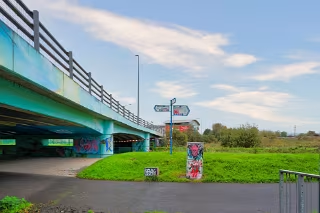
Pa Healy Road is a modern piece of city engineering. Developed around the turn of the millennium as an inner relief corridor, it carves a bypass between Clare Street (the old Dublin Road entrance to the city) and Park Road / Corbally.
Its central engineering feature—Pa Healy Bridge—carries vehicular and pedestrian traffic over the Park Canal, an 18th-century waterway engineered to bypass the rocky, unnavigable lower rapids of the River Shannon.
For drivers, the road is purely functional: a shortcut to skirt city-centre choke points. For walkers on the canal towpath below, however, the bridge presents an entirely different face. In recent years, Limerick City and County Council alongside the Limerick Arts Office helped transform its concrete undercroft into a major canvas. Large-scale murals—depicting local canal biodiversity, kingfishers, and flora—blend alongside evolving grassroots tags and throw-ups, giving an otherwise utilitarian underpass a vibrant, subversive energy.
Who Was Pa Healy?
Limerick rarely names major thoroughfares after sporting figures unless they left an indelible mark on the city's sporting soul.
Patrick "Pa" Healy (1876–1948) was an icon of Limerick's golden era of rugby. A powerhouse forward and club captain for Garryowen FC, Healy earned 11 international caps for Ireland between 1901 and 1904, featuring prominently in home-nation clashes and celebrated victories over England. Standing out in an era of brutally physical forward play, he was also an accomplished Irish amateur heavyweight boxing champion. Known throughout the city simply as "Pa," his name remains etched into Limerick's deep-rooted sporting identity.
Naming a public bridge after a rugby forward makes complete sense only when you understand that in Limerick, rugby is treated not as a weekend diversion, but as a secular religion. Unlike Dublin or London, where the sport historically remained rooted in fee-paying academies and leafy suburbs, Limerick shattered that divide over a century ago. Here, the oval ball belongs to the docks, the working-class parishes, and the city laneways. Club loyalties between Shannon, Garryowen, and Young Munster run as deep as bloodlines, and the collective rituals—from the dead silence observed for kickers at Thomond Park to the canonisation of heroes like Anthony Foley—border on liturgical observance. Pa Healy was an early high priest of that civic creed, carving out the uncompromising, physical template that still defines the town's sporting psyche.
"Bleak and Ugly": The Local DilemmaFrom road level, the initial impression is stark. Flanked by high palisade fencing, corrugated industrial compounds, vacant scrubland, and overgrown margins, the corridor has a raw, unfinished feel. It is a quintessential brownfield zone caught in limbo between historic canal navigation and modern urban expansion. Local sentiment about the area, however, is deeply divided:
A Frustrating Blight: Many locals share the view that this gap between the city centre and the suburbs is an eyesore. During an acute national housing crisis, prime land sitting idle alongside a designated transport artery feels like a monument to bureaucratic delay.
The "Canal Bank" Development Battles: The area has been the focal point of prolonged planning drama. Large-scale proposals—such as the contentious multi-storey "Canal Bank" scheme featuring hundreds of apartments and student accommodation units—have sparked pushback from nearby residents. Objections have focused on building height, traffic pressure feeding onto Pa Healy Road, and the fear of high-density overdevelopment overpowering the low-rise character of neighbouring St Patrick’s and Corbally.
A Treasured Ecological Haven: Drop beneath the road deck to the water level, and the perspective flips. To canal walkers, runners, and anglers, the Park Canal is a peaceful wildlife sanctuary. Otters, herons, swans, and kingfishers inhabit the banks just metres from the tarmac above.
For environmentalists and community groups, the neglect that makes the surface look scrubby and desolate has paradoxically provided a vital urban biodiversity buffer.Pa Healy Road remains a landscape in transition. It is raw, gritty, and incomplete—yet its convergence of sporting heritage, canal history, street culture, and high-stakes urban planning makes it one of the most intriguing urban margins in modern Limerick.
Battery Life Of My Q3
I had visited Limerick with the intention of the Leica being my main camera and the Sony A7RVI being my backup but I had to abandon that idea.
On the 15th October I decided to explore the canal walks and I brought two fully charged batteries with me but the third battery was exhausted by image 667 and I had to return to the hotel to get my Sony A7RVI. When I returned I checked if others were having similar problems and was disappointed by the result:
The Leica Q3’s real-world power draw is notorious among users. Delivering only ~220 frames per battery (667 frames across three BP-SCL6 packs) falls well below Leica's official CIPA rating of approximately 350 shots, but it aligns closely with the common complaints voiced across user forums and field reports.
The issue stems less from physical battery cell defects and more from the camera's baseline operating overhead. Unlike mirrorless bodies whose power consumption scales directly with shutter actuations, the Q3 behaves like a miniature computing terminal where uptime and background processing consume far more power than capturing a still frame.
The most frequently cited culprits behind severe battery drain include:Leica FOTOS Background Tethering (Bluetooth / Wi-Fi): The constant handshake with the Leica FOTOS app (particularly when continuous background geotagging is enabled) is the single biggest battery drain reported by users. It keeps the camera's wireless modules active and polling, preventing deep sleep even between shots.
EVF Refresh Rate & Sensor Readout: Driving a 5.76-million-dot OLED viewfinder alongside a 60MP BSI sensor draws significant current. If the EVF frame rate is set to 120 fps rather than 60 fps, processing and display overhead increases sharply.
Displays & Auto-Off Latency: If the camera is left powered on while walking between subjects, continuous live feed processing and image stabilisation (OIS) run constantly unless aggressive sleep timers are configured.
Autofocus Processing: Leaving the camera in Continuous AF (AF-C) or Intelligent AF forces the Maestro IV processor to continuously calculate phase and contrast points, drawing power even when the shutter button is untouched.
To stretch a single BP-SCL6 closer to 350–450 shots on extended walks, the community generally relies on a few key adjustments:
Sever Wireless Connections:
Switch Leica FOTOS connectivity to Off (or toggle Airplane Mode) during intensive walking sessions, relying on external GPX track logging rather than active Bluetooth/Wi-Fi tethering. ap EVF to 60 fps: Set Display Settings > EVF Frame Rate to 60 fps.
Tighten Sleep Timers: Set Displays/AF Auto Off to 10 seconds and Auto Power Off to 1 or 2 minutes so the camera enters low-power standby quickly while carried.Manual / Zone Focusing: Using the lens in manual focus with depth-of-field scale focusing eliminates AF hunting and drive motor power entirely.