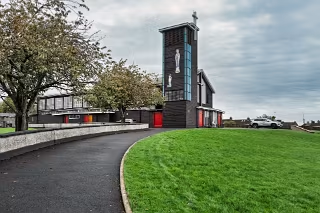
THIS CHURCH ON CHILDERS ROAD NEAR LIDL IS THE CHURCH OF OUR LADY OF LOURDES
When I was trying to find this church I asked for directions and was told that it was near Lidl.
Church of Our Lady of Lourdes on Childers Road occupies a unique chapter in mid-twentieth-century ecclesiastical design in Limerick. Built between 1958 and 1959, the church was designed by architect Patrick Sheehan (P.J. Sheahan) and erected by Lanigan Brothers. While the church is not entirely wooden—it is built with masonry and structural framing—it frequently strikes visitors as unusual because of its distinctive mid-century roof construction, rich internal timbering, and warm ceiling panelling. People also occasionally conflate its heritage with its contemporary sister church across town, Our Lady of the Rosary on Ennis Road (built in 1950), which was celebrated as the city's first light timber-and-steel church structure.
Foundation and Origins: The church did not directly replace an older ecclesiastical building on its site. Instead, it was commissioned as a brand-new foundation to serve the post-war suburban development of Ballinacurra Weston and Rosbrien. Its foundation stone was blessed by Bishop Patrick Murphy on 11 February 1958—the centenary year and feast day of the apparitions at Lourdes.
Parish Status: While the building opened in 1959, the formal Parish of Our Lady of Lourdes was established in 1963 when the rapidly expanding district was officially severed from the historic parish of St Michael’s.
Salvaged Nineteenth-Century Treasures: The interior preserves a poignant architectural rescue. Its striking stained-glass windows were crafted in the 1880s by the famed Mayer of Munich studio and were originally housed in the Sisters of Mercy Convent chapel on Bishop Street before being restored by Abbey Stained Glass Studios and reinstalled here.
From Steeples and Snugs to Supermarkets: Changing Landmarks
Being directed to a church by reference to a nearby Lidl captures the seismic shift in the Irish vernacular landscape. For generations, giving directions in Ireland relied on an unwritten, twin-pillar topography: churches and pubs. Whether in rural crossroads or city lanes, travel was measured by steeples, parish belfries, and neighbourhood public houses on street corners.
In modern Ireland, commercial retail centres, retail parks, and German discount supermarkets have largely supplanted the local church and public house as the primary spatial reference points. The fact that a sacred space erected in the late 1950s is now best located in local shorthand as "near Lidl" speaks volumes about how consumer hubs have become the new civic anchors of suburban life.
Locked Doors and the Loss of Casual Sanctuary
Finding church doors locked outside scheduled service times is an increasingly common and frustrating reality for visitors, pilgrims, and parishioners alike.
Security and Anti-Social Behaviour: Rising incidents of vandalism, metal theft, and opportunist anti-social behaviour have made open-door policies a serious liability for urban parishes.
Insurance Pressures: Diocesan insurers frequently mandate stringent access control and security protocols to cover ecclesiastical buildings, art, and vintage furnishings.
Dwindling Volunteer Resources: Decades ago, parish caretakers, residential sextons, or local parishioners kept a watchful eye over open chapels from dawn until dusk. With an ageing and shrinking pool of active volunteers, parishes simply lack the continuous physical presence required to supervise open sanctuaries during quiet weekday afternoons.
The Departure of Religious Orders from Limerick
Limerick’s nickname, the "City of the Confraternity", was earned through its legendary religious devotion, most famously embodied by the Arch-confraternity of the Holy Family at Mount St Alphonsus, which once drew thousands of working men every week. Yet over recent decades, religious orders have steadily departed or drastically pared back their physical footprint in the city.
Dominicans (St Saviour’s): After nearly eight centuries of continuous presence in Limerick since 1227, the Dominican Friars announced their withdrawal and handed over pastoral care of St Saviour's Church on Glentworth Street in 2020 due to falling vocations and ageing personnel. I will discuss this in greater detail in a future post.
Augustinians: With a heritage in the city stretching back more than 700 years, the Augustinian community on O’Connell Street officially celebrated their farewell Mass in 2022, marking an end to an era in central Limerick.
Franciscans and Jesuits: The Franciscan Friars bade farewell to their Henry Street friary in 2008, while the Society of Jesus (Jesuits) withdrew from the Crescent and Sacred Heart Church at the turn of the millennium.
Teaching and Nursing Sisters: Congregations such as the Sisters of Mercy and the Presentation Sisters have closed large motherhouses and convent chapels (such as the Bishop Street convent that provided the windows for Our Lady of Lourdes), leaving an urban landscape where religious habits, once ubiquitous, have all but vanished.