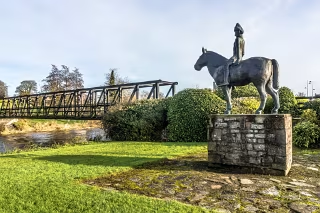
MAEL SEACHNAILL II SCULPTURE BY JAMES McKENNA
I photographed this limestone equestrian sculpture on Christmas Day 2014 beside the Watergate Bridge in Trim. While its condition was somewhat neglected at the time, the surrounding setting had improved compared to previous years.
Created by the Dublin sculptor and playwright James McKenna (1933–2000), the work depicts Máel Sechnaill mac Domnaill (Máel Seachnaill II), member of the Clann Cholmáin and High King of Ireland. Following the death of Brian Boru at the Battle of Clontarf in 1014, Máel Seachnaill resumed his position as High King, presiding over the realm until his death in 1022. It is from him that the leading ruling sept of Brega, the Ó Maoilsheachlainn, claims descent.
Dunshaughlin (Domhnach Seachnaill / Dún Seachlainn), situated further east in County Meath, derives its name from Saint Seachnaill (Secundinus), a contemporary of Saint Patrick who established an early monastic settlement there in the fifth century. It is this patron saint who originally provided the personal name Máel Seachnaill—meaning "servant of Seachnaill".
The Dunshaughlin district encompasses the renowned townland of Lagore, celebrated for its seventh-century royal crannóg where extensive excavations unearthed significant early medieval antiquities. Historical surveys from the mid-sixteenth century record long-standing native families in the parish, including Muintir Uí Fhloinn and Muintir Uí Mhuirí, as well as the Uí Ruanaidh at nearby Trevet. In contrast, prominent Anglo-Norman lineages such as the Delahides, alongside the medieval religious establishments they patronised, have long since vanished from the immediate locality.
James McKenna (1933–2000): Sculptural Style and Approach
James McKenna was a foundational figure in modern Irish figurative sculpture. A co-founder of the Independent Artists group (1960) and the Sculptors' Society of Ireland (1980), as well as an elected member of Aosdána (1983), he steadfastly resisted total abstraction throughout his career. Instead, he worked in direct carving—predominantly Irish limestone, granite, and ancient bog oak—producing weighty, expressionist human and equestrian figures steeped in Celtic mythology, political struggle, and local folklore. His figures favour raw mass, visible tool marks, and gravitational grounding over slick academic polish.
Public and Institutional Sculptures in Dublin and Leinster
1. Ferdia for nÁth / Ferdia at the Ford (1989)
Location: Irish Museum of Modern Art (IMMA), Royal Hospital Kilmainham, Dublin
Medium: Carved Granite
Context & Subject: Commissioned around the mythological themes of the Táin Bó Cúailnge, this towering granite piece depicts Ferdia, the tragic brother-in-arms of Cú Chulainn, standing his ground at the river crossing. The work measures three metres in height and exemplifies McKenna’s late monumental stone style—blocky, stoic, and unyielding. It forms part of IMMA's permanent outdoor collection, donated in 2007 through the poet Desmond Egan.
2. Oisín in Dhiaidh na Féinne / Oisín Caught in a Time Warp (c. 1990)
Location: Áras Chill Dara (Kildare County Council Headquarters), Naas, County Kildare
Medium: Carved Limestone / Composite stone
Gerard Manley Hopkins Festival
Context & Subject: A signature McKenna equestrian motif, depicting Oisín returned from Tír na nÓg, stranded between ancient heroic myth and the alien modern world. The work captures the rider slumping or dismounting, realising the passage of three centuries. It was installed on public view within the Kildare administrative headquarters, reflecting McKenna’s long-standing connection to the county (he lived and worked around Newbridge for much of his later life).
3. Famine Family (1998)
Location: St Vincent’s Hospital (former Athy Workhouse site), Athy, County Kildare
Kildare County Council
Medium: Carved 4,000-year-old Black Bog Oak
Context & Subject: Standing approximately eight feet high, this harrowing composition was carved directly from prehistoric sub-fossil bog oak. Installed outside the historic Athy union workhouse grounds to commemorate the Great Famine, it depicts an emaciated family grouping. The natural fissures, dark patination, and rough grain of the bog wood are integrated into the gaunt figures, giving the sculpture an archaic, spectral presence.
4. Gerard Manley Hopkins Monument (1991)
Location: Monasterevin, County Kildare
Gerard Manley Hopkins Festival
Medium: Carved Limestone
Context & Subject: Commissioned by the Gerard Manley Hopkins Society, this commemorative stone piece honours the English Jesuit poet who wrote many of his works while resting at nearby Monasterevin House. Characteristic of McKenna's architectural-scale heads and herm-like markers, it incorporates poetic inscriptions alongside the poet's stylised visage.
5. Female Figure and Tree
Location: Central Bank of Ireland Currency Centre, Sandyford, Dublin
Christie’s
Medium: Carved Stone
Context & Subject: A corporate commission integrated into the landscape of the Central Bank's secured complex in Sandyford. McKenna juxtaposes the living, organic curve of the tree form with the grounded weight of the female figure, echoing themes of Irish nature, fertility, and sovereign continuity common to his 1970s and 1980s output.