I USED A FUJIFILM GFX100RF TODAY
HONAN'S QUAY IN LIMERICK IS A CANVAS OF CONTRADICTIONS [CLOSE UP USING A FUJUFILM GFX100RF]
When I visited limerick in July 2025 the weather was terrible and I had just obtained a Fujifilm GFX100RF and it did not perform as expected but that is a complicated discussion. I am planning to return to Limerick next week and I will not bring the GFX100RF but I have yet to decide what to bring with me.
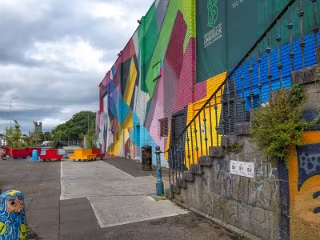
Viewed from across the River Shannon, the former Dunnes Stores site at Honan’s Quay stands as a bold, saturated statement on Limerick City’s skyline. Stepping onto the quay itself shifts the perspective entirely: the expansive artwork wraps beneath your feet, pulling you into an immersive ground-level canvas. Yet, framed through any lens, close up or far away, the site captures an unresolved tension: a dynamic marriage of urban art and waterfront activation set against a backdrop of prolonged vacancy, public spending controversy, and institutional uncertainty.
From Retail Anchor to Waterfront Eyesore
For decades, the building served as a flagship commercial hub in the heart of Limerick. That era concluded abruptly in August 2008, when Dunnes Stores ceased trading at Honan’s Quay. Refocusing on suburban retail parks with dedicated parking and larger floor plans, the retailer left behind an empty concrete shell.
For more than a decade, the prime waterfront location languished. The protracted vacancy drew mounting frustration from locals and city officials alike, with repeated calls for Limerick City and County Council to levy vacant site penalties against the retailer. What should have been a vibrant western gateway along the Shannon had devolved into one of the city centre’s most prominent symbols of urban decay.
The 2019 Acquisition: Ambition Meets Scrutiny
In 2019, the University of Limerick (UL) stepped in, acquiring the 0.6-hectare site for €8 million with the aim of establishing a dedicated City Centre Campus. While the purchase promised to anchor thousands of students directly in the urban core—in alignment with the Limerick 2030 economic regeneration masterplan—the transaction soon triggered intense institutional and political scrutiny.
A retrospective independent valuation concluded that the university had paid approximately one-third above the prevailing market rate, prompting a €3 million impairment charge in UL's financial statements. Subsequent reviews by the Comptroller and Auditor General (C&AG) and hearings before the Public Accounts Committee (PAC) raised serious governance questions regarding the acquisition process and value for money.
With only a modest fraction of the interior brought into operational use, the building's permanent purpose has remained in flux, with prospective long-term options—including the relocation of UL’s School of Medicine—debated amid broader capital review.
Canvas of Contradictions: Art as Urban Intervention
While the building’s internal future hung in balance, the exterior underwent a radical reinvention. Spearheaded by Limerick urban art collective Draw Out, in collaboration with Limerick City and County Council and UL, Spanish urban artist Digo Diego was commissioned to transform the building’s exterior. Diego’s mural introduced fluid organic forms, sweeping brushwork, and vivid tones celebrating the relationship between urban spaces, the River Shannon, and ecological renewal.
Rather than remaining confined to vertical walls, the artwork was extended onto the horizontal surfaces along the quayside. Draw Out distilled the genetic design elements of Diego’s wall mural, transposing them into Limerick’s first comprehensive ground mural. Complemented by mobile urban planters, outdoor seating, and public table tennis tables, the asphalt transitioned into a pedestrian-first civic space designed for social gathering and recreation.
Two Lenses on Regeneration
Seen from across the river, the structure projects optimism—a striking dash of contemporary colour reflected across the Shannon’s surface. Up close, details of everyday public use emerge: skaters navigating the ground patterns, workers lunching by the riverbanks, and visitors engaging with the mural’s fine texture.
Yet beneath this creative intervention remains an unfinished civic task. Honan’s Quay highlights the power of tactical urbanism to salvage an abandoned quarter, while standing as a visible reminder of the transparency, planning, and long-term momentum required to complete genuine urban regeneration.
When I visited limerick in July 2025 the weather was terrible and I had just obtained a Fujifilm GFX100RF and it did not perform as expected but that is a complicated discussion. I am planning to return to Limerick next week and I will not bring the GFX100RF but I have yet to decide what to bring with me.
Viewed from across the River Shannon, the former Dunnes Stores site at Honan’s Quay stands as a bold, saturated statement on Limerick City’s skyline. Stepping onto the quay itself shifts the perspective entirely: the expansive artwork wraps beneath your feet, pulling you into an immersive ground-level canvas. Yet, framed through any lens, close up or far away, the site captures an unresolved tension: a dynamic marriage of urban art and waterfront activation set against a backdrop of prolonged vacancy, public spending controversy, and institutional uncertainty.
From Retail Anchor to Waterfront Eyesore
For decades, the building served as a flagship commercial hub in the heart of Limerick. That era concluded abruptly in August 2008, when Dunnes Stores ceased trading at Honan’s Quay. Refocusing on suburban retail parks with dedicated parking and larger floor plans, the retailer left behind an empty concrete shell.
For more than a decade, the prime waterfront location languished. The protracted vacancy drew mounting frustration from locals and city officials alike, with repeated calls for Limerick City and County Council to levy vacant site penalties against the retailer. What should have been a vibrant western gateway along the Shannon had devolved into one of the city centre’s most prominent symbols of urban decay.
The 2019 Acquisition: Ambition Meets Scrutiny
In 2019, the University of Limerick (UL) stepped in, acquiring the 0.6-hectare site for €8 million with the aim of establishing a dedicated City Centre Campus. While the purchase promised to anchor thousands of students directly in the urban core—in alignment with the Limerick 2030 economic regeneration masterplan—the transaction soon triggered intense institutional and political scrutiny.
A retrospective independent valuation concluded that the university had paid approximately one-third above the prevailing market rate, prompting a €3 million impairment charge in UL's financial statements. Subsequent reviews by the Comptroller and Auditor General (C&AG) and hearings before the Public Accounts Committee (PAC) raised serious governance questions regarding the acquisition process and value for money.
With only a modest fraction of the interior brought into operational use, the building's permanent purpose has remained in flux, with prospective long-term options—including the relocation of UL’s School of Medicine—debated amid broader capital review.
Canvas of Contradictions: Art as Urban Intervention
While the building’s internal future hung in balance, the exterior underwent a radical reinvention. Spearheaded by Limerick urban art collective Draw Out, in collaboration with Limerick City and County Council and UL, Spanish urban artist Digo Diego was commissioned to transform the building’s exterior. Diego’s mural introduced fluid organic forms, sweeping brushwork, and vivid tones celebrating the relationship between urban spaces, the River Shannon, and ecological renewal.
Rather than remaining confined to vertical walls, the artwork was extended onto the horizontal surfaces along the quayside. Draw Out distilled the genetic design elements of Diego’s wall mural, transposing them into Limerick’s first comprehensive ground mural. Complemented by mobile urban planters, outdoor seating, and public table tennis tables, the asphalt transitioned into a pedestrian-first civic space designed for social gathering and recreation.
Two Lenses on Regeneration
Seen from across the river, the structure projects optimism—a striking dash of contemporary colour reflected across the Shannon’s surface. Up close, details of everyday public use emerge: skaters navigating the ground patterns, workers lunching by the riverbanks, and visitors engaging with the mural’s fine texture.
Yet beneath this creative intervention remains an unfinished civic task. Honan’s Quay highlights the power of tactical urbanism to salvage an abandoned quarter, while standing as a visible reminder of the transparency, planning, and long-term momentum required to complete genuine urban regeneration.