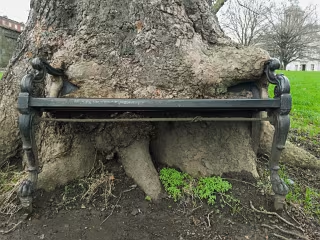
THE HUNGRY TREE PHOTOGRAPHED USING AN APPLE iPHONE 12 PRO MAX
The Hungry Tree at King’s Inns, Dublin
Standing just inside the south gate of the Honorable Society of King’s Inns on Constitution Hill in Dublin 7 is one of the city’s most celebrated botanical curiosities. Known affectionately to Dubliners and visitors alike as the Hungry Tree, this mature London plane (Platanus × hispanica) has spent decades slowly enveloping an early nineteenth-century cast-iron park bench, creating the unmistakable visual illusion that the tree is gradually devouring the seat.
A Century-Old Specimen in "The Temple"
To generations of local residents living around Dorset Street, Bolton Street, Broadstone, and Henrietta Street, the grounds of King’s Inns Park have always been known simply as "the Temple"—a vernacular name preserving the memory of the medieval Dominican Priory of St Saviour that once occupied the site before the establishment of the King’s Inns.
London planes are resilient hybrids that were extensively planted across Dublin’s squares, parks, and thoroughfares during the nineteenth and early twentieth centuries to withstand urban soot and pollution. Measuring roughly 21 metres in height with a trunk girth exceeding 3.4 metres, the specimen inside the Temple is estimated to have been planted between 1900 and the 1930s.
Positioned immediately beside the base of the trunk was a traditional cast-iron bench dating from the early 1800s. As the tree matured and its trunk and root flare expanded outward, the bark met the unyielding ironwork—and simply kept growing around it. Today, the timber has engulfed the backrest and armrests, leaving only fragments of the cast-iron frame and slats emerging from the folds of the bark.
Origins of the Name "The Hungry Tree"
Pinpointing the exact date when the moniker "Hungry Tree" was first coined is virtually impossible, as it emerged organically through north-inner-city oral tradition long before social media turned the spot into an international photographic stop.
Long before the digital era, the tree’s slow collision with the bench was documented by one of its closest neighbours. Irish artist Robert Ballagh, who has lived and worked for decades at Temple Cottages directly along the park railings at Broadstone and Western Way, featured the tree in his 1981 book Dublin, capturing an earlier stage when the bark was pressing firmly against the ironwork without yet swallowing it to the dramatic extent seen today.
By the turn of the millennium, law students, local residents, and walkers passing through the Temple had already dubbed it the "Hungry Tree". The nickname began appearing in print guides in the early 2000s—notably in Pól Ó Conghaile’s Secret Dublin – An Unusual Guide (first published in 2003)—and was later cemented in popular Dublin lore by Frank McNally in 111 Places in Dublin That You Must Not Miss (2016).
When The Urban Cartographer first photographed and catalogued the specimen under the title "Hungry Tree" in 2006, photo-sharing platforms such as Flickr were still in their infancy and mainstream newspaper coverage was more than a decade away. Revisiting the site over the twenty years since provides a remarkable longitudinal record of just how far the bark has advanced over the ironwork in a single generation.
The Preservation Paradox
Recognised by the Tree Council of Ireland as a Heritage Tree for its cultural and visual significance rather than botanical rarity, the Hungry Tree became the subject of an unusual civic debate in July 2017. Green Party councillor Ciarán Cuffe proposed placing a formal Tree Preservation Order on the specimen through Dublin City Council to guarantee its protection.
Council officials ultimately concluded that a separate order was unnecessary, as the tree already enjoys indirect legal protection by standing within the curtilage of the protected structures of King’s Inns. More importantly, planners noted a fascinating preservation paradox: had the council formally listed the nineteenth-century cast-iron bench itself as a protected structure, they could have been legally obliged to
HUNGRY TREE CHRISTMAS 2021