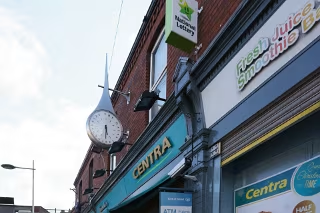
AN INTERESTING PUBLIC CLOCK IN DRUMCONDRA
High above the red-brick terrace at 32–38 Drumcondra Road Lower, the silver teardrop clock outside Groarke’s Centra is one of those small pieces of contemporary street furniture that quietly anchors a busy Dublin thoroughfare. Its dial carries a straightforward prompt for passing commuters and match-day crowds alike: “SEIZE THE DAY” across the upper arc, with “GROARKE’S” curved along the bottom.
Before I photographed it in April 2016, the clock had fallen into poor condition, with failed seals allowing water to gather inside the casing. By the time these frames were taken, however, the housing had been cleaned, resealed, and restored to working order—or replaced like-for-like—so that its brushed-metal spire and clean dial once again stood out sharply against the brickwork.
Unlike many projecting Dublin shop clocks that date back to the nineteenth century, this is a bespoke modern commission. Designed by Mary Laheen Architects (listed in their commercial portfolio as Groarke’s Clock, Drumcondra), the double-sided teardrop form tapers into a slender vertical finial, giving the storefront a distinctive silhouette along the wide Drumcondra corridor without overwhelming the late-Victorian and Edwardian brickwork behind it.
The premises beneath it have served as a northside neighbourhood anchor for decades. Operated by Nathy and Peggy Groarke (Derryowen Retailing Limited), the business spans four merged street numbers—Nos. 32 to 38—combining a Centra convenience store with Drumcondra Post Office on the southern end of the frontage. Even with modern Centra signage, National Lottery branding, and a juice bar fascia in place, the shopfront retains traditional painted script reading “Groarke’s” and “Post Office” on its teal panels, framed by the original decorative timber pilasters and small pedimented capitals of the two-storey red-brick terrace.
The location itself sits at one of the busiest pinch points on the N1/R132 approach into the city centre. Immediately to the south stands the red-brick viaduct and embankment of Drumcondra railway station, originally opened in 1901 by the Great Southern and Western Railway and reopened for suburban commuter rail in 1998. Just to the north along the same block is the former Botanic House / Quinns of Drumcondra at Nos. 42–44. Between rail passengers, Croke Park footfall, and steady streams of Dublin Bus traffic, Groarke’s clock remains a practical landmark—and a welcome reminder to make the most of the day.
PUBLIC CLOCK IN DRUMCONDRA